Mobile Musicians Set to Honor John Coltrane With Annual Holiday Jazz Tribute
Local and regional musicians are set to reunite in Mobile for the annual John Coltrane Christmas tribute, a holiday jazz show built around free-flowing improvisation.
Mobile’s holiday season is filled with long-running traditions, and for the city’s jazz community, one of the most anticipated is a Christmas-season tribute to saxophone legend John Coltrane. The show has become a fixture on the local music calendar, drawing together musicians from Mobile and beyond for an evening built around the free-flowing, improvisational spirit that defined Coltrane’s career. In a city best known nationally for Mardi Gras and its centuries of Gulf Coast history, the annual tribute is a quieter tradition — but for the players and listeners who fill the room each year, it is every bit as fixed on the calendar.
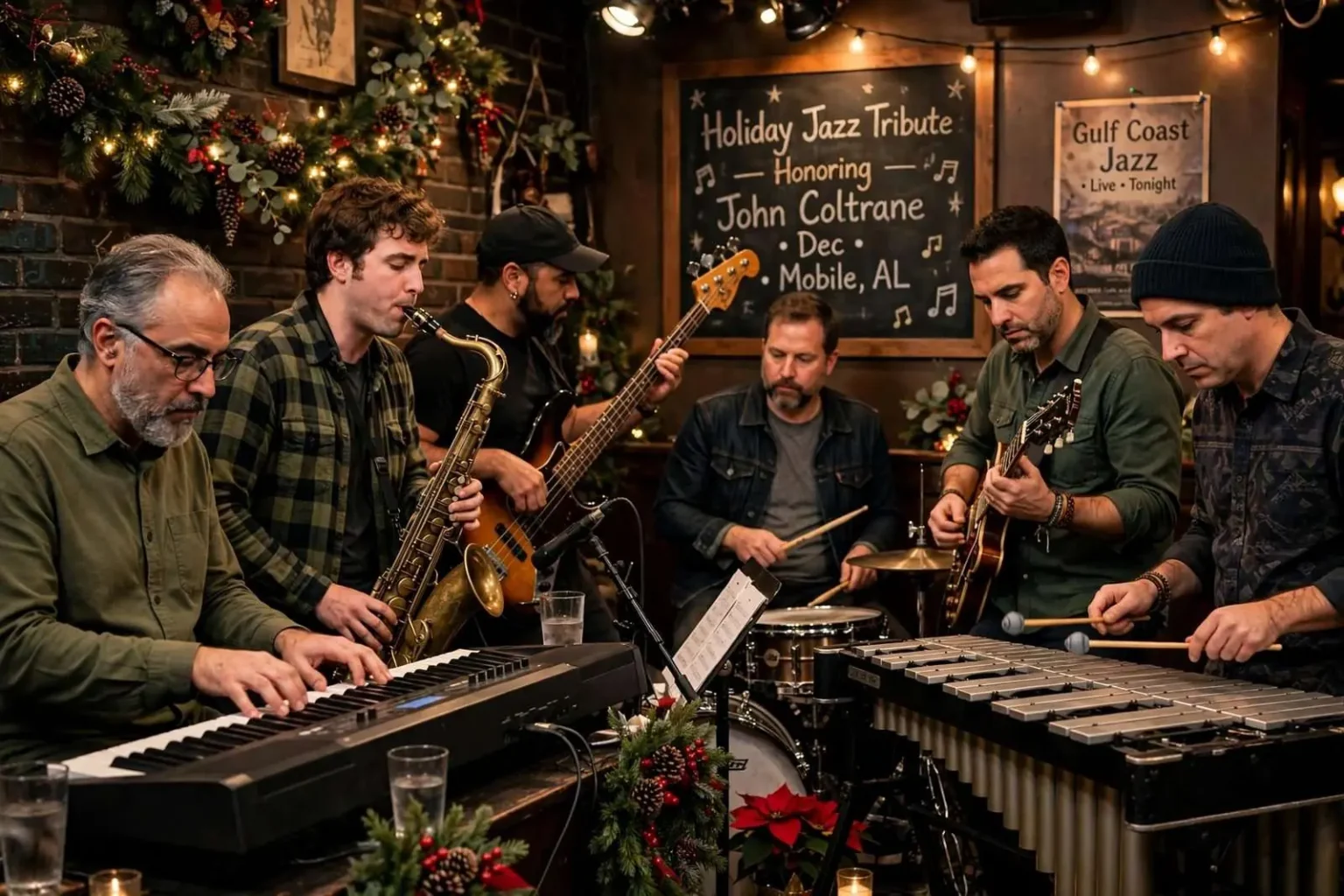
This year’s lineup brings together six players with deep roots in the regional music scene. Keyboardist Chris Spies and his son, saxophonist Christopher Spies, will represent Mobile on stage, continuing a family musical partnership that keeps both father and son busy with a variety of projects in and outside the city. Few arrangements suit a tribute to Coltrane better than a father-and-son pairing at the heart of the band, an echo of the way jazz itself has always passed between generations — learned at the elbow, refined on the bandstand, and handed forward night by night.
Bassist Kevin Scott, whose resume includes stints with Highly Kind and The Church Basement Band, will anchor the low end for the evening. Scott is a familiar presence in Gulf Coast clubs and festival lineups, and his work across funk-forward and improvisational projects has made him one of the region’s most dependable rhythm-section players. Rounding out the rhythm section is drummer Mark Raudabaugh, known for his work with the Americana roots band Donna the Buffalo, a group whose touring schedule has carried its members across the country and given Raudabaugh a national view of audiences far beyond the Gulf Coast.
Guitarist Nick Johnson, a member of the Randall Bramblett Band, will add his playing to the mix, while percussionist and vibraphonist Mike Dillon, of the New Orleans-based group Garage a Trois, will bring an additional layer of texture to the group’s arrangements. Dillon’s involvement is the kind of booking that signals the ambition of the tribute: a New Orleans-based percussionist with a reputation for adventurous, genre-bending work adds a dimension that a straightforward hometown session could not. The vibraphone in particular offers a shimmering, bell-like voice that suits both winter-holiday atmospherics and Coltrane’s harmonic depth.
Why Coltrane, at Christmas
Coltrane’s catalog, known for its harmonic complexity and improvisational reach, gives the assembled musicians wide latitude to reinterpret the material rather than simply replicate it. Across his too-brief recording career, cut short by his death in 1967 at age 40, the saxophonist transformed jazz with landmark albums such as “Giant Steps” and “A Love Supreme,” pushing harmony and spirituality into places the music had never gone. That body of work remains both a benchmark and a challenge for players, who find in it an open invitation to stretch rather than a script to follow.
There is also a natural holiday bridge in the catalog itself. Coltrane’s celebrated recording of “My Favorite Things” — his modal reinvention of a show tune from “The Sound of Music” — has long drifted onto winter playlists, and its swirling waltz-time treatment is among the most recognizable recordings he ever made. Hearing material like that interpreted live, with six players trading the theme back and forth, gives the seasonal framing more substance than a token nod to holiday cheer.
That approach has helped the tribute build a loyal local following over the years, with jazz fans in the Mobile area treating the show as an unofficial kickoff to their holiday season. December audiences for the show tend to know the material — many are musicians themselves or longtime listeners — and the room’s expectations run toward discovery rather than nostalgia. A Coltrane tribute is not a jukebox night; the audience comes to hear what six accomplished players will find inside compositions that have been mined for decades and still yield something new.
The Depth of the Gulf Coast Talent Pool
The gathering underscores the depth of talent that calls the Gulf Coast home, with local players regularly crossing paths with touring and recording musicians from bands with national followings. The corridor that runs from Mobile to New Orleans has long functioned as a single musical ecosystem, with sidemen moving between scenes so fluidly that a band assembled for one night can carry resumes spanning funk, jam-band circuits, Americana, brass tradition and straight-ahead jazz. The Spies family, Scott, Raudabaugh, Johnson and Dillon collectively represent that whole range in a single lineup.
Kevin Scott’s projects, Highly Kind and The Church Basement Band, have been fixtures of the region’s improvisational scene, building followings through relentless live playing rather than radio exposure. Mark Raudabaugh’s tenure with Donna the Buffalo connects the lineup to one of American roots music’s most durable touring institutions, a band whose fan base follows it from festival to festival across multiple states. Nick Johnson’s work with Randall Bramblett — the veteran Georgia songwriter and multi-instrumentalist whose career stretches back through decades of Southern rock and jazz-inflected records — adds another strand of Southeastern musical lineage.
Mike Dillon, meanwhile, embodies the New Orleans tradition of boundary-crossing percussion. As a member of Garage a Trois and through a long list of collaborations across punk, jazz and jam circuits, he has built a reputation as one of the most individualistic vibraphone players working today. Bringing a player of that profile to a Mobile stage reflects both the tribute’s credibility and the practical reality of the Gulf Coast scene, where the distance between Mobile and New Orleans is short enough that the two cities’ musicians effectively share a pool.
Mobile’s own place in that ecosystem runs deep. The city’s musical heritage stretches back through generations — a port city whose streets have carried everything from blues and gospel to jazz and Carnival brass traditions, and whose music education pipelines have produced players who went on to national careers. Local jazz nights and tribute shows give working musicians a hometown stage that pays them something and keeps their chops up between touring gigs, and they give listeners a chance to hear world-class playing without leaving town.
The economics matter more than audiences realize. Small-club jazz survives in cities like Mobile on thin margins, sustained by loyal regulars and by the prestige that visiting players bring when they sit in. A tribute with a lineup of this caliber functions as an anchor event for the local scene — the kind of night that reminds both patrons and proprietors that the city can support serious music.
An Unofficial Start to the Season
The pairing of Coltrane’s music with the holidays has a logic beyond scheduling convenience. His ballad playing, tender and searching, fits the reflective mood of the season, while his modal and free-leaning material offers the energy that keeps a December room engaged. Tribute organizers in other cities have made similar connections, but the Mobile version has lasted because of the players it attracts year after year.
For younger musicians in the audience, the night doubles as an education. Watching six professionals negotiate Coltrane’s changes in real time — listening, responding, leaving space — teaches more about the music than any transcription can, and Mobile’s tribute has historically drawn high school and college players who study the bandstand as closely as any classroom. That passing of knowledge is, in the end, the most Coltrane-like element of the whole evening: the music carried forward by the people who love it.
For Mobile’s jazz community, the annual Coltrane tribute offers a chance to celebrate that connection while paying respect to one of the genre’s most influential figures. It is an evening that serves several purposes at once — a holiday gathering, a master class for younger players in the audience, and a statement that the city’s musical life extends well beyond its famous Carnival season. For the musicians, it is also simply a good night of work among peers, in a town where the audience listens closely and the spirit of the music, as Coltrane understood it, gets the final word.
The six-piece configuration also gives the band room to breathe in ways smaller combos cannot. With two horns-and-keys voices, guitar, bass, drums and a percussionist who can double on vibes, arrangements can shift from a sparse ballad trio to a full-band sprawl within a single number, mirroring the way Coltrane’s own groups expanded and contracted across his career — from hard-bop quartets to the large ensembles of his later, more experimental period. For the players, that flexibility is the draw; for the audience, it means no two versions of the same song sound alike.
Improvisation of that depth requires a shared vocabulary, and that is where the regional cross-pollination pays off. Players who have logged years on New Orleans bandstands, festival grounds and Southern club circuits arrive already fluent in the unspoken grammar of the jam: how to comp quietly behind a solo, how to build a bridge into the next tune without a word spoken, when to push and when to lay out. That fluency is why a one-night-only lineup like this can sound rehearsed.
The tribute also lands at a time when interest in Coltrane’s music keeps finding new generations. His records remain staples of college radio, streaming playlists and music curricula, and each wave of listeners discovers the same qualities that made the original tribute audiences return: technical mastery fused with an emotional directness that never dates. Every December, the Mobile show introduces a few more of those listeners to the material in its natural habitat — live, loud enough to feel, and unrepeatable.