Mobile Officials Weigh Shelter-in-Place Order as Alabama’s COVID-19 Restrictions Mirror Other States
Alabama has resisted issuing a formal stay-home order even as neighboring states adopt them, but a review of the state's existing restrictions shows Mobile and Alabama are already enforcing many of the same measures.
As pressure mounts on state and local leaders to issue a formal “stay home” order, a review of public health restrictions already in place across Alabama shows the state is largely doing what other states have done under such orders, even without adopting the label. U.S. Sen. Doug Jones renewed his call for Gov. Kay Ivey to issue a stay-home order during a press event, arguing that even if the mandate changed little in practice, it would send an unmistakable signal to residents about the seriousness of the coronavirus outbreak. “I’ve been promoting stay-at-home orders for some time,” Jones said during a digital town hall. “It sends a strong message of how significant it is to use social distancing and whatever means necessary to stop the spread of this virus. An order from the governor really gets that message across.”
Ivey has so far resisted, even as neighboring Southern states including Georgia, Florida and Mississippi issued their own shelter-in-place or stay-home orders in recent days.
According to a national news analysis, roughly 297 million people across 38 states, 48 counties and 14 cities, along with the District of Columbia and Puerto Rico, were living under some form of stay-home order or advisory. The debate has intensified as case counts climb.
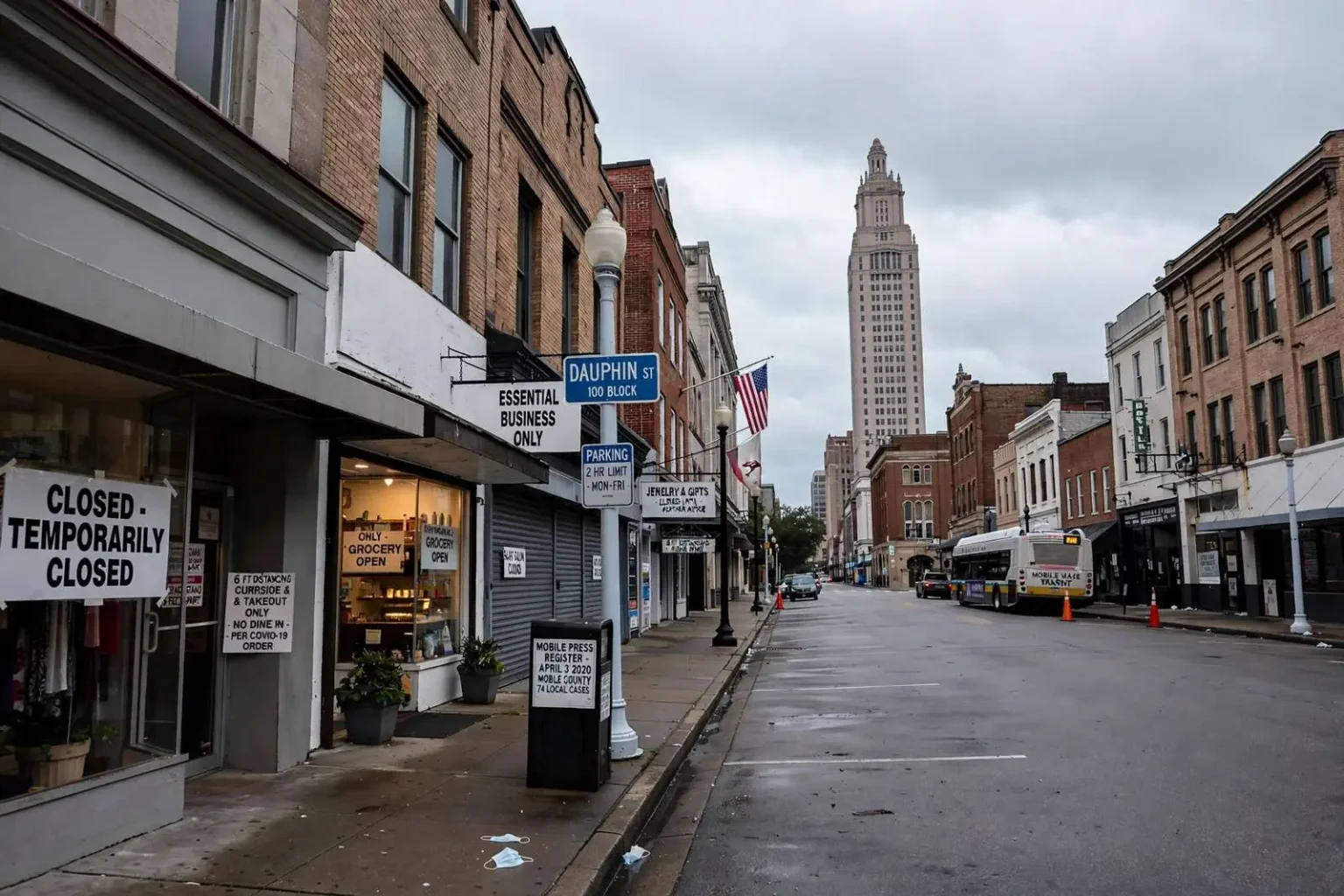
As of Friday morning, Alabama had 1,336 confirmed COVID-19 cases statewide, including 74 in Mobile County, according to the Alabama Department of Public Health. The state had recorded 34 deaths tied to the virus, four of them in Mobile County.
Locally, Mobile Mayor Sandy Stimpson has faced repeated questions about whether he would use his authority to impose a shelter-in-place order or curfew, something leaders in Birmingham and Tuscaloosa have already done. Stimpson and Mobile County Health Officer Dr. Bernard Eichold have both declined to issue any additional stay-home mandate or curfew for the city. In recent interviews with local media, Stimpson pushed back on the idea that a shelter-in-place order would fundamentally change daily life in Mobile, saying the city and state have already implemented most of the restrictions such an order would require.
“The question is: What can we do that’s different from what’s already being done? There’s not much. I’ve chosen not to make it seem like we’ve made some kind of radical changes,” Stimpson said. “You would still need to go to the grocery store, you would still have utilities, you would still have to have banks…. People hear shelter in place and they think everything just shuts down, but there are exceptions to all of it.”
Stimpson has declined to speculate on what a Mobile-specific order might look like if one were adopted, saying he did not want to be “pinned down” on specifics. A spokesperson for Ivey’s office said any decision on further statewide restrictions would be made in consultation with ADPH and State Health Officer Dr. Scott Harris. Multiple requests to ADPH for details on what additional restrictions could look like went unanswered.
Part of the confusion stems from the fact that neither “shelter in place” nor “stay home” carries a single, consistent legal definition from state to state or city to city. In practice, the specific restrictions under either label are typically spelled out in follow-up orders issued by a state or municipality.
Some officials, including New York Gov. Andrew Cuomo, have also argued that the phrase “shelter in place” itself can cause unnecessary panic, since it suggests residents cannot leave their homes at all.
In reality, every state, city and county that has adopted such an order has built in exceptions for essential travel and essential businesses. Those essential categories typically include grocery stores, hardware stores, pet stores, gun stores, banks, liquor stores, utilities, refineries, oilfield production, construction, chemical production, communications, shipyards and healthcare facilities, though the exact list can vary by region.
Alabama has already ordered many non-essential businesses statewide to close, including standalone clothing, furniture and jewelry stores, along with close-contact services and entertainment venues such as theaters, auditoriums, bowling alleys, gyms, yoga studios, playgrounds, barbershops, and nail, tanning and massage salons. Most states, Alabama included, are also restricting gatherings beyond federal social distancing guidance, which recommends no more than 10 people congregate, or that any larger gathering maintain at least six feet of separation between participants.
The Mobile Police Department has said it will rely primarily on voluntary compliance when responding to gatherings that violate the state’s health orders, which are treated as misdemeanor criminal offenses during a declared state of emergency. “Police are asking for voluntary compliance from all, but will take enforcement action if needed, which could include possible fines or jail time,” the department said in guidance issued this week.
In Alabama’s case, the bulk of the state’s pandemic response has come not through a single stay-home order but through a series of escalating emergency declarations from Ivey’s office, developed in coordination with a state coronavirus task force and Harris. By comparison, states like Georgia and Mississippi are only now rolling out orders limiting restaurants to takeout and curbside service and closing non-essential retail and close-contact businesses — restrictions Alabama has already had in place for at least a week, and in some cases more than two weeks.
Alabama has also closed public schools for the remainder of the academic year and granted mayors and local health officials authority to impose additional restrictions they deem necessary for their communities. Jefferson County and the cities of Birmingham and Tuscaloosa have used that authority to adopt stricter measures, including nightly curfews and formal stay-at-home orders.
Mobile has not followed suit, though Stimpson has said repeatedly that “all options are on the table” as the situation develops. Supporters of a statewide shelter-in-place order argue that even if it changes little about which businesses can operate, it sends an important message urging residents to stay home when possible and reinforces social distancing guidance at a moment when health experts have described Alabama’s population as “uniquely vulnerable” to the virus.
Update: Statewide Order Issued
Later on April 3, Ivey issued a statewide stay-at-home order. It took effect at 5 p.m. Saturday, April 4, and was set to expire at 5 p.m. on April 30. The order directed residents to stay at home except for essential activities, such as buying food and medicine, seeking medical care and going to work at essential businesses.