Mobile Opera Brings ‘The Secret of Susanna’ Back to the Murphy Auditorium Stage
Mobile Opera stages Golisciani's 'The Secret of Susanna' Feb. 16 at the Murphy High School auditorium, plus MOJO jazz, Sway's Carnivalesque II and an arts.
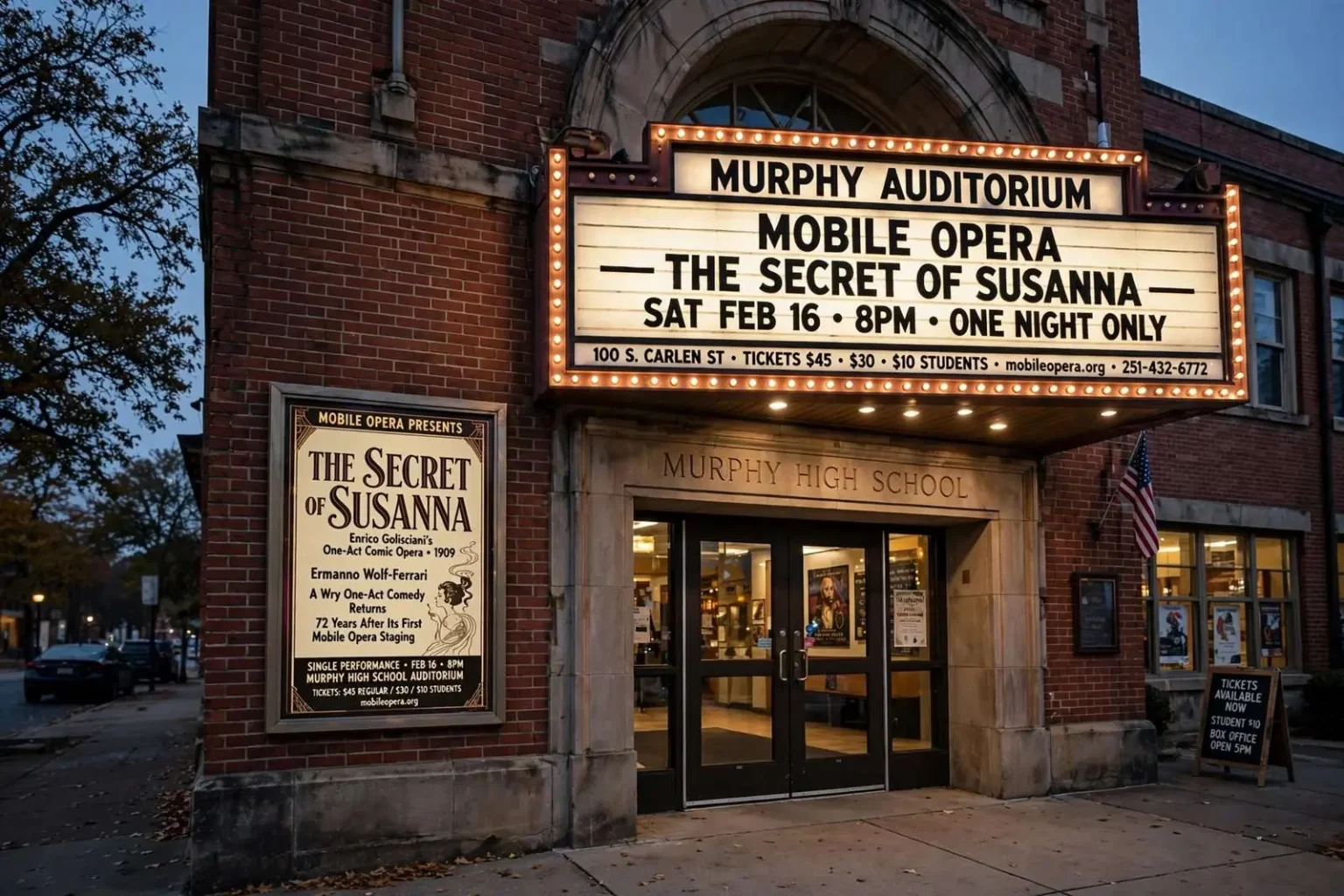
Mobile Opera is reviving a wry one-act comedy with deep roots in the company’s own history. Enrico Golisciani’s “The Secret of Susanna,” first staged by Mobile Opera 72 years ago, returns to the Murphy High School auditorium at 100 S. Carlen St. for a single performance on Saturday, Feb. 16 at 8 p.m.
Bringing back a title the company mounted seven decades ago is a statement about institutional memory. Mobile Opera is among the oldest opera companies in the country, and its midcentury production of this particular work sits far enough back that the revival doubles as a piece of the organization’s own biography. The choice of venue carries its own resonance: the Murphy auditorium has served generations of Midtown families as the place where school plays, graduations, and community performances happen, making it an approachable setting for an art form that too often struggles with the perception of exclusivity.
Single tickets remain available at $45 for regular seating, $30 for a second tier, and $10 for students. Reservations can be made by calling 251-432-6772 or online at mobileopera.org.
The student price deserves particular note. At ten dollars, the company is pricing the show below the cost of a Friday movie, a deliberate bet that the surest way to build an audience for opera is to put young people in a seat before anyone tells them the art form is not for them.
The Story and Its Wry Charm
The 1909 opera spins its tension from a deceptively simple premise: a husband becomes convinced he has seen his wife wandering the streets alone, and his imagination runs toward infidelity. A curious aroma clinging to her clothes finally forces an embarrassing confession into the open, and the suspense builds from there.
The work — composed by Ermanno Wolf-Ferrari to Golisciani’s libretto — trades on a joke that has aged better than most operatic plots: the scandalous secret at the center of the marital crisis is that Susanna has taken up smoking cigarettes. What played as racy domestic comedy in the salons of pre-war Italy plays today as near-farce, and the opera’s brief running time and conversational style make it an ideal entry point for first-time operagoers who might find a four-hour tragedy daunting.
One act, two singers at its core, and a plot that turns on jealousy, tobacco, and a husband’s overactive imagination: the piece has long been a favorite of companies that value wit and vocal charm over spectacle. Its return to Mobile gives the company’s regulars a rarity — a work they likely saw the company perform only if their memories reach back generations — while offering newcomers an evening that asks little and gives much.
The domestic-comedy tradition the opera belongs to has always suited Mobile’s audiences, who have supported the company through eras when Gulf Coast cities many times its size supported no opera at all. That longevity is the quiet argument behind the programming: a company does not reach its eighth decade by accident, and reaching back into its own repertoire is both a celebration and a reminder of how unusual the institution is.
More on the Mobile Arts Calendar
The weekend also brings a showcase of college-level jazz talent. The Mystic Order of the Jazz Obsessed (MOJO) stages its February Jazz Jambalaya, themed “College 101,” featuring the Coastal Alabama Community College Jazz Band under the direction of Rebecca Barry.
The show is set for Monday, Feb. 18 at 6:30 p.m. in Bernheim Hall at the Ben May Public Library, 701 Government St. Admission is $15, $12 for students and military, and $10 for MOJO members; details are available at 251-459-2298 or mojojazz.org.
MOJO’s monthly gatherings have become a fixture of the city’s jazz life, pairing performances with the sort of convivial, educational framing the organization’s name promises. The “College 101” theme turns the spotlight on the next generation: the Coastal Alabama band carries the repertoire and discipline of a college program into a room full of listeners who remember when the city’s clubs rang with live jazz every night. Bernheim Hall, with its acoustics and its setting inside the main branch of the Mobile Public Library, has proven an ideal host for the series.
Downtown, the exhibition “Carnivalesque II” runs at Sway, 10 S. Conception St., from February through April 6, timed to Mardi Gras season with work from 15 area artists including Lucy Gafford, Jessica Maples, Jordan Atchison and Billy Jordan. Information is at 251-650-4020.
The show’s title leans into the season deliberately. Mardi Gras has always been Mobile’s greatest collective artwork — a centuries-old collaboration of costumers, builders, musicians, and painters — and a gallery exhibition that mines that visual culture gives local artists a frame the whole city understands. Sway, an artist-run space in the lower Dauphin district, has specialized in exactly this kind of locally rooted programming, and a run that stretches through Carnival and into spring gives the exhibition room to catch multiple audiences.
On the grants front, the Gulf Coast Ethnic and Heritage Jazz Festival received a $3,050 award from the Alabama State Council on the Arts on Dec. 12. The nonprofit has brought jazz education and performance to the Mobile area for two decades, including its two-week Marcus Johnson Jazz Camp each midsummer, and plans a recital, student concerts and a headlining concert for the season ahead.
The grant is modest in dollar terms and significant in what it represents: state arts dollars following an organization whose two-decade record shows results. The jazz camp has trained generations of young players from across the Gulf Coast, many of whom have gone on to college music programs and professional careers, and the festival’s summer concerts have kept touring jazz artists coming through Mobile in an era when such bookings have grown rare.
A Season That Shows the City’s Range
Taken together, the week’s offerings sketch the breadth of Mobile’s cultural economy. An opera company reviving a title from its own past, a jazz society putting college students on stage, a gallery exhibition built on Carnival’s visual traditions, and a festival nonprofit winning state support for its educational work — these are not competing events so much as four faces of the same creative community, each sustained by a different mix of ticket sales, memberships, and grants.
That mix is worth understanding. Opera survives on single-ticket buyers and season subscribers who fill the Murphy auditorium’s seats; MOJO runs on the $10 and $12 admissions of a membership-based society; Sway’s exhibitions depend on visitors and the sale of work by the artists on its walls; and the jazz festival leans on grants like the Council’s December award to keep its camps and concerts priced within reach of the families they serve. Every ticket sold at any of the four events is an argument for the next one being programmed.
Timing plays its part too. Carnival season brings visitors into downtown Mobile in numbers the city sees at no other time of year, and arts organizations have learned to program around the parades rather than against them — a matinee or evening show that gives parade-goers something to do between processions, and a calendar that stretches the season’s economic benefits into April. The Opera’s single Saturday performance and the “Carnivalesque II” run through early April both reflect that strategy.
The Opera Company’s Long View
For Mobile Opera specifically, the revival of “The Secret of Susanna” fits a programming philosophy that has served the company across its long history: balance the canonical repertoire audiences expect with rarities and comedies that keep the art form lively. A one-act comedy with a cast at its core and a running time that respects the calendar is also a pragmatic production, allowing the company to put its resources into voices and staging rather than spectacle.
The company’s leaders have long argued that opera in a city Mobile’s size survives only by being embedded in community life — in school auditoriums rather than distant concert halls, at prices residents can actually pay, and with programming that connects to the city’s own story. A work the company first staged 72 years ago, performed again in a school auditorium in the middle of Midtown, makes that argument in a single evening.
For audiences, the invitation is straightforward. Saturday’s performance offers a witty, compact evening of vocal artistry with a storyline anyone can follow and a confession everyone will enjoy. Reservations are available at 251-432-6772 or mobileopera.org, and at $10 for students, the company has made the decision about as easy as it can be made.
The February date also situates the performance inside the company’s broader season, which typically reaches its busiest stretch as Carnival gives way to spring. Companies across the Gulf Coast have learned that the weeks surrounding Mardi Gras offer the year’s best opportunity to reach new audiences — visitors and locals alike are already in the habit of going out at night — and Mobile Opera’s choice to place a light, accessible comedy in that window is as smart as programming gets. An evening that ends with laughter is the easiest invitation to a second opera anyone has ever devised.