Mobile Volunteers Built Oyster Reef for Coastal Restoration in 2011
A 2011 WKRG report covered volunteers building an oyster reef in Mobile as part of a coastal restoration effort.
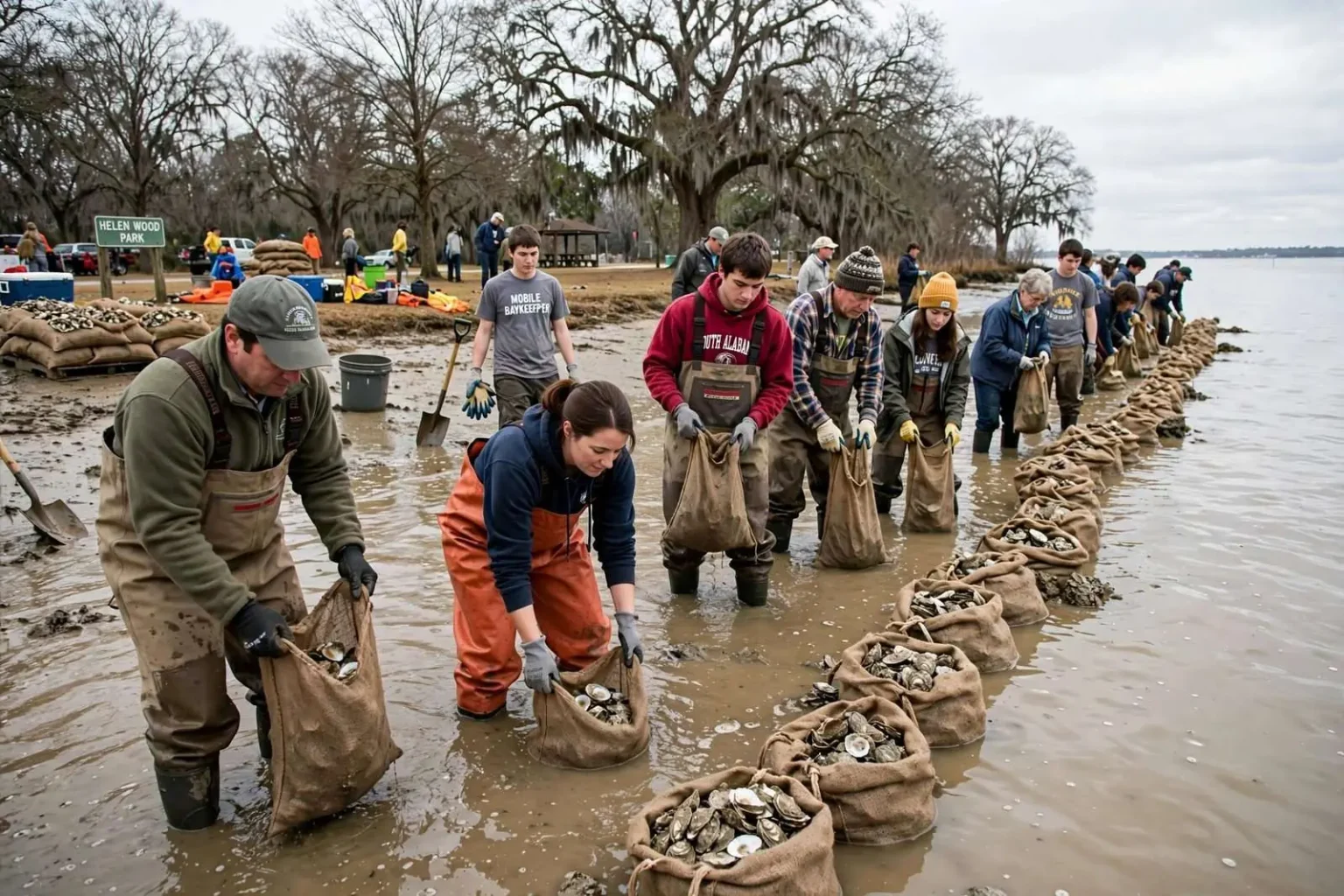
Hundreds of volunteers gathered at Helen Wood Park in Mobile in January 2011 to build an oyster reef as part of the 100-1000 Restore Coastal Alabama project, according to a local station. Organizers aimed to construct a quarter-mile reef in muddy water. The work was difficult, and volunteers did not finish as much of the project as planned on the first day. Organizers asked for additional volunteers to return the following morning to help complete the effort.
The scene along the Mobile Bay shoreline that winter morning was one of the most visible displays yet of Alabama’s volunteer-powered coastal restoration movement. Wading into shallow, sediment-choked water in waders and work gloves, crews of residents, students, church groups and conservationists lowered bags of oyster shell into place along the park’s edge, stacking them in long, low lines designed to calm the waves that had been chewing away at the shoreline for years.
The quarter-mile target was ambitious for a single weekend, and the mud made it more so. Volunteers found that every bag had to be placed by hand, that footing was treacherous, and that the pace of the work was dictated by the tide and the muck as much as by muscle. By the end of the first day, the reef lines extended only part of the distance organizers had hoped. Rather than call the effort short, coordinators put out the call for more hands the next morning — and, in the manner that has defined the project since, volunteers answered.
The 100-1000 Restore Coastal Alabama project
The effort at Helen Wood Park was one installation in the 100-1000 Restore Coastal Alabama initiative, a partnership campaign with a simple, sweeping goal: build 100 miles of oyster reefs and plant 1,000 acres of seagrass in Mobile Bay over a five-year period. The project brought together conservation organizations, universities and community groups — among them The Nature Conservancy, Mobile Baykeeper and the Alabama Coastal Foundation — in an attempt to mobilize ordinary residents as the labor force for a large-scale habitat restoration.
The design behind the reefs is elegantly practical. Stacks of bagged oyster shell, placed in parallel lines a short distance from shore, act as breakwaters. They absorb wave energy before it can slap against the bank, which slows erosion of the shoreline behind them. In the calm water between the reef and the beach, seagrass can take root where waves once kept the bottom stirred to mud. And the reef itself, seeded with living oysters, grows: larval oysters settle on the shell, and the structure accretes over time, becoming self-repairing habitat.
Each reef, in other words, is meant to become living infrastructure. Oysters filter enormous volumes of water as they feed, improving clarity in the bay; the reef nooks shelter juvenile fish, blue crabs, shrimp and other species that support the bay’s commercial and recreational fisheries; and the breakwater function protects public parkland, private property and roads from storm-driven erosion. Few restoration tools deliver that many benefits per volunteer-hour, which is why the model spread from Mobile Bay to shorelines around the Gulf.
Why Helen Wood Park
Helen Wood Park, on the western shore of Mobile Bay along the Scenic Highway 98 corridor, had been losing its shoreline steadily. The park’s beaches and tree line sat squarely in the path of southbound wind and waves that sweep up the bay, and storm after storm had eaten at the bank. Choosing a public park as an early reef site made the work visible: thousands of motorists pass the park daily, and a reef built by neighbors in plain sight did more to recruit the next wave of volunteers than any brochure could.
The January 2011 build was also a statement about scale. Large coastal restoration projects are usually the work of heavy machinery, engineering firms and government contracts — processes measured in years of permitting and millions of dollars. The 100-1000 project demonstrated that a meaningful portion of restoration could be done the other way: neighbors, hand tools, bagged shell and weekend commitments. Every reef line the volunteers set was footage of shoreline that would erode more slowly and habitat that would grow without further construction.
That is not to say the work was easy, as the first day’s shortfall proved. The bay’s shallow margins at the park are soft with years of accumulated silt, and moving through them while carrying bags of shell is exhausting. Weather windows matter, tides matter, and the physical arithmetic of a quarter-mile reef — thousands of bags placed in overlapping rows — simply outran the first day’s crew. The request for volunteers to return the following morning was a candid acknowledgment that the community itself was the project’s critical resource.
Oysters and the Gulf Coast’s working history
Oyster reefs once framed Mobile Bay so extensively that early maps marked natural reef bars as navigation features, and the oyster fishery was a pillar of the coastal economy for generations. Over the past century, a combination of overharvesting, sedimentation, storm damage and disease reduced that reef footprint dramatically — a loss measured not just in shellfish but in the erosion control, water filtration and fish habitat the reefs had quietly provided.
Restoration efforts like the Helen Wood Park build are part of a longer, ongoing effort to recover some of that function. In the years since 2011, Alabama’s coastal programs, scientists and volunteer groups have continued constructing reef breakwaters along the bay’s shorelines, monitoring which designs catch oysters best and which sites need reinforcements. The early volunteer-built reefs provided data and proof of concept for larger funded projects that followed, including work funded through post-oil-spill restoration dollars that began flowing to the Gulf Coast later in the decade.
For the volunteers who waded into the mud at Helen Wood Park, the immediate rewards were modest — sore backs, a partially built reef, a request to come back Sunday. But the cumulative result of that approach, repeated at site after site around Mobile Bay, reshaped how the region thinks about its shoreline. What had been treated as a problem for engineers became a project for the community, one bag of shell at a time.
The January 2011 build remains a historical marker of that shift: hundreds of Mobilians, a quarter-mile goal, muddy water and unfinished work — and the simple, durable idea that the best way to restore a bay is to let its own residents build the reefs back.
A volunteer model that kept growing
What happened at Helen Wood Park on that January weekend became the template for dozens of later builds. Community reef construction events across coastal Alabama adopted the same recipe: recruit through churches, schools, businesses and civic clubs; stage bags of shell and safety gear at the site; brief volunteers on the placement pattern; and work in shifts until the tide and the daylight ran out. The learning curve was steep at first — the first-day shortfall at Helen Wood Park taught organizers to stage materials more efficiently and to sequence the placement so that the line advanced evenly — but each event made the next one faster.
The value of the volunteer approach went beyond the free labor. Residents who built a reef came away with an understanding of the shoreline that no public meeting could convey: they knew where the water had gotten shallow with sediment, why waves were eroding a particular bend, and how a line of shell changed what happened to the beach behind it. Those volunteers became the project’s most effective advocates, and many went on to help at subsequent sites around the bay, bringing friends and family with them.
Scientists and coastal engineers, meanwhile, tracked how the reefs performed. Monitoring visits recorded oyster settlement on the shell, fish and crab activity in the reef structure, and changes in the shoreline position behind the breakwaters. That record mattered: it gave funders and regulators evidence that community-scale reef construction delivered measurable benefits, which in turn supported the larger restoration programs that came later in the decade as Gulf-wide restoration funding took shape after the 2010 oil spill.
The spill itself shadowed the timing of the Helen Wood Park build. The Deepwater Horizon disaster unfolded in the spring and summer of 2010, and concern about the bay’s health gave restoration work a new urgency in the months that followed. Building a reef in January 2011 was, for many volunteers, a way to do something concrete for a coastline they feared for — one modest, tangible project on a shoreline that no one could yet predict how the spill would affect.
More than a decade later, the quarter-mile goal of that first day reads differently: not as a deadline missed, but as the opening installment of a much longer shoreline of volunteer-built reef that followed. The mud, the sore backs and the call to come back Sunday were the price of a project that turned Mobile Bay’s restoration into a resident-led effort — and it started with hundreds of neighbors willing to get in the water.