MOBILE, Ala. — A 13-year-old is in custody after leading Mobile police on a high-speed chase that reached speeds of up to 100 miles per hour early Thursday morning, a pursuit that ended without injuries but raised familiar questions about young drivers, stolen moments and the dangers of police chases through city streets.
According to police, a Mobile Police Department officer first spotted a burgundy 2007 Lexus traveling southbound in the wrong lane on Stanton Road. The officer caught up to the vehicle on Springhill Avenue and attempted to initiate a traffic stop, but the driver refused to pull over and instead accelerated, leading officers on a pursuit that reached triple-digit speeds through the area.
The route took the fleeing car through one of west-central Mobile’s busiest corridors. Springhill Avenue carries traffic past homes, churches and small businesses, and at the early morning hour when the chase unfolded the roads were largely empty — a factor that likely prevented the speeds involved from producing a catastrophic collision with another vehicle or a pedestrian.
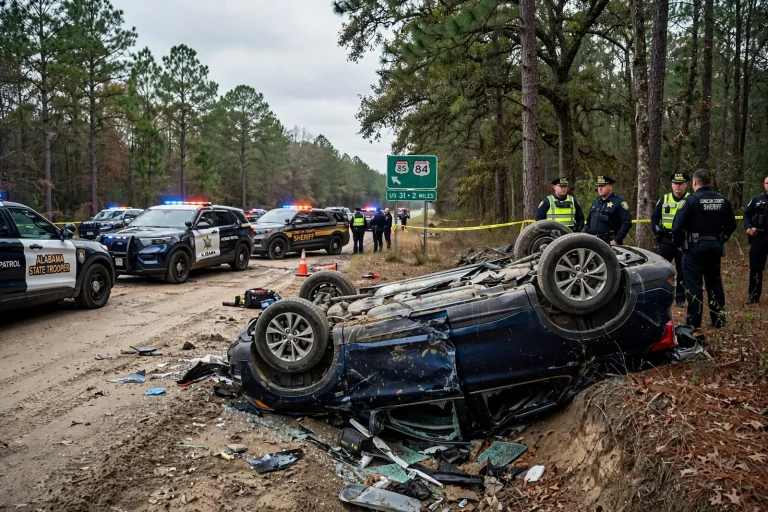
Officers were ultimately able to end the chase by deploying a spike strip, which disabled the vehicle. The Lexus then ran over a curb before coming to a stop, allowing police to take the driver into custody without further incident. Spike strips — mats of hollow spikes laid across a roadway — are designed to deflate tires gradually rather than blow them out, slowing a fleeing vehicle enough that a driver can no longer maintain pursuit speeds while still allowing some steering control, which reduces the chance of a violent crash at the moment of the stop.
Police confirmed the driver was a 13-year-old juvenile. The age of the driver transformed what would ordinarily be a traffic and pursuit case into a juvenile matter, with all the legal constraints that status carries in Alabama.
What Happens Next in the Juvenile System
Because the driver is a minor, further details about the case, including any charges filed, are expected to be handled through Alabama’s juvenile justice system rather than released publicly in the same manner as an adult case. Juvenile proceedings in the state are generally closed, records are confidential, and law enforcement agencies release only limited information — typically the age of the juvenile and the general nature of the allegations.
If the case proceeds, a juvenile court intake officer would review the matter, and a judge could detain the child, release them to a guardian pending a hearing, or route the case into diversion programs aimed at younger offenders. Eligibility for an adult-facing process is governed by strict statutory criteria that generally apply to older teenagers facing serious felony charges, making a conventional juvenile delinquency proceeding the likely path for a 13-year-old.
Investigators will also work to determine who owned the vehicle and how a 13-year-old came to be behind it. In cases involving young drivers fleeing police, questions about the car itself — whether it was taken without permission, borrowed or owned by a family member — shape what charges, if any, ultimately attach, and can pull additional individuals into the case.
The Calculus of High-Speed Pursuits
High-speed pursuits involving juvenile drivers raise particular safety concerns for law enforcement, since officers must balance the need to stop a fleeing vehicle against the risks a chase poses to the young driver, other motorists and pedestrians. Department pursuit policies typically direct supervisors to weigh the severity of the suspected offense against the danger created by the chase itself, and to call off or restrict pursuits when the risk outweighs the need for immediate apprehension.
A 13-year-old behind the wheel compounds that calculus. Young drivers lack the experience to manage a vehicle at speed, are more likely to panic, and cannot legally hold a license or insurance, meaning every second of a pursuit multiplies a risk the driver is poorly equipped to control. Departments nationally have revised their pursuit policies in recent years, and Mobile’s approach reflects the modern emphasis on ending chases quickly rather than letting them run.
The use of a spike strip in this case allowed officers to bring the pursuit to an end without a collision, a tool increasingly relied on by departments like MPD to reduce the danger of prolonged high-speed chases through residential and commercial corridors. Successful deployments require planning and positioning — an officer ahead of the fleeing vehicle, a stretch of road where the strip can be laid safely, and coordination across units so the driver is funneled into the interception point rather than past it.
The alternative outcomes are the ones that make headlines nationwide: chases that end in fiery crashes, in injuries to innocent third parties, or in officers and suspects both hurt at the moment of arrest. That Mobile’s version ended with a curb strike and a quiet arrest is, by the standards of pursuit incidents, the best available result.
The episode also highlighted a pattern that police departments across Alabama and the nation have struggled with for years: juveniles behind the wheel in police chases. Auto thefts and unauthorized use of vehicles remain among the most common offenses involving young teens, and the demographics of those crimes have proven stubborn — the age of drivers recovered in stolen-vehicle cases has trended younger in many cities, a phenomenon criminologists attribute to a mix of social factors and the spread of vehicles that are easier to start without keys.
The Neighborhood Where It Ended
The chase began and ended in a section of Mobile where residential streets meet arterial roads — the kind of grid where a car moving at 100 miles per hour covers blocks in seconds and where the margin for error is measured in feet. Stanton Road and Springhill Avenue both serve established neighborhoods whose residents have frequently raised traffic safety with the city, from speeding cut-through drivers to the dangerous intersections where the two corridors connect.
For residents who heard or saw the pursuit, the aftermath offered a lesson in how these incidents actually unfold: radio traffic coordinating units, officers positioned at intersections to warn cross traffic, and the spike strip deployment that turned a runaway chase into a controlled stop. The technology is low-cost and low-tech — hollow spikes that poke tires and let air escape — but the coordination behind a clean deployment is not.
The child taken into custody Thursday morning will now move through a system designed, at least in theory, around rehabilitation rather than punishment. Juvenile court judges in Alabama have discretion to order counseling, educational programming and supervision, and outcomes for offenders so young typically emphasize intervention over incarceration — a recognition that a 13-year-old at the wheel of a stolen car at 2 a.m. is as much a failure of the systems around that child as a crime by the child alone.
Mobile police have not released additional details about the incident, including the precise time the chase began or how many units were involved, and it remained unclear Thursday whether other juveniles were in the vehicle. Additional information, if released, would come through the department’s public affairs channels.
Traffic safety researchers have documented what Mobile police experienced firsthand Thursday morning: the first moments of a pursuit are the most dangerous, both because speeds spike immediately and because drivers fleeing at night are navigating streets they know only as a blur. Departments that publish pursuit data consistently report that a majority of chase-related injuries occur to uninvolved parties — the drivers of cars that happen to be at an intersection, the pedestrians on a sidewalk.
How Mobile Police Handle Stops and Pursuits
The Mobile Police Department, the largest municipal law enforcement agency in south Alabama, operates across a city of roughly 190,000 residents with patrol districts covering everything from downtown’s dense core to the suburban edges of west Mobile. Its officers handle the full range of traffic enforcement, and pursuits — while a small fraction of stops — occur often enough that the department, like its peers, has invested in tools and training to end them safely.
The department’s officers receive training on when to initiate a pursuit, when to terminate one, and how to deploy interception tools like spike strips. Modern dashboard and body cameras capture these decisions, and the footage becomes part of the record when a pursuit ends in a crash or a complaint — a level of documentation that has transformed how departments account for chases compared with a generation ago.
What investigators will now piece together is the full picture of the incident: where the Lexus came from, who owned it, whether it was reported stolen, and what led a child to be driving it at 100 miles per hour through west-central Mobile before sunrise. Those answers will determine the charges presented to juvenile court and whether any adults connected to the vehicle face their own.
For the neighborhoods along the route, the incident ends with relief rather than tragedy — and with a reminder of why residents on both sides of the city press the city on traffic safety and youth programs alike. A chase that ends with everyone alive is the outcome every department trains for, and the one Mobile’s officers delivered before most of the city woke up.
The case will proceed in Mobile County’s juvenile court system, where records are closed and outcomes are designed to steer young offenders away from the path that put a 13-year-old behind the wheel of a fleeing car in the first place.