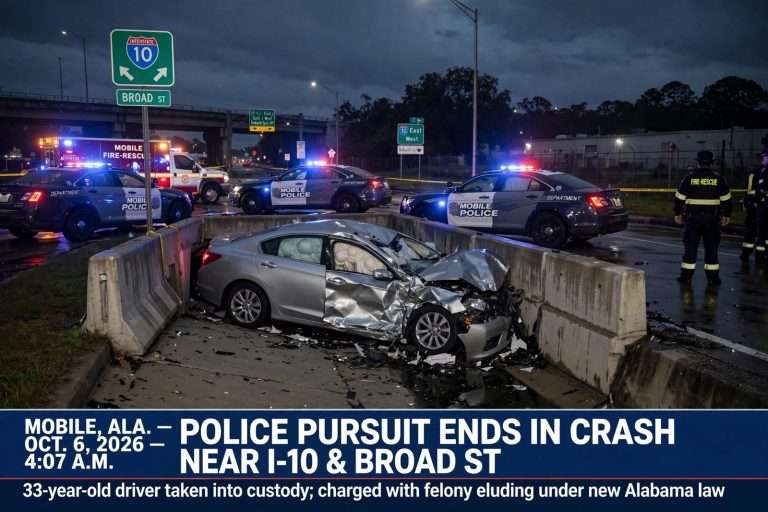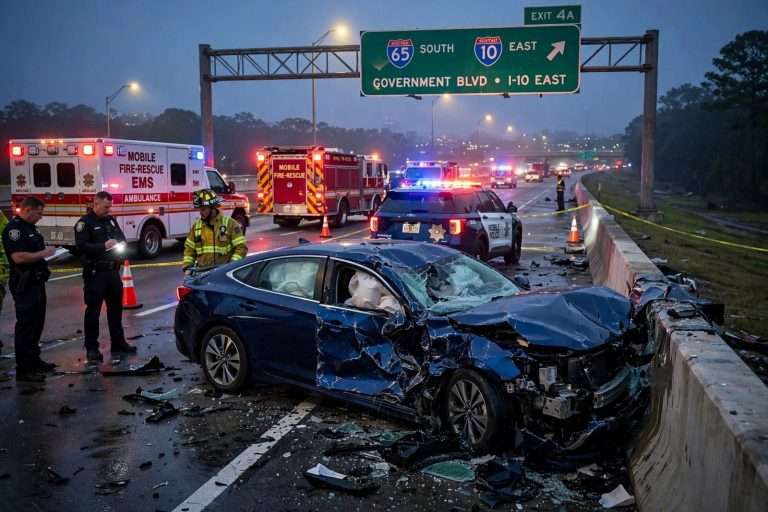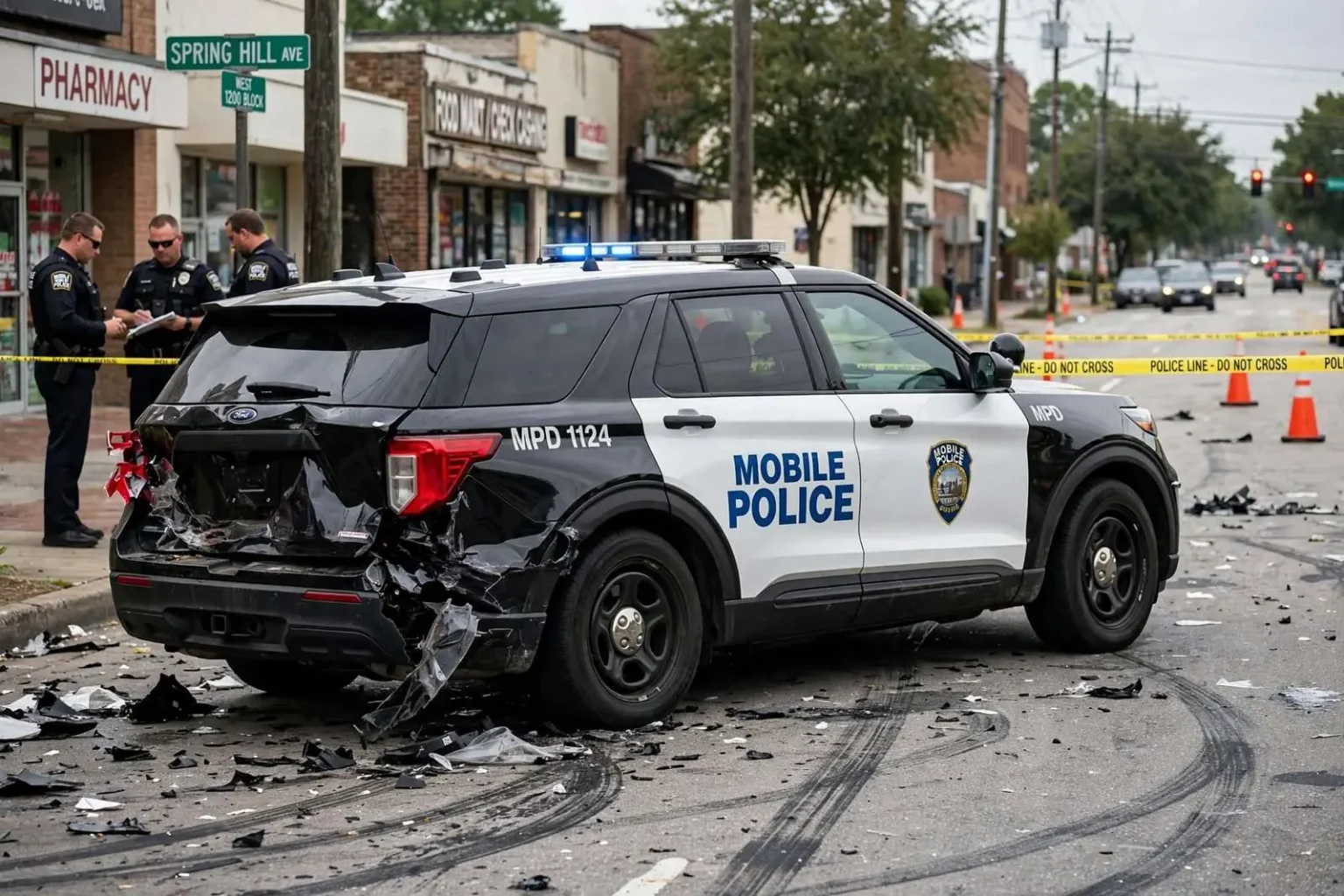
A Mobile Police Department patrol car was damaged after a suspect fleeing officers in a reported stolen vehicle rammed into the back of the cruiser during a chase that sent both vehicles racing the wrong way down one of the city’s busiest streets, according to police. By Thursday afternoon, MPD said a male juvenile had been arrested in connection with the incident, bringing a dangerous pursuit to a close without any reported injuries.
The episode unfolded along Spring Hill Avenue, a corridor that carries heavy traffic between midtown Mobile and the city’s western neighborhoods, and its wrong-way phase underscored the split-second dangers that vehicle pursuits pose to everyone in their path — officers, suspects and drivers who had no idea a chase was approaching.
How the Chase Began
Officers first attempted to stop the vehicle after learning it had been reported stolen, but the driver refused to pull over and sped off, prompting a pursuit, according to MPD. Pursuits of stolen vehicles present officers with an immediate calculus: the need to apprehend a suspect weighed against the risk that continuing the chase poses to the public. Once a fleeing driver makes the decision to run, officers work to bring the event to a safe conclusion while supervisors monitor whether the danger justifies pressing on.
In this case, the pursuit escalated quickly. The chase carried the suspect’s car and the pursuing officers eastbound in the westbound lanes of Spring Hill Avenue, one of Mobile’s main east-west corridors, before the white sedan struck the rear of a patrol vehicle. Driving against traffic on a major arterial road put the vehicles on a collision course with any ordinary motorists traveling in the opposite direction, and the rear-end impact with the cruiser showed how little margin separated the pursuit from a far worse outcome.
The suspect kept driving after the crash, continuing toward the Greers area before officers were able to end the pursuit. Police said one person was detained at the scene and that no injuries were reported in connection with the chase or the collision — a result that, given the wrong-way speeds and the damage to a marked patrol car, officials and residents alike could consider fortunate.
Juvenile Suspect Taken Into Custody
MPD confirmed Thursday afternoon that the person detained is a male juvenile who has since been arrested in connection with both the chase and the crash. Because the suspect is a minor, police have not released his name, and further details on potential charges had not been made public as of the department’s latest update.
The handling of juvenile cases follows a different path than those involving adults. Young suspects taken into custody are typically processed through the juvenile justice system rather than county jail, and information about charges, court proceedings and outcomes is far more limited. What begins as a public incident often ends with details that never become fully public, a reality designed to give young offenders a path to rehabilitation without a permanent public record.
Why Wrong-Way Pursuits Are So Dangerous
Wrong-way pursuits are considered among the most dangerous scenarios police can encounter, since they put officers, suspects and uninvolved drivers at risk of head-on collisions on roads not designed for oncoming traffic. Motorists traveling legally have little warning that a vehicle is approaching from the wrong direction, and the closing speeds in a head-on crash — the combined speed of both vehicles — leave virtually no time to react.
Departments across the country weigh those risks in their pursuit policies. Many restrict or discourage chases for minor offenses, reserving vigorous pursuit for violent crimes or immediate threats, and require supervisory review whenever a pursuit extends onto congested roadways or moves against traffic. The Mobile department has not said how the chase came to move into oncoming lanes, and the department said the incident remains under investigation.
The damage to the patrol car itself illustrates the hazards officers absorb during these events. A cruiser disabled by a collision removes one unit from service, requires repair or replacement at public expense and, more seriously, can leave an officer stranded in the path of a fleeing vehicle. That the struck officer’s car was the only casualty reported in this incident is the exception rather than the rule in wrong-way crashes.
The Broader Context: Stolen Vehicles and Youth in Mobile
The case touches on two recurring concerns for Mobile law enforcement: auto theft and the involvement of young offenders in serious vehicle crimes. Stolen-car complaints generate frequent calls for service across the city, and vehicles taken for joyrides or used in other offenses often lead to exactly the kind of dangerous encounters that unfolded on Spring Hill Avenue. A driver behind the wheel of a car that is not theirs has little incentive to stop, and officers know the vehicle may be connected to additional crimes.
The arrest of a juvenile also reflects a pattern that community leaders and officials across Mobile County have wrestled with publicly in recent years, as forums and town halls have examined why young people end up behind the wheel of stolen cars and what interventions might interrupt that path before a pursuit ever begins. Those conversations have ranged from parental accountability measures to expanded after-school and mentoring programs aimed at giving young residents alternatives.
What Comes Next
Police said the case remains open and that additional information may be released as the investigation continues. Investigators will typically reconstruct the route of a pursuit like this one, review dash camera and any available video footage, document the damage to the patrol car and determine the full set of charges the case will support — in juvenile matters, those determinations are made in consultation with the District Attorney’s Office and the juvenile court system.
For residents along Spring Hill Avenue and the neighborhoods the chase crossed, the incident serves as a reminder of how quickly a routine traffic stop can escalate. Motorists who see a pursuit passing are advised to pull over, stay in their vehicles and let officers manage the situation rather than attempting to follow or intervene. Anyone with information about vehicle thefts or other crimes in the area can contact Mobile police or leave an anonymous tip through the department’s standard channels.
As of the department’s latest update, no injuries had been reported, the juvenile was in custody, and the investigation into how the pursuit traveled the wrong way down one of Mobile’s busiest corridors was continuing.
Spring Hill Avenue: A Corridor Under Pressure
The street that hosted the pursuit is one of Mobile’s most familiar thoroughfares. Spring Hill Avenue runs east-west across the central part of the city, connecting the Spring Hill neighborhood — one of Mobile’s oldest and most established communities — with the medical district and downtown. Schools, churches, businesses and dense residential streets all feed onto the avenue, which means traffic at most hours includes commuters, students and families whose exposure to a wrong-way chase is purely a matter of chance.
Corridors like Spring Hill Avenue are also where the consequences of a pursuit extend beyond the vehicles involved. Each wrong-way mile forces oncoming drivers to make split-second evasive decisions, clogs intersections as traffic scatters and consumes police resources from multiple units at once. That is why police executives nationally treat the decision to continue a pursuit as a continuously reassessed judgment rather than a single choice made when the driver first flees.
The fact that this chase ended near the Greers area, with a suspect in custody and no injuries, will likely factor into the department’s internal review of the incident. Departments routinely examine pursuits afterward to confirm that policy was followed and to identify anything that might make the next encounter safer — a process that matters both for public accountability and for officer training.
Inside the Juvenile Justice Process
For the young suspect, the road ahead runs through a system built differently from adult criminal court. In Alabama, juveniles accused of serious offenses are generally taken to a juvenile detention facility rather than county jail, appear before a juvenile court judge rather than a district court jury, and face a process focused by design on supervision, education and rehabilitation. Depending on the outcome of intake reviews, a juvenile case can be resolved with probation and services, adjudication in juvenile court or, in the most serious cases and for older teens, a transfer hearing to determine whether the case belongs in adult court.
Charges stemming from an incident like this one can be layered: the underlying vehicle theft, eluding or fleeing officers, and damage caused during the pursuit all represent separate matters for the court to weigh. The fact that a patrol car was struck adds a dimension agencies take seriously, since it documents the danger created not just for the public but for the officers engaged in the chase.
Because state law shields juvenile proceedings from broad public disclosure, residents should not expect the granular details — the suspect’s name, the specific charges or the court’s disposition — to be released. What MPD has committed to is updating the public as the investigation continues, and any additional information about the incident would come through the department’s usual channels.
A Reminder for Motorists
Incidents like this one are rare enough that most drivers will never witness one, but they unfold fast when they do happen. The safest response for anyone who encounters a pursuit — whether it is approaching head-on or passing at high speed — is to slow down, move right, stay in the vehicle and allow officers room to work. Attempting to follow a chase, film it from the roadway or block a fleeing car adds civilians to an event that police are already struggling to contain.
For now, the count that matters is the one police reported: one juvenile in custody, one damaged patrol car, and no injuries on a busy Mobile corridor that could easily have produced far worse.