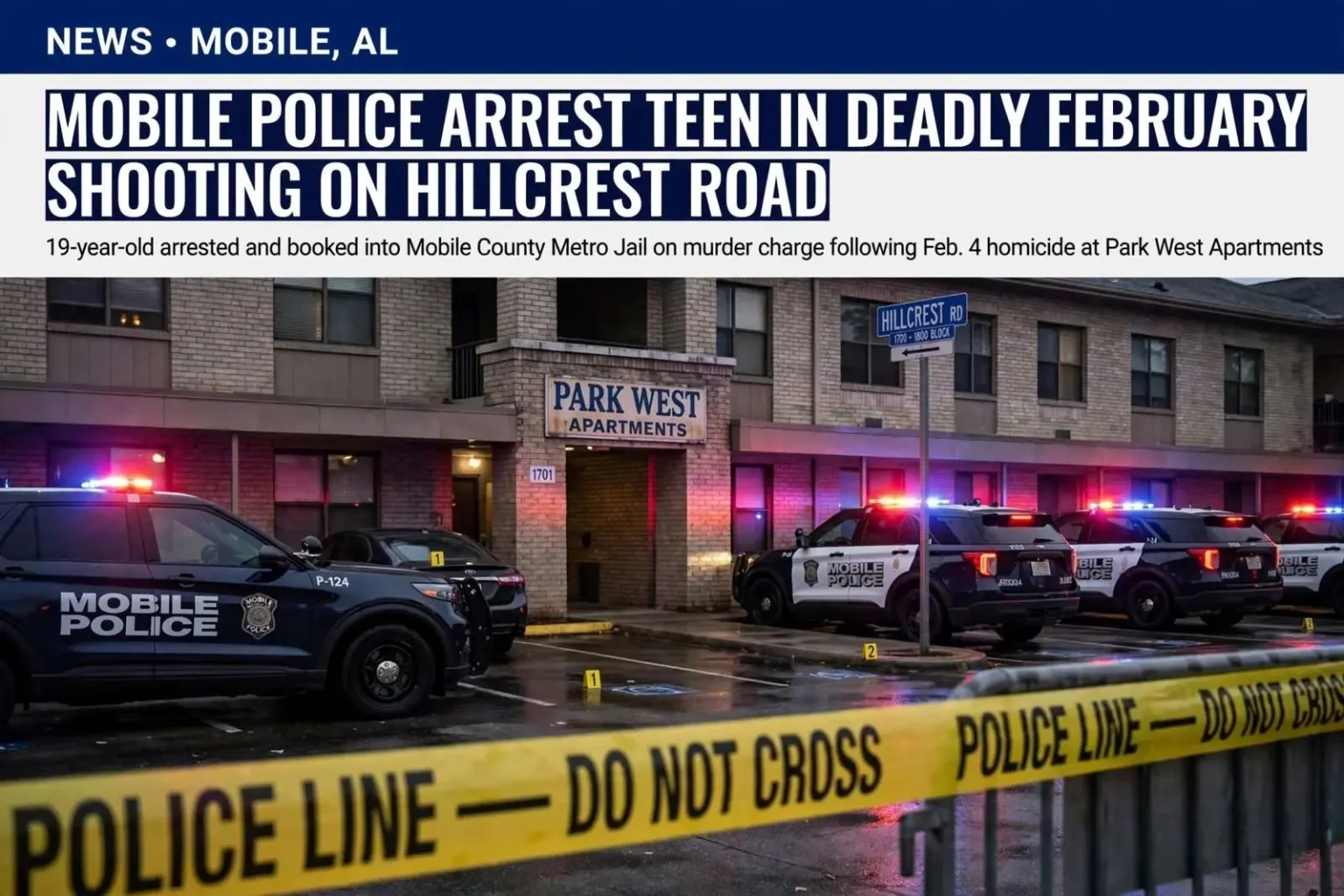
Mobile police have made an arrest in connection with a fatal shooting that took place on Hillcrest Road in early February, department officials confirmed. A 19-year-old man was taken into custody and booked into the Mobile County Metro Jail on charges of murder, closing weeks of investigative work that began the night the shots were reported.
Investigators identified the man arrested as Christian Rogers. According to the Mobile Police Department, the case stems from a shooting reported on Feb. 4 at Park West Apartments, located at 1701 Hillcrest Road — a complex along one of west Mobile’s busiest commercial and residential corridors.
Responding officers found the victim, 21-year-old Deion L. Dembert, dead on the ground near a vehicle in the apartment complex’s parking lot. The scene — a young man killed in a parking lot steps from his neighbors’ doors — became the starting point for an investigation that would run through the rest of the winter.
The weeks between the shooting and the arrest involved an investigation by Mobile police detectives working to identify a suspect and build a case sufficient for murder charges. Homicide work of that kind typically moves through interviews with witnesses, review of surveillance footage from the complex and surrounding businesses, and forensic analysis of the scene — all of it conducted while a neighborhood still reckons with what happened in its parking lot.
The Case Against Christian Rogers
Rogers was booked into the Mobile County Metro Jail, where a bond hearing was scheduled for later in the week, according to jail records. The booking marked the formal start of the legal process: from here, the case belongs as much to prosecutors and judges as to the detectives who assembled it.
Murder cases in Alabama begin in district court, where a judge determines whether probable cause exists to send the charges to a grand jury. If the grand jury returns an indictment, the case proceeds to Mobile County Circuit Court, where felony prosecutions are tried. Along the way, defense attorneys will examine the state’s evidence — witness statements, physical evidence and any forensic results — as both sides prepare for a trial that may be many months away.
The arrest closes out one chapter of the investigation, though the case will now move through the Mobile County court system as prosecutors pursue the murder charge against Rogers. Prosecutors will need to present the evidence gathered by detectives to a grand jury and, ultimately, to a trial jury — a process shaped by how many witnesses were willing to come forward in the days after the shooting.
For Dembert’s family, the arrest arrives weeks after a loss that began with a February phone call no family expects. Families in Mobile’s homicide cases often describe the investigation period as a second ordeal — waiting for news, pressing for updates and learning to navigate a court process that moves at its own pace. The charging of a suspect does not end that experience; it changes it into something that unfolds one hearing at a time.
Shootings at apartment complexes and other residential areas remain a persistent concern for Mobile police, who continue to urge residents with information about violent crimes to come forward. The Hillcrest Road corridor — lined with apartments, retail strips and busy intersections between Airport Boulevard and the I-65 interchange — has seen periodic violence over the years, and cases like this one test the relationships between detectives and the communities they serve.
Police leaders in Mobile have repeatedly said that most violent crime is concentrated among a relatively small number of people and places, and that the department’s challenge is intervening quickly enough to keep disputes from escalating into shootings. Apartment complexes, where dozens or hundreds of people live within sight of a single parking lot, present a particular difficulty: many residents see something, and fewer feel safe saying it.
How the Investigation Came Together
In the days after the shooting, detectives canvassing the complex would have worked to establish a timeline — when Dembert arrived, who he met, what the witnesses heard. Surveillance cameras at apartment complexes and nearby businesses often provide the most reliable framework for such timelines, and investigators typically supplement them with shell casings, vehicle records and phone data where warrants allow.
The decision to charge a 19-year-old with murder reflects the standard Mobile police apply to fatal shootings: the department treats each one as a homicide investigation from the first moments, and detectives are trained to keep cases open until evidence, not time, determines the outcome. Weeks between a shooting and an arrest is not unusual — building a case that survives a grand jury and a trial takes longer than identifying a suspect.
The Mobile County Metro Jail, where Rogers is being held, processes thousands of bookings each year from every law enforcement agency in the county — Mobile police, the sheriff’s office, Prichard, Saraland and the smaller municipalities. Bond hearings there typically occur within days of booking, where a judge sets conditions for release or keeps a defendant in custody pending trial based on the seriousness of the charge and any prior record.
West Mobile has grown steadily for decades, and the Hillcrest Road area now holds one of the denser concentrations of multifamily housing in the city. Park West Apartments sits among a cluster of complexes near the road’s busiest stretch, where residents range from students and young workers to families who have lived in the same units for years. Homicides in such settings tend to unsettle the whole complex, not just the neighbors closest to the scene.
Police officials have encouraged complex managers and residents alike to invest in the measures that help solve these cases: working cameras, good lighting in parking areas, and prompt reporting of suspicious activity. In the Hillcrest Road case, as in many others, the pieces detectives used to build the case likely came from that everyday infrastructure — the recordings and recollections produced by an ordinary parking lot on an ordinary night.
The age of both the victim and the suspect has drawn attention to the broader pattern of young adults involved in Mobile’s shootings. City and community organizations have pushed a range of responses over the years, from violence-intervention programs that work with people at risk of shooting or being shot, to summer employment initiatives aimed at the age group most often represented in both categories. Each fatal case, officials acknowledge, represents a failure of every layer of that system.
What Happens in Court
If Rogers is indicted, his case will join the docket of Mobile County Circuit Court, where murder prosecutions typically take a year or more from arrest to trial. Defense attorneys will have the right to review the evidence, challenge how it was gathered and negotiate or proceed to trial. Witnesses — many of them residents of the complex who saw or heard part of what happened — may be asked to testify months after the events, a gap that tests memories and resolve.
The bond hearing scheduled in the days after booking will offer the first public look at the state’s case. Prosecutors typically outline the basis for the charges, and judges weigh flight risk and public safety in setting bail. In murder cases, Alabama law allows judges to deny or set high bail depending on the circumstances, and the hearing often becomes the first public accounting of what investigators believe happened in that parking lot.
Whatever the outcome, the case will move through the system at the pace the courts set, with hearings, motions and scheduling conferences that most families find slower than they hoped. Mobile County’s criminal courts handle one of the heavier dockets in the state, and homicide cases compete for courtroom time with every other felony prosecution in the county.
For the neighborhood around 1701 Hillcrest Road, the arrest is a measure of closure but not a cure. The parking lot where Dembert died is the same one residents cross every day, and the questions that follow such a case — what led to the shooting, whether it could have been prevented, whether anyone else will be charged — remain open even after a suspect is in custody. Police have not said whether they believe others were involved.
Mobile police have repeated the same request in case after case: anyone with information about violent crime should come forward, whether through investigators directly or through the department’s tip channels. Anonymous tips, officials note, have been decisive in arrests across the city, and the department’s record of solving cases depends heavily on witnesses willing to be part of that process.
The department has also pointed residents to programs that let people report concerns before violence happens — the kind of early warnings that give patrol officers and intervention workers a chance to step in between a dispute and a shooting. In a city of Mobile’s size, where shootings cluster in a limited number of locations and relationships, that early information is often the difference between a disturbance and a homicide investigation.
Dembert, 21, will be remembered by his family and friends in the terms families of young victims always reach for: a life cut short in a place he had every right to be. The arrest of Christian Rogers ensures that a court will now weigh what happened on Feb. 4 at Park West Apartments, and that the answers will come — however slowly — through the Mobile County justice system rather than in silence.
As the case proceeds, investigators have left the door open for additional information. Anyone who was in the area of the complex on the night of the shooting, or who knows anything about the events that led to it, has been asked to contact the Mobile Police Department — the same request the department makes in every homicide, and the one that most often makes the difference between a case that ends in an arrest and one that ends in a file.