
Mobile Police Ask 14 Long-Term Missing Persons to Confirm They Are Alive and Well
Mobile Police are asking 14 people listed as long-term missing to visit headquarters and confirm they are alive and well so investigators can close their.
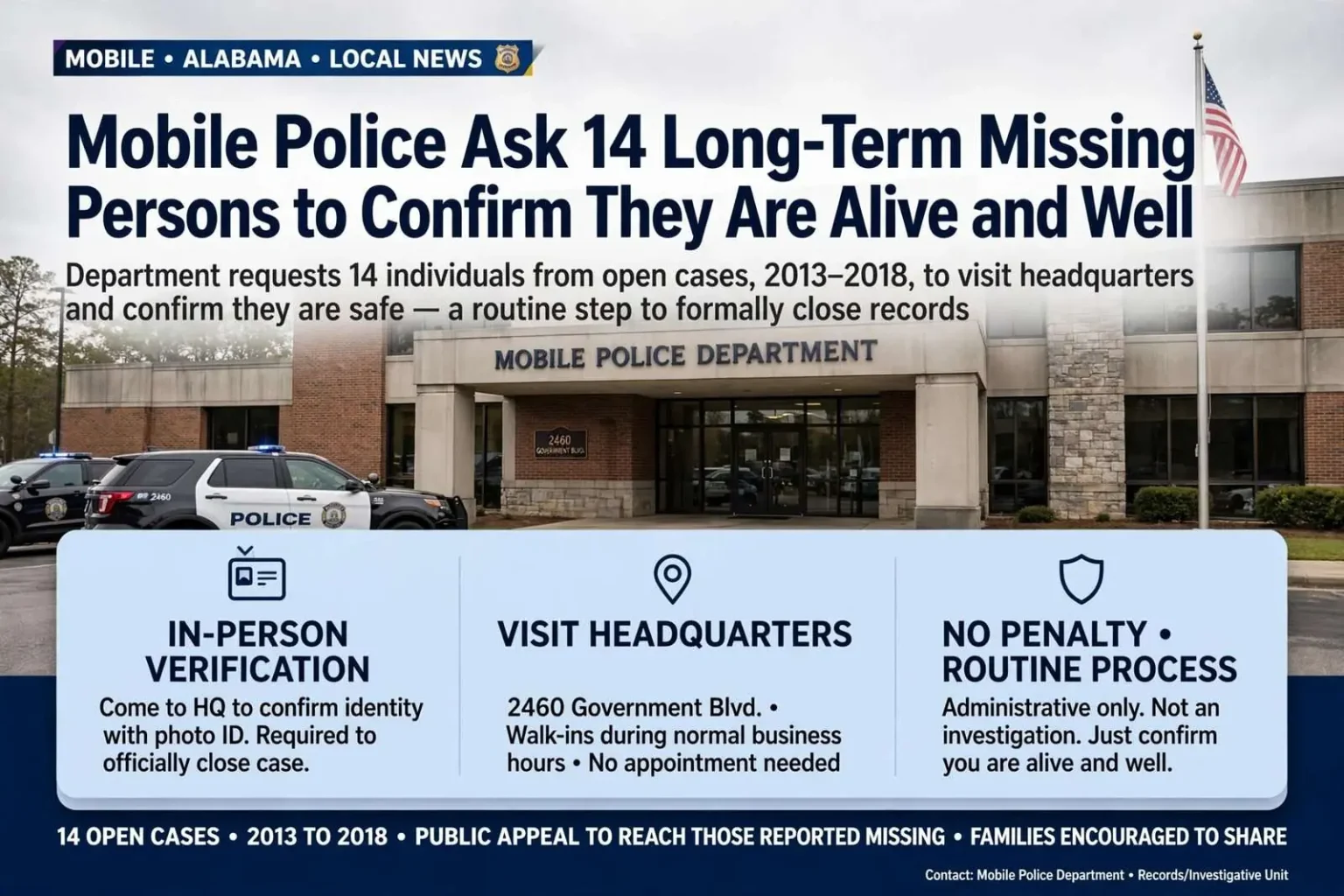
Mobile Police are asking the public for help closing out 14 long-running missing persons cases that investigators believe may already be resolved. The department says there are 14 active missing-person investigations that appear to be accounted for, but officers cannot formally close them without proof the individuals are alive and well. The unusual outreach is aimed at cleaning up the books in cases where the people are likely living ordinary lives somewhere, unaware that their names still sit in an open police file.
To clear their status, the 14 people are asked to visit police headquarters at 2460 Government Blvd. in person so officers can confirm they are no longer missing. The in-person requirement is deliberate: a phone call or a message from a relative is not enough to formally resolve a missing-person case, since investigators must verify identity face to face before they can document that the individual is safe and close the investigation. The department is framing the visit as a simple administrative step, not an interview under suspicion, and notes that clearing a case is in the individual’s own interest as well.
The names, with the years they were reported missing, are: Emma Leveritt, reported missing in 2013; Joshua Jammond Grayson, 2013; Tynikkia Tyshelle Tanner, 2013; Kali Nicole Sherman, 2013; Quinsheryl Louise Mosley, 2013; Ashley Delana Taylor, 2014; Diane S. Sullivan, 2015; Rashad Keith Walker, 2017; Tobias Marquis Fikes, 2017; Cory Denon Quinnie, 2017; Thomas Claude Adams, 2018; Analicia Marie Sharp-Bowman, 2018; Breana Dortch, 2018; and Jaylen Longmire, 2018.
Why Cases Stay Open for Years
Missing-person investigations are notoriously difficult to close even when the outcome is a happy one. Once a person is entered into the national missing-persons database, the case remains active until an officer documents the individual’s whereabouts with positive identification, something that requires the person, or someone authorized on their behalf with verification, to come forward. Many people who left home years ago, especially those who left as teens or young adults, do not know their families ever reported them missing, and some who do know assume the case resolved itself long ago.
That gap between reality and the record is what the department is trying to erase. An open missing-person case ties up investigative attention, keeps a family’s wound open, and can complicate practical matters for the individual, from background checks to interactions with law enforcement in other jurisdictions. Closing the file with a verified sighting or visit benefits everyone involved: the department’s recordkeeping, the families who reported the disappearances, and the individuals themselves.
In several cases, public records suggest the individuals are safe. Emma Leveritt renewed her driver’s license in November 2018, according to records cited by police. Tobias Fikes received a traffic citation in October 2018, and Jaylen Longmire graduated from high school in May, police said. Those records indicate activity that strongly suggests the individuals are alive and going about their lives, but records alone cannot substitute for the in-person verification that formally closes a case.
What the Department Is Asking
Anyone who recognizes a name or can help an individual confirm their status is asked to contact the Mobile Police Department. Officers stress that friends and relatives can play a decisive role here: the person most likely to get one of the 14 to headquarters is someone who knows them, and a simple conversation explaining that the visit is routine and administrative can clear up a case that has lingered for years. Family members who reported the disappearances originally are also being encouraged to reach out with any updated information they may have.
The department has not suggested anything suspicious about the individuals or their disappearances. The cases span a range of circumstances typical of missing-person reports, including young people who left home, adults who lost contact with family, and reports that may have been filed in moments of family crisis. What unites them is that investigators believe the people are, in all likelihood, fine, and that the only thing missing is documentation.
For the individuals on the list, the request comes with no penalty attached. Coming forward to confirm their identity does not expose them to arrest or consequence, and police emphasize that people who were reported missing as minors and are now adults have nothing to fear from the visit. The goal is a clean record and a closed file, not an interrogation.
How Missing-Person Cases Are Usually Resolved
Nationally, the overwhelming majority of missing-person reports are resolved quickly, with the individual found or returned within days. The small fraction that remain open for years tend to share features with the Mobile cases: the person was likely capable of living independently, contact with the reporting family was voluntary, and no evidence of foul play ever emerged. Those cases drift, not because anyone failed, but because resolving them requires the missing person to participate, and nobody has located them to ask.
Public appeals like this one have proven effective in other cities for exactly those cases. A name in a news story or a social media post can reach the individual, or someone who knows them, in a way that years of detective work cannot, particularly when the person has moved, changed phone numbers, or simply never knew they were the subject of a search. Police in other jurisdictions have cleared dozens of dormant cases with a single well-publicized list, and Mobile’s department is hoping for a similar result.
The 14 cases also serve as a reminder to families of the mechanics of reporting. Anyone can be reported missing regardless of age, and reports are taken seriously from the first hour; there is no waiting period required to file. Families who later learn that a loved one is safe are encouraged to tell police so the record can be updated, because an unreported resolution leaves the file open indefinitely, exactly the situation these 14 cases represent.
The headquarters location on Government Boulevard sits in the heart of the city’s police administration campus, and the department has indicated that individuals can walk in during normal business hours and ask for the records or investigative unit handling missing-person cases. Bringing a photo ID will speed the verification, and officers will photograph and document the encounter to complete the closure paperwork. For anyone hesitant about the visit, the department has emphasized that it is brief, and that the officer’s task is simply to confirm identity and wellbeing.
Relatives of the individuals on the list who have moved, lost touch, or lost contact years ago are also part of the equation. In several of these cases, the reporting family may no longer even live in Mobile, and the department’s outreach through media is often the only practical way to reach either the individual or someone who knows them. Anyone with a current address, phone number, or workplace information for a person on the list is asked to share it with investigators, even if the individual declines to visit; a verified tip can still move a case toward closure.
Clearing these 14 cases would also free investigative capacity for the missing-person cases that genuinely need it. Every open file carries an obligation of periodic review, database maintenance, and follow-up, and detectives assigned to dormant cases are detectives not working active ones. Departments that periodically audit their open files, as Mobile is doing here, find not only administrative closure but sometimes the overlooked lead that solves a real case, which is a further reason the practice is considered good police work rather than paperwork for its own sake.
For the city at large, the appeal is a rare piece of good news in missing-person coverage: a police department announcing that a group of its open cases probably ended happily years ago, and asking the community’s help in writing down the last chapter. The 14 names, ranging from reports filed in 2013 to reports filed just this year, represent people who were missed once and are, by every indication, safe today. Getting them to headquarters is the final step in proving it.
The timing of the appeal is also notable. The most recent names on the list were reported just this year, while the oldest date back to 2013, and grouping them in a single public appeal suggests the department conducted a systematic review of its missing-person files rather than responding to any individual case. Audits of that kind are increasingly common as departments modernize their records systems, and they often surface exactly this pattern: cases where downstream records, license renewals, citations, school records, job applications, show the person living their life while the file sat untouched.
Social media is expected to do much of the heavy lifting in spreading the list. Missing-person appeals travel fastest through community groups and shared posts, and a list covering 14 people gives friends and relatives many chances to recognize a name. The department’s request that people contact police rather than confront or question the individuals directly reflects standard practice, keeping verification in trained hands and avoiding any awkwardness or alarm for the person being sought.
Anyone with questions about the appeal, or who believes they may be one of the individuals listed, can reach the Mobile Police Department directly for guidance on completing the verification. The process is straightforward, the visit is short, and the result, a closed case and a confirmed safe status, is worth an hour at headquarters on Government Boulevard.


