
Mobile Police Ask LoDa Project to Halt Cathedral Square Feedings
WALA Fox-10 reports Mobile police asked the LoDa Project to stop feeding the homeless in Cathedral Square, sparking debate over downtown help.
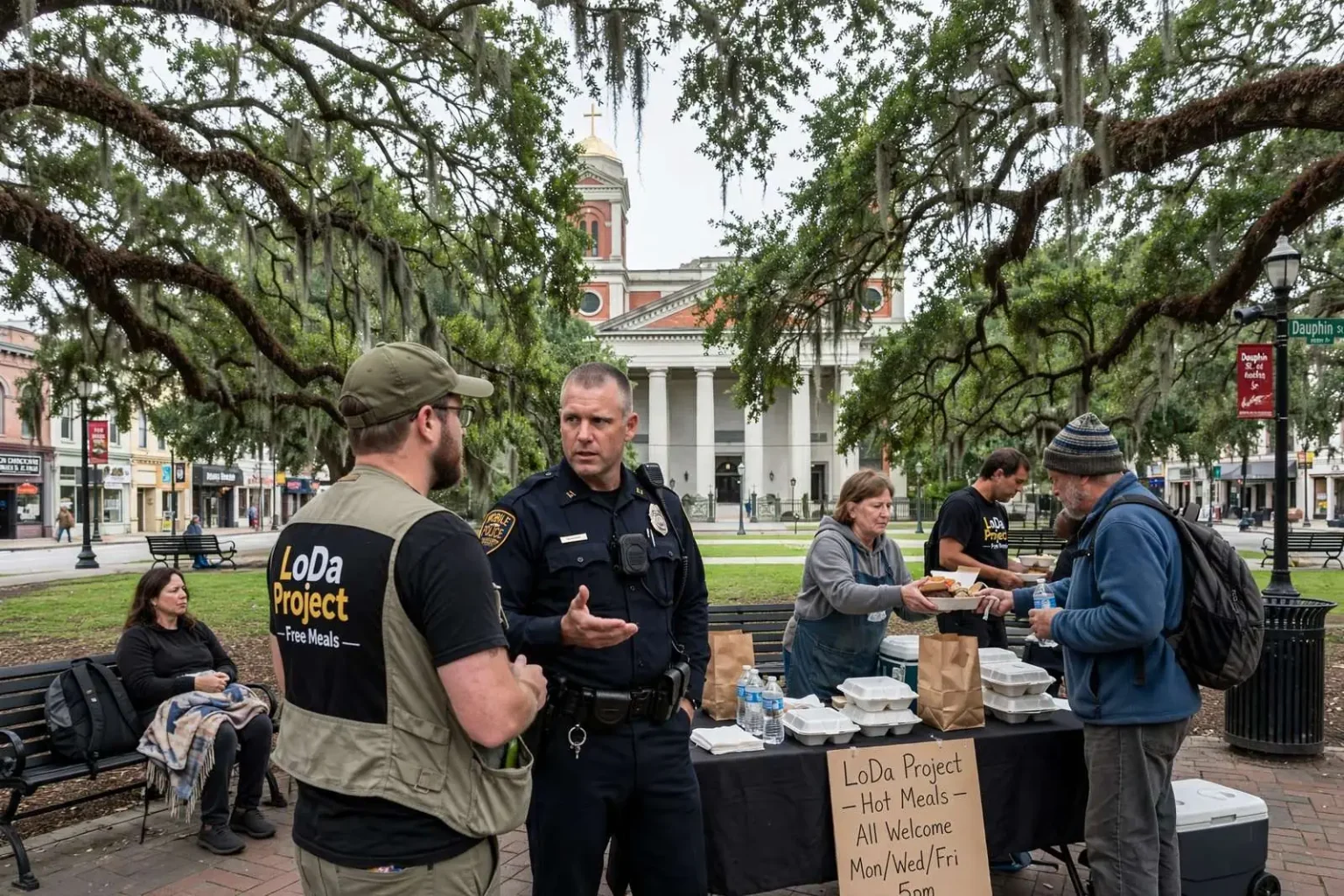
MOBILE, Ala. — WALA Fox-10 is reporting that Mobile police have asked the LoDa Project to stop serving free meals to homeless people in Cathedral Square, a pocket park in the heart of downtown Mobile’s entertainment district. The request spotlights a long-running tension between grassroots feeding efforts and downtown business interests, and it puts a familiar Gulf Coast dilemma squarely in view: what to do with people who have nowhere to eat when the alternative is a park bench in the middle of a revitalized commercial corridor.
Cathedral Square sits at the edge of the lower Dauphin entertainment district, the blocks of bars, restaurants and galleries that Mobile has spent years cultivating as its downtown nightlife anchor. Bounded by the Cathedral of the Immaculate Conception and shaded by live oaks, the square hosts art walks, festivals and public events, and it has become one of the most visible public spaces in the city. That visibility is precisely what makes informal feeding programs there so contentious: a meal served on a park bench is, in the eyes of business owners, a daily display of the problem at the front door of the district’s success.
The LoDa Project, named for the LoDa district it serves, is a grassroots effort organized around feeding people who would otherwise go without. Its volunteers bring food to the square on a regular schedule, and over time the meals have drawn a consistent crowd of unhoused residents, some of whom consider it the most reliable meal of their day. Programs like it operate in cities across the country, usually run by small nonprofits or church groups working with donated food and volunteer labor, filling gaps that institutional services do not always reach.
Praise for the Effort — and a Plea to Stop
Supporters of the LoDa Project, including the local news outlet that surfaced the story, praise organizer Mr. Hunt’s work feeding people who would otherwise go without. The concern they raise is not about the generosity itself but about the setting and the long-term effect on the people being served.
“We applaud Mr. Hunt’s efforts. However they are hurting downtown businesses and in the long run are not good for the homeless — who need to be connected with the shelters where they can receive not only food but shelter and guidance,” the outlet wrote, calling instead for a structured, countywide approach that routes people to shelters.
That argument mirrors the debate that has played out in city after city where outdoor feedings collide with downtown revitalization. Business owners report that crowds gathered for street meals can leave litter, intimidate patrons and concentrate the appearance of disorder in front of their storefronts, and some cities have responded with ordinances restricting public feedings outright. Advocates for the unhoused counter that shutting down street meals without expanding indoor capacity simply removes the one reliable service a person may have, and that the people being fed do not disappear — they relocate.
Mobile police’s request — a request, not a citation — falls in between. By asking the project to move rather than enforcing a ban, the department has left open the question of where the meals should go, and that question is the heart of the dispute. A feeding program that stops without an alternative leaves the same hungry people with fewer options; a program that relocates without coordination simply moves the tension to another block.
Advocates on both sides agree the answer lies in connecting people with shelters that can provide food, housing and case management rather than one-off street meals. A shelter meal comes with more than calories: intake, a case worker, a bed, a path toward services that a park bench cannot offer. The difficulty is that shelters have finite capacity, rules and hours, and some portion of the street population — because of mental illness, prior bans, personal preference or simply the arithmetic of beds available on a given night — is not inside those walls at mealtime. Street feedings persist precisely because they reach people the system is not reaching in that moment.
Mobile’s homeless services landscape reflects the region’s reliance on that patchwork. The city has leaned in recent years on nonprofit and faith-based groups to coordinate services: emergency shelters, day centers, meal programs and outreach teams operating with limited funding and heavy demand. Mobile and Baldwin counties together account for the bulk of the Gulf Coast’s homeless population in Alabama, and the Downtown Mobile Alliance — the organization behind much of the entertainment district’s growth — has been part of the conversation about how a thriving downtown and a visible street population coexist.
Officials in other Gulf Coast cities have tried various models. Some have created dedicated day centers where people can get meals, showers and services without occupying a public square. Others have partnered with churches to rotate meal service indoors, moving the food to where case workers are already stationed. Still others have invested in housing-first programs that aim to bypass the shelter stage altogether for the most vulnerable. Each approach requires money, coordination and political will — the ingredients that are hardest to assemble when the debate is happening block by block, in real time, in front of diners.
What Comes Next for the Square
For now, the police request leaves the LoDa Project’s organizers facing a choice: relocate their meals, coordinate with an indoor partner, or continue and risk enforcement. Each option carries a cost. Moving the program to an industrial edge of town may quiet the business complaint but also cut off the visibility that connects donors and volunteers to the work. Continuing as before invites a legal test that most grassroots groups cannot afford. Partnering with a shelter or church to serve the same population indoors would satisfy the letter of the request but changes the character of the effort and may leave some of the people it serves behind.
What the dispute has already accomplished is to put the question of countywide coordination back in front of the public. The call for a structured approach — one that routes people to shelters and services across Mobile County rather than concentrating them in a single park — is a call for exactly the kind of coalition that homeless services providers have long said is needed: government, nonprofits and the business community sharing both the cost and the responsibility. Cathedral Square is where the tension became visible; the solution, if it comes, will be built in meeting rooms rather than on the square.
The episode is also a test of downtown Mobile’s self-image. The entertainment district’s growth has been one of the city’s clearest civic success stories of the past decade — new bars and restaurants filling historic buildings, art walks drawing thousands, and a residential population slowly returning to the core. But the same growth raises the stakes of every visible social problem downtown. A city that markets itself as a destination has to decide how it treats the people sleeping in its parks, and that decision will be judged not only by visitors and businesses but by the congregations and volunteers who do the daily work of feeding people.
The disagreement reflects a challenge familiar to many Gulf Coast cities, from Pensacola to New Orleans: how to balance compassion for unhoused residents with the needs of a revitalizing downtown. The geography intensifies the problem. These are cities with compact, walkable cores, where the same few blocks hold the nightlife district, the historic churchyards, the transit stops and the public squares — and where an unhoused population drawn to services and foot traffic is always visible to the same crowds the city is trying to attract.
The Cathedral Square question is likely to keep drawing attention as downtown’s nightlife and residential population grow. More residents downtown means more neighbors with a stake in how the square is used at every hour of the day; more bars and restaurants means more owners with a direct financial interest in the streetscape. Neither the police department nor the LoDa Project can resolve that pressure alone, and neither can the downtown business community, which ultimately depends on the same public safety and social services infrastructure the city provides.
In the meantime, the people the dispute is about still need to eat. Whatever arrangement emerges — relocation, coordination with shelters, or a broader countywide plan — the measure of its success will be whether it connects more people to food, shelter and guidance, or simply moves hunger out of sight. The LoDa Project’s meals in Cathedral Square were, at minimum, an honest display of a need the city has not yet met, and the response to the police’s request will show whether Mobile’s answer is better services or merely a quieter square.


