Officer and Two Others Hospitalized After Mobile Police SUV Collides With Pickup on Spring Hill Avenue
A Mobile Police SUV and a pickup truck collided on Spring Hill Avenue near the I-65 interchange around 1 a.m. Sunday. The officer and two people in the pickup were hospitalized with what officials described as minor injuries.
MOBILE, Ala. — Mobile police are investigating a pre-dawn crash Sunday involving one of the department’s own vehicles and a pickup truck. The collision happened on Spring Hill Avenue near the Interstate 65 interchange at about 1 a.m.
Overnight crashes carry particular challenges for investigators. Darkness limits visibility for everyone involved, traffic cameras and business surveillance capture less usable footage than they would in daylight, and potential witnesses are scarce at that hour. Officers working the scene must reconstruct what happened from the physical evidence on the pavement, the damage patterns on the vehicles, and whatever statements can be gathered from the drivers and any late-night passersby. That process takes time, and it is the reason early reports from serious overnight collisions tend to be sparse while details accumulate over the following days.
Damage at the Scene
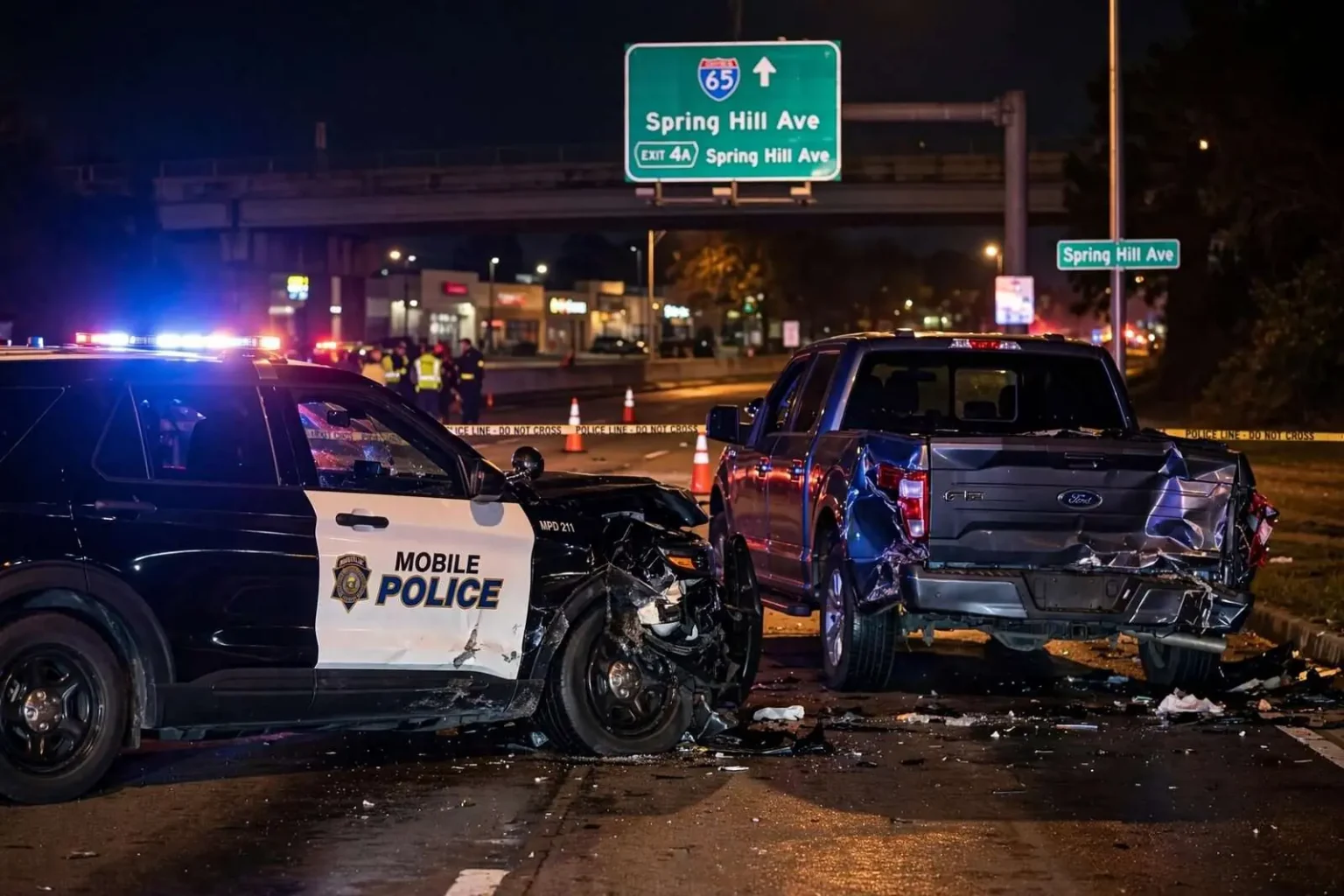
A Mobile Police SUV sustained significant damage to the front driver’s side. The pickup truck was damaged at the rear and tailgate — a damage pattern consistent with a front-to-rear impact, though investigators have not released a determination.
Damage patterns are one of the first things crash investigators read at a scene. Front-to-rear impacts are among the most common configurations on multi-lane corridors, and they raise immediate questions about speed, following distance, lane position, and whether either driver was impaired or distracted. Investigators have not said which direction either vehicle was traveling or how the two came together, and the location near the interstate interchange adds possible variables, since merging, ramp, and through traffic all converge in that stretch.
Injuries Reported
An official at the scene said the officer and two people in the pickup truck were taken to a hospital to be evaluated for minor injuries. All three were reported as having injuries described as minor, and no fatalities were involved.
Standard procedure following a crash involving a police vehicle includes medical evaluation for everyone involved, and the transport of all three people to a hospital indicates that responders followed the usual precaution of having injuries checked thoroughly even when they appear minor at the scene. Occupants of a crash like this are typically evaluated for whiplash, airbag-related injuries, and other conditions whose full effects are not immediately obvious.
Crashes involving law enforcement vehicles are also handled with an added layer of scrutiny. Because a department vehicle is involved, the investigation typically documents the circumstances with particular care — the officer’s assignment at the time, the vehicle’s speed and lighting, and the standard questions that apply in any two-vehicle collision. The findings are then reviewed through the department’s normal channels before any conclusions are drawn. That added documentation is routine, not a signal of fault, and it exists to protect everyone involved.
What Is Not Yet Known
Police did not have information about how the crash occurred, including which vehicle was traveling in which direction, whether the cruiser was responding to a call at the time, or whether emergency lights were in use.
Those unanswered questions matter for both the official investigation and the public’s understanding of the incident. Whether a patrol vehicle is on routine patrol, responding to a call with lights and siren, or simply traveling between assignments changes the legal and practical framework of the analysis, and investigators generally decline to speculate until the evidence supports a clear picture. In many overnight crashes, toxicology results, vehicle data, and completed reconstruction work fill in the missing details in the days that follow.
Residents who may have witnessed the collision or its aftermath are typically encouraged to come forward, since even brief observations — a vehicle’s speed, a light color, a sound — can help investigators resolve the questions that physical evidence alone cannot. Late-night collisions on arterial roads sometimes have witnesses among rideshare drivers, delivery workers, and shift-change commuters who do not immediately realize what they saw mattered.
The Spring Hill Avenue Corridor
The Spring Hill Avenue corridor near the I-65 interchange carries a mix of highway ramp traffic and surface street traffic, and the intersection sees consistent volume even at overnight hours. Spring Hill Avenue is one of Mobile’s older and busier east-west arteries, running from the Spring Hill neighborhood in the west through some of the city’s most heavily traveled commercial and residential stretches toward the central city, and its crossing of Interstate 65 makes it a natural funnel for drivers entering and leaving the highway at all hours.
Interchanges like the one at I-65 concentrate conflict points: vehicles accelerating down ramps, others decelerating toward them, signalized intersections cycling between the highway traffic and the surface street traffic, and drivers making turns across lanes. Overnight, that mix is thinner but not absent — late-shift workers, travelers, and delivery traffic keep the volume steady — and the combination of reduced visibility and higher prevailing speeds after dark makes the corridor a recurring focus of the city’s crash history.
What Happens Next in the Investigation
The investigation now moves through the standard sequence that follows any injury collision in the city. Officers complete the crash report, documenting the scene measurements, vehicle damage, and witness statements gathered on the night. If a formal reconstruction is warranted, specialists map the scene and analyze the physical evidence to establish speeds and points of impact. Any citations or findings come only at the end of that process, and the department’s internal review of the involvement of its own vehicle runs in parallel.
A request for comment has been submitted to the Mobile Police Department, and this story will be updated when the department releases additional details. Departments typically release more complete information once the initial investigation allows them to describe how the crash occurred and whether any enforcement action results.
In the meantime, the incident serves as a reminder of the conditions that shape overnight driving across Mobile. Arterial roads like Spring Hill Avenue carry steady traffic around the clock, the darkness after 1 a.m. shortens every driver’s reaction window, and the areas near interstate interchanges demand extra attention as ramp traffic merges with surface street flow. Safety officials’ standing advice applies plainly: reduce speed in unfamiliar stretches, keep headlights in good working order, avoid distractions, and never drive impaired.
Overnight Crashes and the Broader Picture
Collisions in the small hours of the morning make up a meaningful share of the serious crashes recorded on Alabama roads each year. Overnight driving combines several risk factors at once — fatigue, higher speeds on emptier roads, a greater likelihood of impaired drivers leaving late-night establishments, and slower emergency detection when few witnesses are around. State and local traffic safety campaigns have long targeted those factors, and the state’s weekday and weekend fatality statistics consistently show elevated risk during nighttime hours.
For first responders, the pre-dawn hours also mean working scenes in reduced light, redirecting what little traffic there is, and managing the logistics of clearing damaged vehicles from a corridor that must return to service by morning. A crash at an interstate interchange compounds that work, since shutting down part of the surface street network there pushes traffic onto surrounding neighborhood streets in the middle of the night.
Further updates on the condition of those injured, the results of the investigation, and any determination about how the collision occurred will be reported as the Mobile Police Department releases them. In the days ahead, drivers passing through the Spring Hill Avenue corridor near I-65 will find little visible trace of Sunday’s collision — but for the officer and the two occupants of the pickup, the minor injuries reported at the scene represent a fortunate outcome in a crash type that too often ends far worse.
How Police Involved Crashes Are Typically Handled
When a patrol vehicle is part of a collision, the responding agency usually separates roles carefully. Officers who investigate the crash are, where practical, different from those involved or from the involved officer’s immediate chain of supervision, and the scene documentation is held to the same or a higher standard than an ordinary collision. The vehicle’s data, dispatch records showing its assignment, and any dashboard or body camera footage from the period become part of the file alongside the usual photographs and measurements.
That process exists to produce a defensible record either way. If the officer was responding to an emergency with lights and siren, state law and department policy attach specific requirements about speed and caution; if the vehicle was on routine travel, the ordinary traffic rules apply without modification. Determining which was the case is a matter of records and evidence rather than assumption, which is why departments generally say little in the first hours.
Spring Hill Avenue: One of Mobile’s Busiest Arteries
The stretch of Spring Hill Avenue where the crash occurred sits at one of the city’s busiest crossroads. Spring Hill Avenue threads through neighborhoods whose histories reach back more than a century, and its intersection with Interstate 65 connects the Spring Hill, Toulminville, and surrounding communities to the interstate that loops around the city’s core. Drivers use the corridor to reach hospitals, schools, and shopping areas on both sides of the highway, and the road’s mix of residential frontage and commercial nodes means pedestrians and turning traffic add to the demands on drivers’ attention.
City and state transportation officials have long tracked crash patterns along corridors like this one, using the data to guide signal timing, signage, and enforcement deployments. Interchange areas receive particular scrutiny because their crash rates tend to run above the road network’s average, driven by the merging and turning movements concentrated there. Overnight, enforcement shifts to focus on impaired driving, and the reduced traffic volume can tempt higher speeds even as darkness degrades the conditions.
For the residents who live along Spring Hill Avenue and the drivers who cross the I-65 interchange daily, Sunday’s crash is a familiar scenario played out in an unfamiliar way — with a police vehicle among the damaged. The department’s findings, when released, will determine the next steps, and the corridor’s daily rhythm continues in the meantime.