Man Killed in Labor Day Night Shooting on Calgary Drive in West Mobile
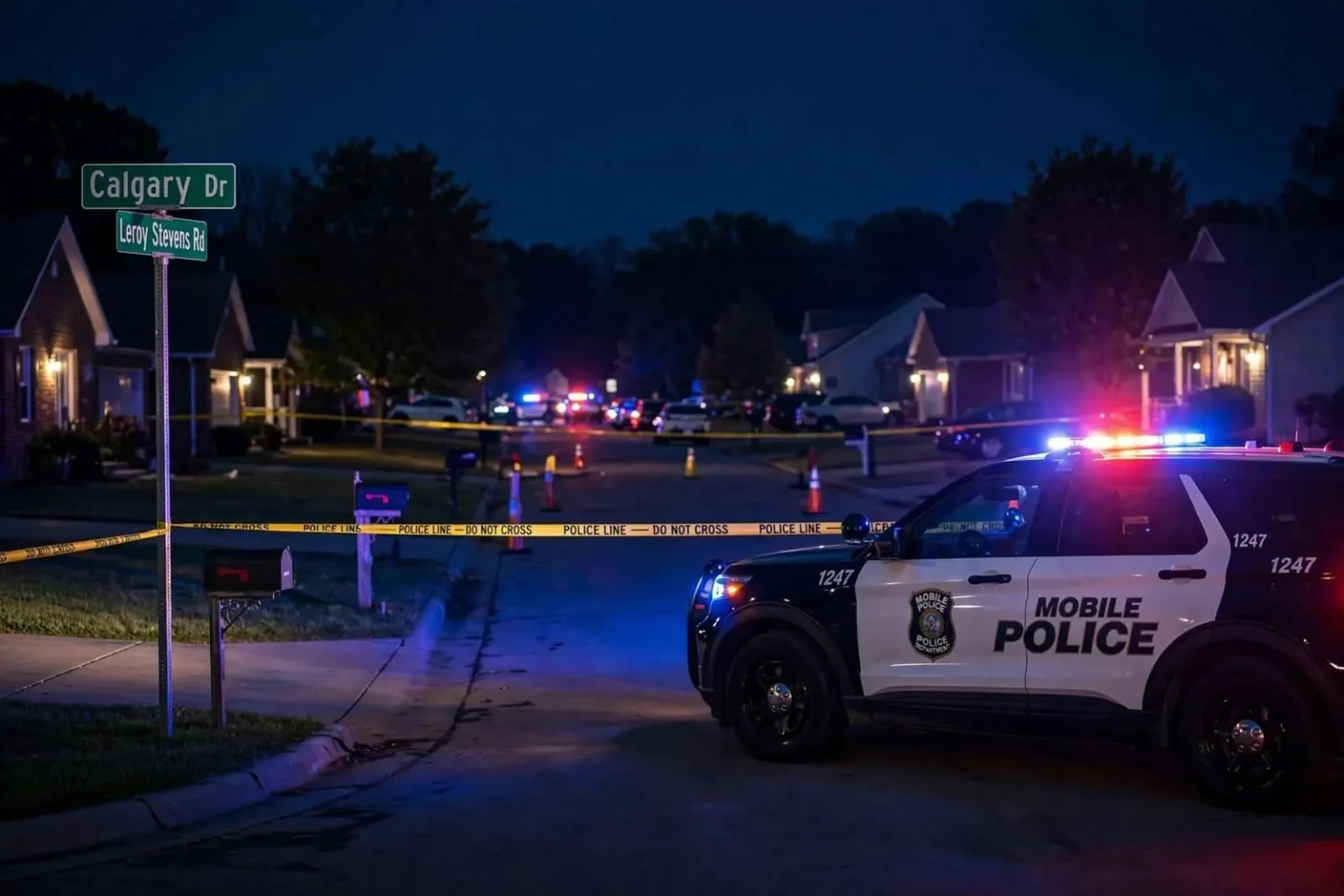
Mobile Police were called to Calgary Drive off Leroy Stevens Road about 9:30 p.m. Monday after neighbors reported multiple gunshots. A man died of his wounds. No suspect has been named and the investigation is ongoing.
MOBILE, Ala. — A man was shot and killed in a west Mobile neighborhood on Labor Day night, and police have not said whether they are looking for anyone in connection with it.
The Mobile Police Department said officers were called to Calgary Drive, off Leroy Stevens Road, at around 9:30 p.m. Monday. Neighbors had reported hearing multiple gunshots. Police confirmed that a man died from his gunshot wounds.
Investigators have not named a suspect, and the department did not say it was searching for one. The investigation is ongoing.
What Police Have Released
The department’s account is short, and at this stage that is not unusual. What has been confirmed:
- The call came in at approximately 9:30 p.m. Monday, Sept. 7.
- The location was a residential street, Calgary Drive, off Leroy Stevens Road.
- Multiple gunshots were reported by neighbors.
- One adult man died of gunshot wounds.
- No suspect has been identified publicly, and police have not stated that a suspect is being sought.
The victim’s name has not been released. In Alabama, as in most states, a law enforcement agency generally holds a homicide victim’s identity until the next of kin has been notified, a process that can take anywhere from hours to several days depending on how quickly family can be located.
The Neighborhood
Leroy Stevens Road runs through the western side of Mobile, in an area that has changed considerably over the past two decades. What was once the outer edge of the city has filled in with subdivisions, apartment complexes, schools and retail as development pushed west along Airport Boulevard, Cottage Hill Road and Grelot Road. Calgary Drive sits in that band of residential streets.
It is the kind of area where a shooting registers immediately with neighbors — not a commercial strip or a highway shoulder, but a street where people were home on a holiday evening. The initial reports to police came from residents who heard the shots.
What Happens Next in an Investigation Like This
A death investigation of this type follows a fairly standard sequence, most of which takes place out of public view.
The scene. Patrol officers secure a perimeter. Crime scene technicians photograph and map the area, recover shell casings and any projectiles, and collect biological and trace evidence. Shell casings are important beyond the obvious: they carry tool marks left by the firearm that chambered and ejected them, which can be entered into the National Integrated Ballistic Information Network and compared against casings recovered from other scenes, sometimes linking incidents across jurisdictions and years.
The canvass. Detectives go door to door. In a residential neighborhood in 2026 that increasingly means asking about doorbell cameras and security systems as much as asking what people saw or heard. Video from a house two streets over can establish a vehicle’s direction of travel or a timeline that no witness could.
The autopsy. The Alabama Department of Forensic Sciences conducts the postmortem examination, establishing cause and manner of death, recovering any projectiles that remain in the body, and documenting wound characteristics such as range of fire.
The records. Cell site data, call records, social media activity and license plate reader hits are all standard investigative avenues, most of which require court authorization.
None of that is fast, and departments routinely decline to characterize a motive or a suspect until enough of it is complete that a public statement will not compromise the case or wrongly implicate someone.
Why the Silence on a Suspect Matters
The department’s statement is notable for what it does not include. Police did not name a suspect, and they did not say they were looking for one. Those are two different things, and neither should be over-read.
An agency that believes an armed suspect is at large in a neighborhood generally says so, because public safety requires it. An agency that has already identified or detained someone often says that as well. The absence of both statements most commonly means the investigation is early — that detectives are still establishing the basic facts of what happened before characterizing who was involved.
The Broader Picture in Mobile
This newsroom has covered a steady run of shooting investigations in Mobile and Mobile County in recent weeks, including a man shot twice at a Whistler-area apartment complex, gunfire that struck two occupied mobile homes on Zeigler Boulevard, and multiple homicide cases moving through the courts. Each is its own set of circumstances, and it would be wrong to string them together into a trend on the strength of proximity alone.
What is fair to say is that gun violence in Mobile is most often interpersonal rather than random. In the large majority of shootings that departments eventually solve, the people involved knew one another or had some prior connection. That pattern is why investigators spend so much of their time on relationships and communications rather than on the physical scene alone, and it is also why homicide clearance depends heavily on whether people who know something are willing to say so.
How to Help
Anyone with information about the shooting on Calgary Drive is asked to contact the Mobile Police Department. Tips can also be submitted anonymously through Mobile County Crime Stoppers, which does not require a caller to give a name and which can pay cash rewards for information that leads to an arrest.
Residents in the area who have doorbell or security camera systems are encouraged to check footage from roughly 9 to 10 p.m. Monday, even if nothing appears unusual on it. Vehicle movement, timestamps and audio of the shots themselves can each be useful to investigators building a timeline.
This story will be updated as the Mobile Police Department releases additional information, including the victim’s identity once next of kin have been notified.
What the Neighborhood Can Expect in the Coming Days
Residents of Calgary Drive and the surrounding streets should anticipate a visible investigative presence for some time after the initial response. That typically includes detectives returning to the block during the same hours the shooting occurred, on the theory that the people present at 9:30 p.m. on a Monday are likely to be present at 9:30 p.m. on a Wednesday. It may include a second canvass, since people who were unavailable or unwilling on the first pass sometimes reconsider.
It is common for a department to say very little publicly during this period. That silence is frequently misread as inactivity. In practice, the interval between an initial statement and a charging announcement is when most of the work happens.
Homicide Clearance and Why Cooperation Matters
Nationally, the share of homicides that end in an arrest has declined over the past several decades. The reasons are debated, but investigators and researchers tend to converge on one factor above the others: witness cooperation.
Physical evidence establishes what happened. It is considerably less effective at establishing who. A shell casing can tell an examiner which firearm ejected it; it cannot tell them who was holding the firearm. Video can capture a vehicle; it frequently cannot capture a face. In the large majority of solved shootings, the identification comes from a person.
That creates a well-documented problem in communities where cooperation carries real or perceived risk. People who were present decline to speak. Cases go unsolved. Unsolved cases erode confidence that speaking would have mattered, which reduces cooperation further. It is a loop that is far easier to describe than to break.
Anonymous tip programs exist specifically to interrupt it. Mobile County Crime Stoppers assigns a numeric identifier rather than recording a name, and rewards are paid on that identifier. It is not a perfect solution — anonymous information cannot be used in court without a witness willing to testify — but it frequently gives investigators the direction they need to build a case through other means.
Safety Guidance for Residents
With no suspect information released, there is no basis for telling residents that a specific threat does or does not remain in the area. The general guidance from law enforcement in the days after a neighborhood shooting is unremarkable but worth repeating:
- Preserve, don’t review and delete. If you have camera footage from Monday evening, download and save it before your system overwrites it. Many consumer systems retain only a few days.
- Report what seems minor. Investigators, not witnesses, decide what is relevant. A vehicle description or a timestamp that seems useless in isolation may complete a sequence.
- Do not conduct your own investigation. Approaching people you suspect, or posting speculation and names on social media, interferes with the case and creates genuine risk of harm to people who had nothing to do with it.
- Talk to children about it. Children in a neighborhood where this happens generally already know. Age-appropriate conversation is better than silence.
Support for Families
Families of homicide victims in Mobile County can access victim services through the Mobile County District Attorney’s Office, which maintains staff to guide families through the investigative and court process. The Alabama Crime Victims Compensation Commission administers a fund that can help with funeral expenses, counseling and certain other costs for eligible victims of violent crime.
Grief and trauma support is available through hospital-affiliated programs, community mental health providers and congregations across Mobile. Families frequently do not learn these resources exist until well after they would have been most useful.
Update: Police Say Homeowner Shot an Intruder; Victim Identified
Mobile police released a fuller account of the Calgary Drive shooting, and it changes the shape of the story considerably. According to the Mobile Police Department, the man who died was shot by the homeowner after breaking a window and entering the house without permission.
The department identified the man who was killed as David Lee Jr., 37.
Officers were called to the 8300 block of Calgary Drive at about 9:19 p.m. Monday, Sept. 7, in reference to a shooting. “Upon arrival, officers discovered a male subject deceased with a fatal gunshot wound inside of the home,” the department said in its release. Investigators subsequently determined that “a male homeowner shot the subject after he broke a window and unlawfully entered the home.”
Police have not identified the homeowner. No charges have been filed, and the case has been turned over to the Mobile County District Attorney’s Office for review.
Why the Case Goes to the District Attorney
A referral to the district attorney is the ordinary next step when a killing may have been legally justified. Police investigate and document; the decision about whether to charge belongs to prosecutors, who may present the matter to a grand jury or decline to pursue it.
That review will center on Alabama’s self-defense statute. Under Alabama law, a person is generally not required to retreat before using physical force — including deadly physical force — against someone who unlawfully and forcefully enters a dwelling the person occupies. The statute creates a presumption favoring the resident in exactly the circumstances police have described: a broken window, an unlawful entry, an occupied home.
That presumption is not automatic immunity. Prosecutors still examine whether the entry was in fact unlawful and forcible, whether the person using force was lawfully present, and whether anything in the encounter falls outside the statute’s protection. The review can take days or weeks.
What Has Not Been Said
Police have not described any relationship between Lee and the residents of the home, have not said whether anyone else was inside at the time, and have not released the number of shots fired. Officers were also staged in a business parking lot one street over on the night of the shooting; the department has not explained why.
A biohazard cleanup crew was at the house the following day.
This section will be updated if the district attorney’s office announces a charging decision.