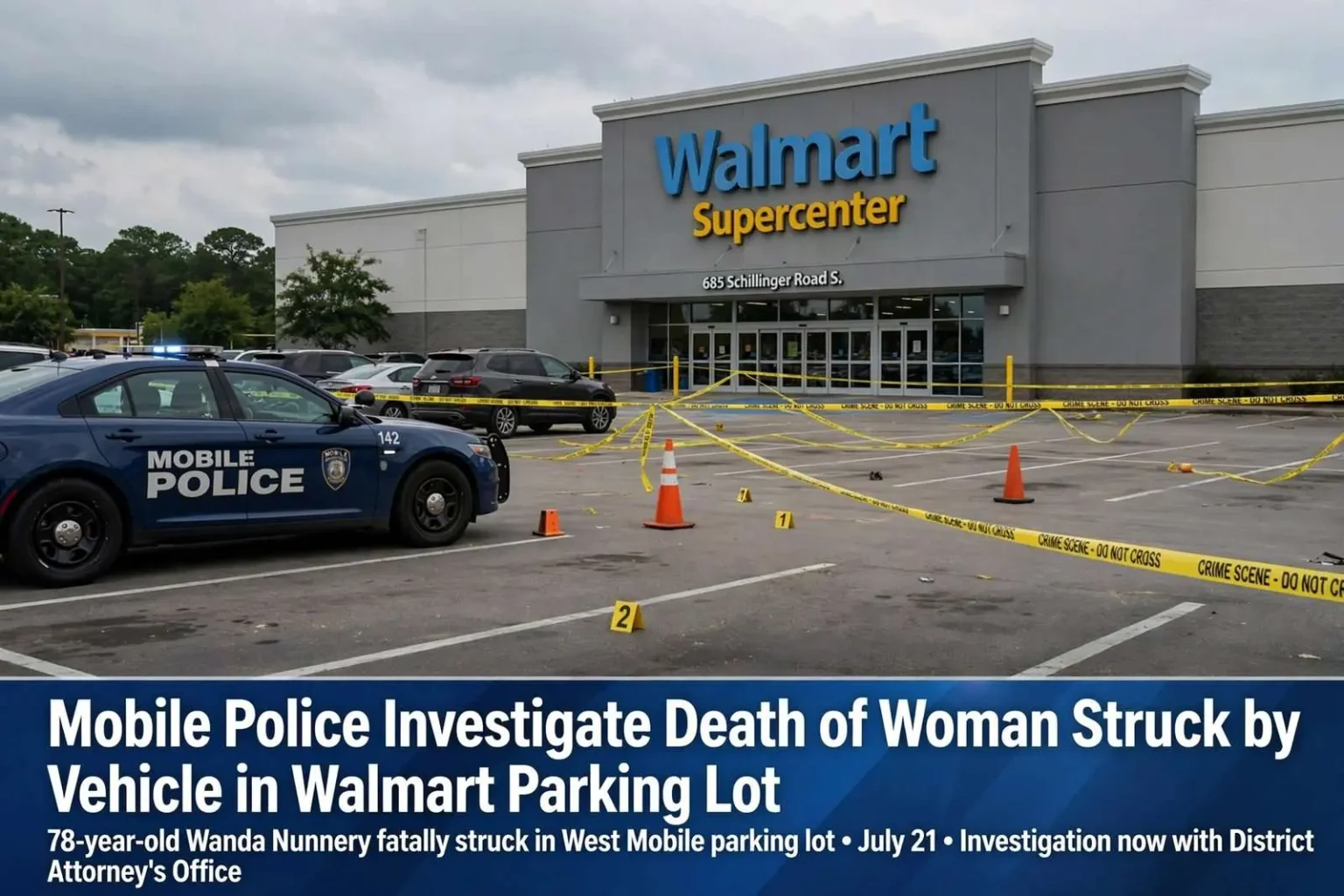
Mobile police are investigating after a woman was fatally struck by a vehicle in the parking lot of a Walmart Supercenter on the city’s west side. The Mobile Police Department says the woman was leaving the store at 685 Schillinger Road S. on Tuesday, July 21, when she was struck by a vehicle in the parking lot. The impact also struck four other vehicles that were parked nearby, scattering the sequence of events across a stretch of one of the busiest retail parking areas in west Mobile.
Officers responded to the scene at approximately 1:23 p.m. and found the woman with severe, life-threatening injuries. She was transported to a local hospital, where she later died. Police have identified the victim as 78-year-old Wanda Nunnery. What began as an injury call became a death investigation within hours, and the department’s account of the incident, released as the inquiry proceeded, has been careful to distinguish what is known from what remains under review.
The driver of the vehicle was taken to Mobile Police Department headquarters for questioning, and the case has since been turned over to the Mobile County District Attorney’s Office for further review. Investigators say no additional details will be released at this time. That handoff is a standard step in cases where a death results from a vehicle collision in a non-roadway setting, and it means the next decisions in the matter — whether any charges are appropriate and what, if anything, is filed — rest with the prosecutor’s office rather than with the investigators who documented the scene.
Where It Happened: Schillinger Road S.
The Walmart Supercenter at 685 Schillinger Road S. sits in one of west Mobile’s principal commercial corridors, an area that has grown into a dense concentration of retail, restaurants and services serving the neighborhoods west of Cody Road and out toward the Mobile County line. Schillinger Road itself carries heavy daily traffic, and the shopping centers along it generate the kind of constant vehicle movement — entering, exiting, circling for spaces, backing out — that makes parking lots among the most collision-prone environments in any commercial district.
Parking lots are, statistically, where a significant share of pedestrian collisions occur. Drivers navigate at low speeds but with divided attention, and pedestrians — often older adults, often carrying bags — move through lanes that were never designed as walkways. Sightlines between vehicles and pedestrians are frequently blocked by parked cars, and the layout of a supercenter parking lot, with its long rows and continuous cross-traffic, asks both drivers and walkers to share space that offers no formal separation. Nationwide safety research has repeatedly identified parking areas as a persistent hazard zone, particularly for older pedestrians.
The Investigation Process
When a pedestrian dies after being struck by a vehicle, the police response follows a structured sequence. Officers secure the scene and document it — vehicle positions, skid evidence where present, camera angles from the store’s exterior systems — before the parking lot returns to normal use. The driver is interviewed, and in a case like this one, that interview took place at police headquarters. Investigators also work to establish the basics: the vehicle’s speed and path, the victim’s movements, and any mechanical or medical factors that might have contributed.
The referral to the Mobile County District Attorney’s Office is the mechanism by which those findings become a charging decision. Prosecutors review the investigative file and determine whether the evidence supports criminal charges, whether the matter should be presented to a grand jury, or whether no charge is warranted. That review can take time, and the police department’s statement that no additional details will be released reflects the posture investigators must maintain while a potential prosecutorial decision is pending — public statements about fault, made before the file is complete, can complicate the process that follows.
For the victim’s family, the sequence — a routine shopping trip, a parking lot, a hospital, and then identification — is the hardest kind of loss to process, and it is the kind of incident that rarely produces public resolution quickly. Cases turned over for prosecutorial review can conclude without charges, resolve through the court system over months, or end with findings that are never announced with the prominence of the original news. The family is left to follow a process that moves at the speed of paperwork, not grief.
Pedestrian Safety in Commercial Parking Areas
Incidents like this one renew a conversation that safety advocates have been having for years about how commercial properties are designed. Parking lots occupy a regulatory gap: they are private property, so they fall outside much of the roadway engineering that governs streets, yet they function as public thoroughfares for thousands of trips a day. Marked pedestrian crossings inside parking lots are inconsistent from one shopping center to another, speed control relies on signage and driver judgment rather than enforcement, and lighting — a major factor in evening collisions — varies widely by property.
Older adults face elevated risk in these environments for reasons that are well documented in traffic safety research. Changes in mobility and reaction time make it harder to recover from an unexpected vehicle movement, and a collision that a younger pedestrian might survive can be fatal. A 78-year-old shopper walking to or from a store entrance is exactly the pedestrian for whom the margins in a busy parking lot are thinnest.
For shoppers, the practical guidance safety organizations offer is unglamorous but consistent: use marked walkways where they exist, walk against the flow of traffic so oncoming vehicles are visible, avoid walking between rows of backing vehicles, and be conspicuous to drivers rather than assuming you have been seen. For drivers, the same guidance runs in reverse — slow down in lots, assume pedestrians will appear from between parked cars, and treat the parking lot as the mixed-use space it actually is rather than as a road with obstacles.
How to Contact Mobile Police
Anyone with information that could assist in the investigation is asked to contact the Mobile Police Department at 251-208-7211. Tips can also be submitted anonymously by texting 844-251-0644 or by visiting mobilepd.org/crimetip. Anonymous submission channels exist precisely for cases like this one, where witnesses may have seen a piece of the sequence — a vehicle’s movement through the lot, a moment before the collision — and may hesitate to come forward publicly. Even fragments of information can help investigators reconstruct a timeline.
Witness accounts matter most in the early days of an investigation, before memories blur and before any prosecutorial review narrows what becomes public. The department’s request for information remains open, and the tip lines operate continuously, allowing residents who were in the Schillinger Road S. parking area that Tuesday afternoon to contribute what they saw without identifying themselves.
The death of Wanda Nunnery is now in the hands of the process that follows such losses — investigators’ findings, a prosecutor’s review, and eventually whatever clarity the system provides to a family that lost a 78-year-old mother, grandmother or friend on an ordinary Tuesday afternoon in a parking lot she had probably walked across many times before.
The Mobile Police Department’s Role
The Mobile Police Department is the primary law enforcement agency for Alabama’s fourth-largest city, patrolling precincts that range from the downtown core to the sprawling west side where the Schillinger Road corridor sits. Its investigators handle hundreds of traffic-related incidents each year, and the department has long maintained public tip channels — the 251-208-7211 line, the text number and the crimetip web portal — as a way of widening the flow of information beyond what officers can gather at a scene. In cases involving fatalities, the department’s practice is to release confirmed facts in measured stages: initial circumstances, victim identification, and then the referral to prosecutors, with the details in between held until the review is complete.
That staging can frustrate the public’s appetite for answers, but it reflects the dual character of a case like this one. The collision itself was documented within minutes; the meaning of what happened — whether it was a terrible accident, a case of negligence, or something else entirely — can only be established through the slower work of interviews, evidence analysis and prosecutorial judgment. The department’s terse public updates, including its statement that no additional details will be released at this time, are the public face of a process that is deliberately withheld from real-time narration.
What Comes Next
The practical next steps in the case sit with the Mobile County District Attorney’s Office, which will evaluate the police file and decide how — or whether — the matter proceeds. The timeline for such reviews is not fixed. Simple cases can be resolved quickly; cases that require reconstruction analysis, additional witness interviews or consultation with experts take longer. None of the outcomes is announced in advance, and the family of the victim typically learns of decisions at the same time or before the public does.
Meanwhile, the four other vehicles struck in the lot have their own place in the file. Property damage claims, insurance inquiries and repair decisions proceed on a separate track from the criminal review, handled through insurers rather than the courts. For the people who came out of the store that afternoon to find their parked cars damaged, the incident was a financial inconvenience; for the Nunnery family, it was a loss. The discrepancy in scale is part of what makes parking-lot fatalities so jarring — an ordinary Tuesday errand produced, in seconds, outcomes that will occupy a family and an investigation for months.
Anyone who was in the Walmart Supercenter parking lot at 685 Schillinger Road S. on Tuesday, July 21, and who saw anything relevant — a vehicle’s speed or path, a pedestrian’s movements, a moment before or after the collision — can still contribute to the record. The Mobile Police Department’s tip channels remain open at 251-208-7211, by text at 844-251-0644, and online at mobilepd.org/crimetip, with anonymous submission available to anyone who prefers it.
The investigation continues, and with it the ordinary machinery by which Mobile attempts to answer the questions a family is left with: what happened in those seconds in the parking lot, and what the law will make of it. Until that review concludes, the confirmed record remains as the police department stated it — a 78-year-old woman leaving a west Mobile store, a vehicle, four other cars struck, and an afternoon that ended at a hospital.