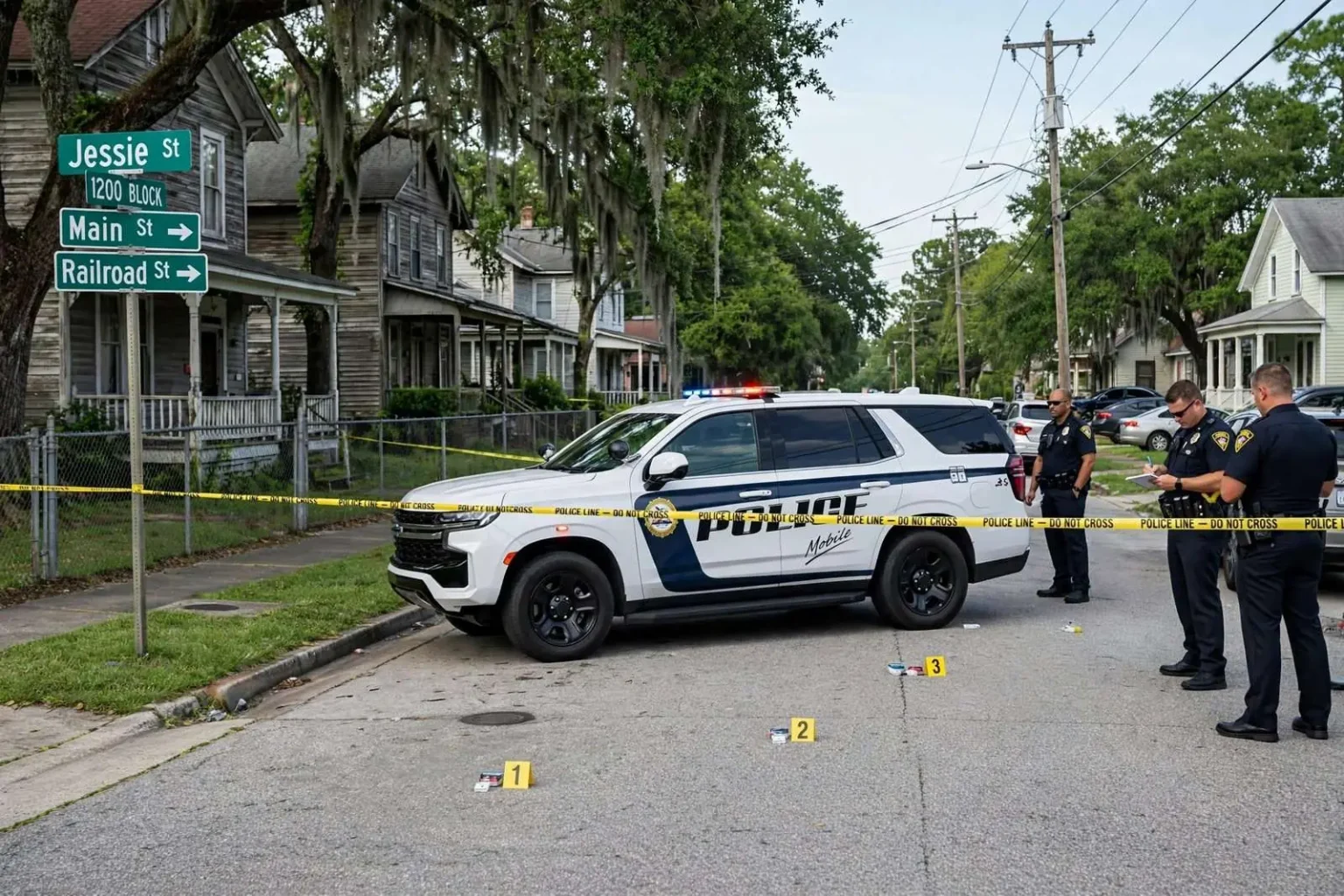
Mobile police are investigating a shooting that left a man with non-life-threatening injuries on a Tuesday afternoon in July. According to a Mobile Police Department spokesperson, officers were called to the 1200 block of Jessie Street, near the intersection of Main Street and Railroad Street, around 3:07 p.m. on July 21 after reports of gunfire in the area. The call brought patrol officers into a residential block in the middle of the afternoon, when many neighbors were home and outdoors.
When officers arrived, they found a man suffering from multiple gunshot wounds described as minor. He was transported to a nearby hospital for treatment, and police said his injuries were not expected to threaten his life. The location — a stretch of Jessie Street just off the Main Street and Railroad Street junction — sits in one of Mobile’s older residential areas, where streets laid out in a grid more than a century ago now carry steady neighborhood traffic between the commercial corridors nearby.
The response on Jessie Street
The first officers on a shooting scene have a checklist that runs faster than most people realize: secure the area, render aid or confirm medical help is coming, look for the shooter, and hold every person and vehicle present until investigators sort out who witnessed what. A 3:07 p.m. call means schools were still in summer session schedules and many residents were home; officers on the scene typically move quickly to separate bystanders from the immediate area where evidence may lie on the ground.
Mobile Police Department procedure in such cases is well rehearsed. Patrol units establish a perimeter, medics treat and transport the victim, and patrol supervisors notify the department’s investigators. Detectives from the shooting unit respond to both the scene and the hospital, because a wounded man’s first account — given while memories are freshest and, often, while medications have not yet clouded them — is among the most important evidence a case will have.
What the evidence team looks for
A daytime shooting in a residential block generates evidence of a particular kind. Shell casings mark where a shooter stood and can indicate how many shots were fired and from what kind of weapon. Bullet strikes on houses, fences, vehicles, and trees map the trajectory of the gunfire, and investigators document each one. In neighborhoods of closely spaced homes, nearly every shooting leaves marks on nearby property, and detectives spend hours walking the block, photographing and measuring before the scene is released.
Doorbell cameras and home security systems, now common across Mobile’s residential streets, have changed the first hours of investigations like this one. Detectives canvass door to door asking for video as well as accounts, and a single camera catching a vehicle or a figure in motion can break a case that witnesses did not see. The department’s public appeals for video in recent years reflect how central that evidence has become to clearing shootings in city neighborhoods.
The neighborhood context
Jessie Street’s location near Main Street and Railroad Street places it in a part of Mobile where residential blocks sit close to active roads and rail lines. The area, like much of the city, has seen the department’s ongoing efforts to reduce gun violence through a combination of enforcement, intervention programs, and community partnerships. Group violence intervention models, increased patrols in hot-spot areas, and cooperation with federal partners on gun cases are all parts of the toolkit the department has described in public discussions of its strategy.
Residents of blocks where gunfire erupts in the afternoon often describe the same mix of fear and frustration, along with a willingness to help police when they feel the relationship is genuine. Community organizations and churches in Mobile’s neighborhoods have long played a role in that bridge — hosting meetings with precinct commanders, organizing peace walks, and pressing for the street-level investments that research consistently links to lower violence: lighting, blight removal, and youth programming.
As of the initial reports, police had not said whether a suspect had been identified or taken into custody, and the investigation remained active. That status leaves open the basic questions a neighborhood asks after gunfire: who fired, at whom, and why. Investigators will pursue those questions through the victim’s account, witness interviews, and the physical and video evidence collected at the scene, and any arrest will be announced through the department’s usual channels once charges are approved.
Reading a police update carefully
The information released in the first hours of a shooting investigation is deliberately limited, and readers benefit from understanding why. Descriptions of suspects that are still being confirmed can mislead; details about the victim’s background can complicate the investigation or endanger witnesses; and theories about motive, before evidence supports them, can shape testimony. A spokesperson’s careful phrasing — injuries not life-threatening, investigation active — is not evasion but the standard vocabulary of an open case.
What those early details do establish is meaningful. A man was shot multiple times in daylight on a residential street. His wounds were described as minor, which means doctors expected a recovery. Officers responded within minutes of the 3:07 p.m. call. Those facts, modest as they sound, are the foundation on which the rest of the investigation is built, and they were confirmed by the department before any other account of the incident circulated.
Gun violence response in Mobile
Shooting investigations like this one are part of the recurring workload of a mid-sized Southern city’s police department. Mobile’s gun violence numbers have moved up and down with national trends over the past decade, and the department has publicized its responses: focused deterrence conversations with identified offenders, partnerships with federal prosecutors on cases involving stolen guns or prior felons, and funding for violence interruption work in the neighborhoods most affected. Each afternoon shooting sets that machinery in motion again — the scene work, the canvass, the follow-up interviews — regardless of how minor the wounds are classified.
The classification of wounds matters to more than headlines. Minor wounds still mean surgery sometimes, infection risk, medical bills, and time away from work, and victims’ advocates note that the word minor understates what the person shot will actually experience. It also matters to prosecutors, because the severity of injury is one of the factors that determines charges: a wounding with minor injuries supports assault charges of a different degree than a shooting that kills or gravely injures, though firing a gun at a person is itself a serious felony in Alabama regardless of where the bullets land.
What neighbors can do
Police departments consistently ask the same things of residents after a shooting in their block: report what you saw or heard, preserve any video before it is overwritten, and call in information anonymously if fear of retaliation is a concern. Mobile Area CrimeStoppers accepts anonymous tips and pays rewards for information that leads to felony arrests, a channel that exists precisely because the people closest to a shooting are often the most exposed.
The department also reminds residents that shell casings, damaged property, and doorbell footage should be left in place for investigators rather than cleaned up before officers have been through. A neighborhood that preserves its scene gives detectives the best chance of answering the question everyone on Jessie Street was asking after the afternoon of July 21: who did this, and will they be held accountable. The investigation remained active, and the department’s standing promise in such cases held — that updates would come as the work produced them.
The timing of the shooting — mid-afternoon rather than the late-night hours when many shootings occur — shapes both the response and the evidence. Daylight incidents tend to produce more witnesses, simply because more people are awake and outside, but they also unfold on streets where children play and neighbors sit on porches, which heightens the community’s alarm. Afternoon shootings on residential blocks often draw a crowd before officers arrive, and one of the first tasks for responding units is moving onlookers back from casings and other evidence while the scene is still intact.
Investigators will also consider the possibility of connection between the shooter and the victim, which is the pattern in most non-fatal shootings. Random gunfire that wounds an unintended person does occur, but detectives approach every case without assuming either scenario, letting the interviews and evidence sort the question out. The victim’s account once he is medically able to give one will be central, and investigators typically re-interview wounded victims days later as well, when pain medication has cleared and recall is sharper.
Whatever the outcome, the case now enters the department’s tracking systems, where it will be reviewed alongside the city’s other shooting investigations for patterns — locations, times, and networks that recur. That analysis drives where proactive patrols go and which blocks get the lighting and blight investments that accompany the enforcement side of the strategy. For the 1200 block of Jessie Street, the afternoon of July 21 becomes a data point in that larger picture, and for the man who was shot, the beginning of a recovery that will continue long after the officers and tape are gone from his street.