
Mobile Police Identify Victims in Devander Drive Murder-Suicide
Mobile police say a man shot a woman he knew inside a parked vehicle in the 1200 block of Devander Drive before killing himself. Names are withheld pending notification of next of kin.
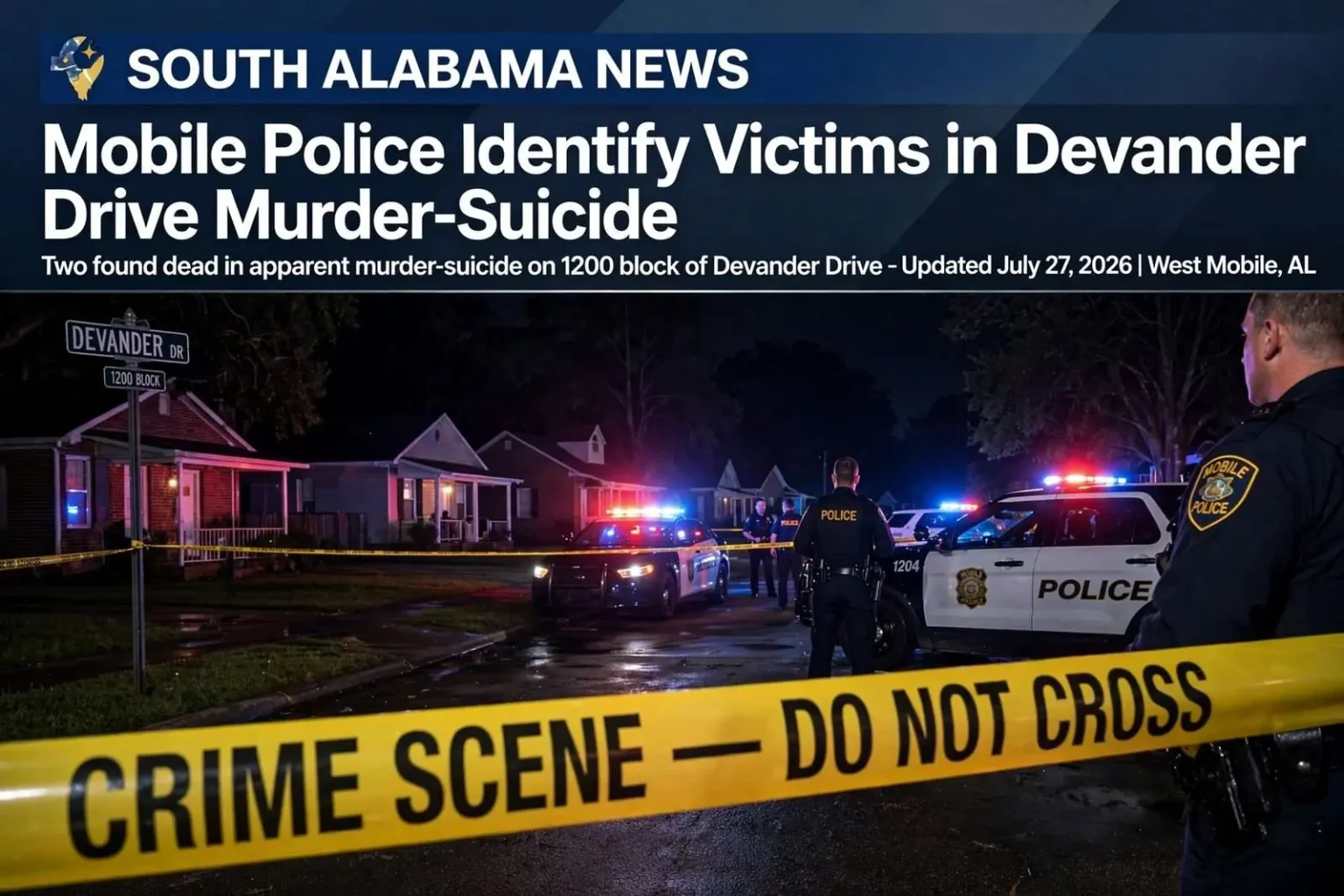
Mobile police are investigating an apparent murder-suicide after officers responded to a shooting in the 1200 block of Devander Drive late Tuesday night, a case that has now claimed the lives of two people in west Mobile’s residential neighborhoods. According to police, officers were called to the address at approximately 11:33 p.m. on Tuesday, July 21, 2026. When they arrived, they found a female victim and a male subject both dead outside the home.
Investigators say the male subject shot a woman he knew while she was sitting inside a vehicle parked at the home, then shot and killed himself outside of the vehicle. The sequence of events, as described by police, unfolded quickly in a quiet residential block where neighbors were beginning to settle in for the night.
Update, July 27, 2026: Mobile Police have identified the two people who died as 37-year-old Jessica Tucker and 37-year-old Frederick Barnes. Investigators believe Barnes shot and killed Tucker while she sat inside a car parked at the Devander Drive address before turning the gun on himself.
Police have not released the relationship between Tucker and Barnes or a possible motive. The only detail investigators have offered about the connection between the two is the initial report that the man knew the woman he shot. Detectives have not said how long the two knew each other or what circumstances brought them to the Devander Drive address that night.
Police say Barnes and Tucker’s next of kin have now been notified. Authorities describe this as an active and ongoing investigation, and no additional details are being released at this time.
How the Night Unfolded
The emergency call brought officers to the 1200 block of Devander Drive, a residential street in a part of Mobile where single-family homes and longtime residents define the neighborhood. Dispatchers routed the report as a shooting, and the first units on scene encountered a scene that quickly shifted from a possible injured person to a double fatality.
Responding officers secured the area while investigators were summoned to process the scene. The vehicle in which Tucker was found, and the area outside it where Barnes was discovered, formed the center of the overnight investigation. Detectives worked through the early morning hours photographing the scene, collecting evidence and canvassing for anyone who might have seen or heard what happened.
Neighbors reported hearing what sounded like gunfire shortly before police arrived, according to scanner traffic from the incident, though investigators have not confirmed any specific account of the moments before the shooting. What is clear from the police account is that the entire sequence — the shooting of the woman in the parked vehicle and the gunman’s own death — took place outside the home, not inside it.
Inside the Police Response
The Mobile Police Department, one of the largest law enforcement agencies in Alabama, divides the city into precincts and assigns patrol, investigative and support functions across them. A late-night shooting call of this kind draws an immediate response from patrol officers, who secure the scene, and then from specialized investigators trained in death investigations.
When officers arrived at Devander Drive shortly before midnight, their first tasks were to determine whether anyone involved was still alive, secure any potential evidence, and protect the scene from contamination. Finding both parties dead shifted the response from a rescue to an investigation: the block was cordoned off, detectives were called in, and the department’s crime scene personnel began the methodical work of documenting everything they found.
The overnight hours are critical in death investigations. Neighbors are interviewed while memories are fresh, and physical evidence — shell casings, the vehicle, footprints, blood evidence — is photographed and collected before daylight can bring crowds and weather. By the time the sun rose over the quiet street, the investigative groundwork had largely been laid, and the case had moved into its longer phase: identification, notification, autopsies and the slow work of building a complete account of the final hours of two lives.
Identifying the decedents took days, as it often does. Police released the names of Jessica Tucker and Frederick Barnes only after autopsies were scheduled, family members were reached and confirmation was complete — a process that reflects both investigative caution and respect for the families involved.
The Investigation Continues
Police have not said whether any weapon has been recovered or whether any notes or messages were found. Investigators will typically examine phone records, surveillance video from nearby homes and businesses, and interviews with family members and acquaintances to establish a timeline. In cases classified as murder-suicides, the medical examiner’s office performs autopsies on both decedents, and its findings become part of the final record.
The Mobile Police Department treats cases like this one as open investigations even when no arrests are possible, in part because the documentation matters to surviving families for insurance, inheritance and legal purposes. Detectives also review the circumstances for patterns that might inform the department’s domestic violence prevention work.
Mobile, like communities across Alabama and the nation, has seen incidents in which violence within a known relationship escalates to fatal ends. Advocates note that warning signs — threats, controlling behavior, prior violence — frequently precede such events, and that intervention resources exist for people who recognize them in their own relationships or in those of family members and friends.
Domestic Violence Resources
Anyone in an abusive relationship or concerned about someone who may be in danger can contact the National Domestic Violence Hotline at 1-800-799-7233, which operates around the clock and can connect callers with local shelters and services. In immediate danger, authorities urge people to call 911 rather than waiting to seek other help.
Local advocacy organizations in the Mobile area provide emergency shelter, counseling and court advocacy, including assistance with protective orders. Police and victim advocates stress that leaving an abusive relationship can be the most dangerous period, and that planning with professional help improves safety for those attempting to leave.
Alabama’s network of domestic violence shelters and service organizations operates across the state, with outreach programs in Mobile, Baldwin and surrounding counties. Advocates emphasize that confidential help — by phone, text or chat — is available before a situation becomes a headline, and that services are free regardless of a caller’s ability to pay.
A Community Confronts the Aftermath
Murder-suicides leave a distinctive mark on the neighborhoods where they occur. Unlike other violent crimes, there is no suspect to be sought and no open question about who is responsible, which can leave residents with a sense of unfinished grief. Community members on Devander Drive were left to process the sight of police tape and patrol cars on their street, and the knowledge that two people died in a parked car steps from their homes.
Mobile’s faith communities and neighborhood associations have historically responded to such events with vigils and outreach, and clergy in west Mobile were among those available to counsel residents in the days that followed. Grief counselors point out that children exposed to violence nearby — even indirectly, through overheard conversations and police activity — benefit from direct, age-appropriate conversations about what happened.
The Medical Examiner’s Role
In Alabama, deaths from violence fall under the jurisdiction of the state’s forensic system, which performs autopsies to establish cause and manner of death. The findings in cases like this — the nature of the injuries, toxicology results, the mechanism of death — become part of the official record and can confirm or refine the sequence of events described by investigators.
That process takes weeks, not days. Toxicology alone can take substantial time, and final reports often arrive long after the initial headlines. When they do, they close the record on cases like the one on Devander Drive, giving families and officials a full accounting of what occurred.
How to Help Investigators
Anyone with information that could assist investigators is asked to contact the Mobile Police Department at 251-208-7211. Tips can also be submitted anonymously by texting 844-251-0644 or by visiting mobilepd.org/crimetip.
Anonymous tip lines have become an important tool for Mobile investigators, allowing witnesses who are reluctant to come forward publicly to provide information that can be verified independently. Detectives emphasize that even small details — a vehicle seen in the neighborhood, an overheard argument, a text message — can help complete the picture of what happened.
The Devander Drive case remains under investigation, and South Alabama News will provide updates as additional information is released by authorities.
For residents of the Devander Drive neighborhood, the days since the shooting have been a reminder that violence of this kind rarely arrives with warning. Police have thanked the community for its patience during the investigation, and officers familiar with the case say any information from neighbors remains valuable, however small it may seem, as the department works to complete its account of what happened on July 21.
