Mobile Police Trained on Motorcycles for Mardi Gras in 2009
Mobile Police trained officers on motorcycles at Municipal Park ahead of the 2009 Mardi Gras season, including navigating crowded parade conditions.
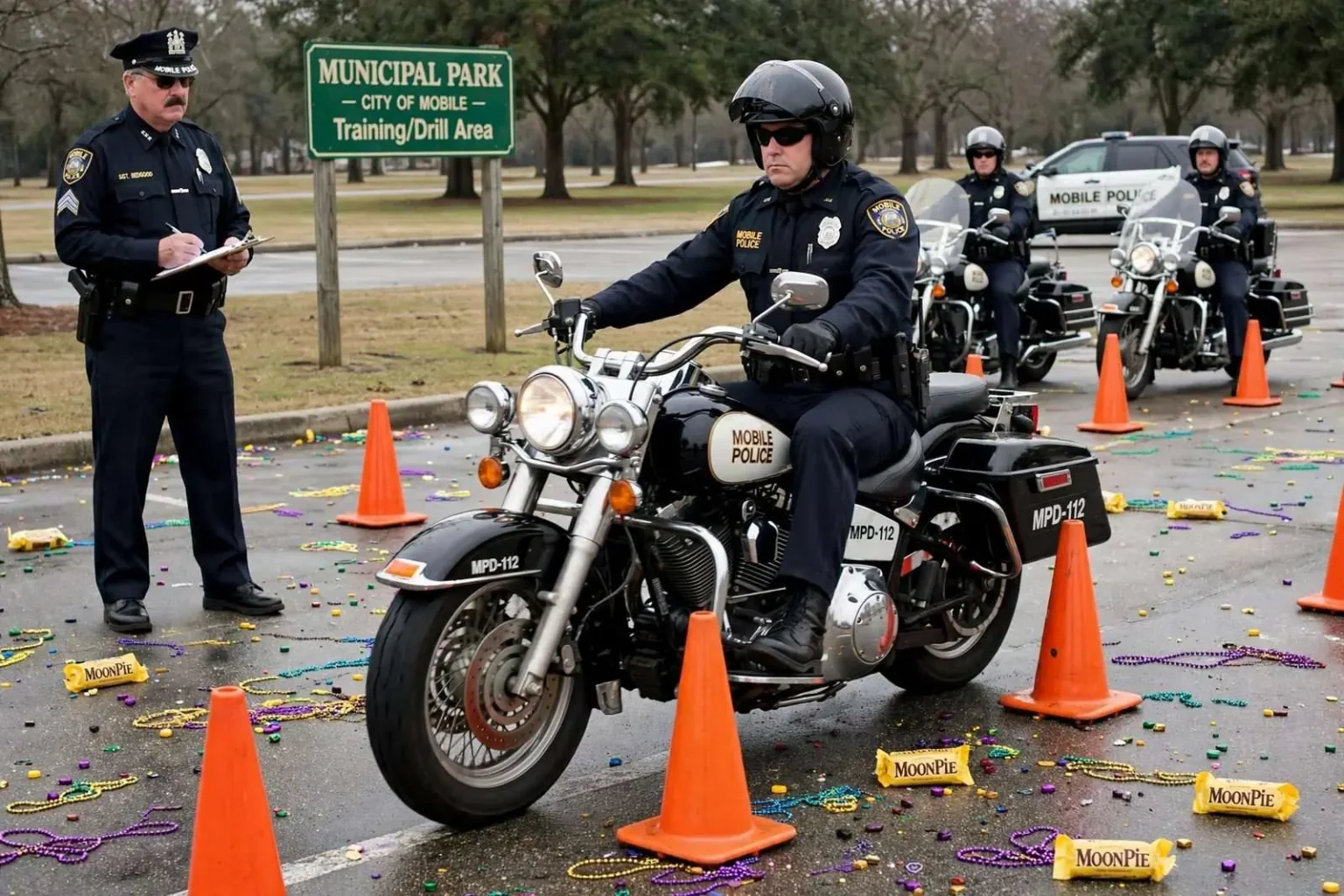
Mobile Police trained officers on motorcycles at Municipal Park ahead of the Mardi Gras season in 2009, according to an archived local news report from that February. The training sessions put officers through the specific skills needed to handle patrol motorcycles during one of the busiest stretches of the year on downtown Mobile streets.
Sgt. Bill Bedgood said officers needed to learn to navigate tight spaces as well as parade debris such as beads, MoonPies and candy in the road. The training prepared officers for the crowded conditions of the Mardi Gras season, when hundreds of thousands of revelers pack the parade routes and surrounding blocks for weeks of nightly processions.
Municipal Park, in west Mobile, gave the department a large, controlled space away from downtown to run the drills. Officers practiced the kind of slow-speed maneuvering that motorcycle officers use constantly during parade season — easing through gaps between vehicles, holding the bike steady at walking pace in packed crowds, and recovering from the slippery patches that thrown debris creates on asphalt.
Training on the practice course also reflected the reality that parade routes are nothing like ordinary patrol streets. Mobile’s downtown grid narrows at key intersections, curbs crowd the corridors along Government Street and Royal Street, and the sheer volume of pedestrians means officers cannot simply ride around an obstacle the way they would on a routine shift.
Mardi Gras: A Public Safety Operation Like No Other
Mobile’s Mardi Gras is the oldest in the country, with roots stretching back to the early 1700s and organized mystic societies parading in the city since the 1830s. By the time Fat Tuesday arrives, the season has already been underway for more than two weeks, with multiple parades rolling on many nights and each one leaving behind tons of thrown items for cleanup crews and hazards for anyone on two wheels.
Beads are the signature throw of the season, and they accumulate by the sackful along the routes. MoonPies — the marshmallow-and-chocolate snack that has become the iconic Mobile Mardi Gras throw — are soft enough that they are prized by riders of all ages precisely because they do not injure the way hard throws can, but under a motorcycle tire a dozen of them make a slick patch all the same. Candy and other small throws scatter across intersections where crowds surge at the end of each parade.
Motorcycle officers are among the most visible faces of the department’s Mardi Gras operation. They escort floats along the routes, clear intersections ahead of processions, respond quickly to medical calls in areas that patrol cars cannot reach, and manage traffic as crowds pour in and out of downtown. The job demands precision riding in conditions that a standard traffic-school course never approaches.
Why Slow-Speed Skills Matter So Much
Motorcycle handling at low speeds is a distinct skill set, harder in many ways than riding fast. A patrol bike weighs several hundred pounds, and keeping it upright at walking pace requires balance, clutch control, and constant small corrections rather than the gyroscopic stability that comes with speed. In a packed Mardi Gras crowd, an officer cannot simply put a foot down or swerve — the space is full of people, and a mistake means injuries.
The debris factor adds a layer that is unique to parade work. A road scattered with beads behaves like a surface of loose marbles, and an officer braking hard in an emergency can lose traction on a handful of strands. Training that simulates those conditions — riding through cone courses littered with thrown items, braking on slick patches, maneuvering in tight quarters — is designed to make those hazards feel routine by the time the first parade rolls.
Training at a park facility also allowed instructors to standardize the drills. Officers typically run courses that mimic the situations they will face: tight U-turns between obstacles, slow races that force clutch and throttle finesse, sudden stops within a marked box, and weaving patterns that simulate moving through stopped traffic. Repeating the maneuvers until they are automatic is the point — in a crowd, there is no time to think through a technique.
The Department’s Broader Mardi Gras Preparation
Motorcycle training is one piece of the much larger public-safety effort Mobile undertakes every Carnival season. The department works extended shifts during the two weeks leading up to Fat Tuesday, bringing in officers from other shifts and coordinating with fire-rescue, medical teams stationed along the routes, and cleanup crews that work overnight to clear the streets before the next day’s events.
Coordination extends well beyond the police department. Parade marshals from each mystic society, transit adjustments for downtown workers, street closures, and towing plans for vehicles left along the routes all have to mesh with the security plan. Officers who have trained specifically for the conditions — crowds, debris, narrow passage — are the ones assigned to the most demanding posts along the routes.
The 2009 season was a typical example of the scale involved. On peak nights, multiple parades from different mystic societies rolled in sequence, meaning downtown stayed crowded from late afternoon until well past midnight. Keeping the crowds safe and moving between parades is exactly the environment the motorcycle drills at Municipal Park were built to prepare officers for.
A Look Back at 2009
This article records a 2009 operations practice and is not a current public-safety notice. The training described took place in February 2009, as the city prepared for that year’s Carnival season, and the details come from archived local news coverage of the department’s preparations at the time.
The passage of years has not changed the fundamentals that drove the training. Mobile’s Mardi Gras still fills downtown streets with crowds and thrown beads, MoonPies and candy every winter, and motorcycle officers still face the same tight quarters and slick pavement that Sgt. Bedgood described when the 2009 sessions were reported. Municipal Park remains a familiar training ground for area agencies, and the basic skills — slow-speed control, hazard braking, crowd navigation — remain the core of motorcycle officer preparation across the Gulf Coast.
For readers looking back at how Mobile has handled its signature season, the 2009 training report is a small window into the year-round work behind the celebration. Every parade that rolls smoothly past packed sidewalks is supported by weeks of preparation, from route planning and staffing to on-the-bike drills that make navigating a street full of MoonPies look easy when it is anything but.
Inside a Motorcycle Officer’s Training Course
The drills that departments like Mobile’s run at facilities such as Municipal Park trace back to nationally recognized police motorcycle training programs. A typical course starts with the basics of low-speed balance: officers ride a straight line within a narrow lane, then progress to circles and figure-eights that force them to lean the bike while keeping their eyes up and their body position neutral. From there the courses add cones, boxes, and offset gates that replicate the spaces an officer has to thread downtown.
Braking exercises come next, and this is where the debris simulation matters most. Officers practice stopping from moderate speed in progressively shorter distances, then repeat the drills on surfaces scattered with thrown beads and other parade items. The difference is immediate and memorable — traction that feels solid on clean pavement disappears under a layer of loose beads, and officers learn to brake with a lighter touch, to use engine compression, and to keep the bike vertical in a panic stop rather than leaning into it.
Instructors also drill recovery techniques. A bike that starts to slide on MoonPies or candy needs immediate, practiced correction, and the difference between a wobble and a fall often comes down to fractions of a second. Repeating recovery maneuvers on a closed course, where the only consequence of a mistake is a dropped practice bike rather than an injury in a crowd, is the entire logic of holding the training away from the parade routes.
The MoonPie and the Culture of the Throw
The training report’s mention of MoonPies is a distinctly Mobile detail. While neighboring New Orleans made plastic beads the currency of Carnival, Mobile’s celebration developed a fondness for the soft, individually wrapped snack cakes, and throwing MoonPies became a beloved signature of the city’s parades over the years. Local bakers even produced MoonPie varieties tied to the season, and the treat has become as identifiable with Mobile Mardi Gras as the mystic societies themselves.
For the street-sweeping crews and the police officers who work the routes, however, the MoonPies are simply one more variable on the pavement. A thrown MoonPie lands whole, sits on the road until someone steps on it or it is run over, and turns into a slick smear underfoot. Multiply that by tens of thousands of throws per parade, and the scale of the cleanup and hazard problem becomes clear — and explains why officers trained specifically for those conditions rather than assuming their regular street skills would carry over.
The 2009 report captured the department in the middle of that annual cycle: practice in the daylight and quiet of a west Mobile park, followed by nights of application in the loudest, most crowded place in south Alabama. It is a rhythm the city has repeated for generations, and the archived coverage preserves a snapshot of the work that makes the celebration possible.