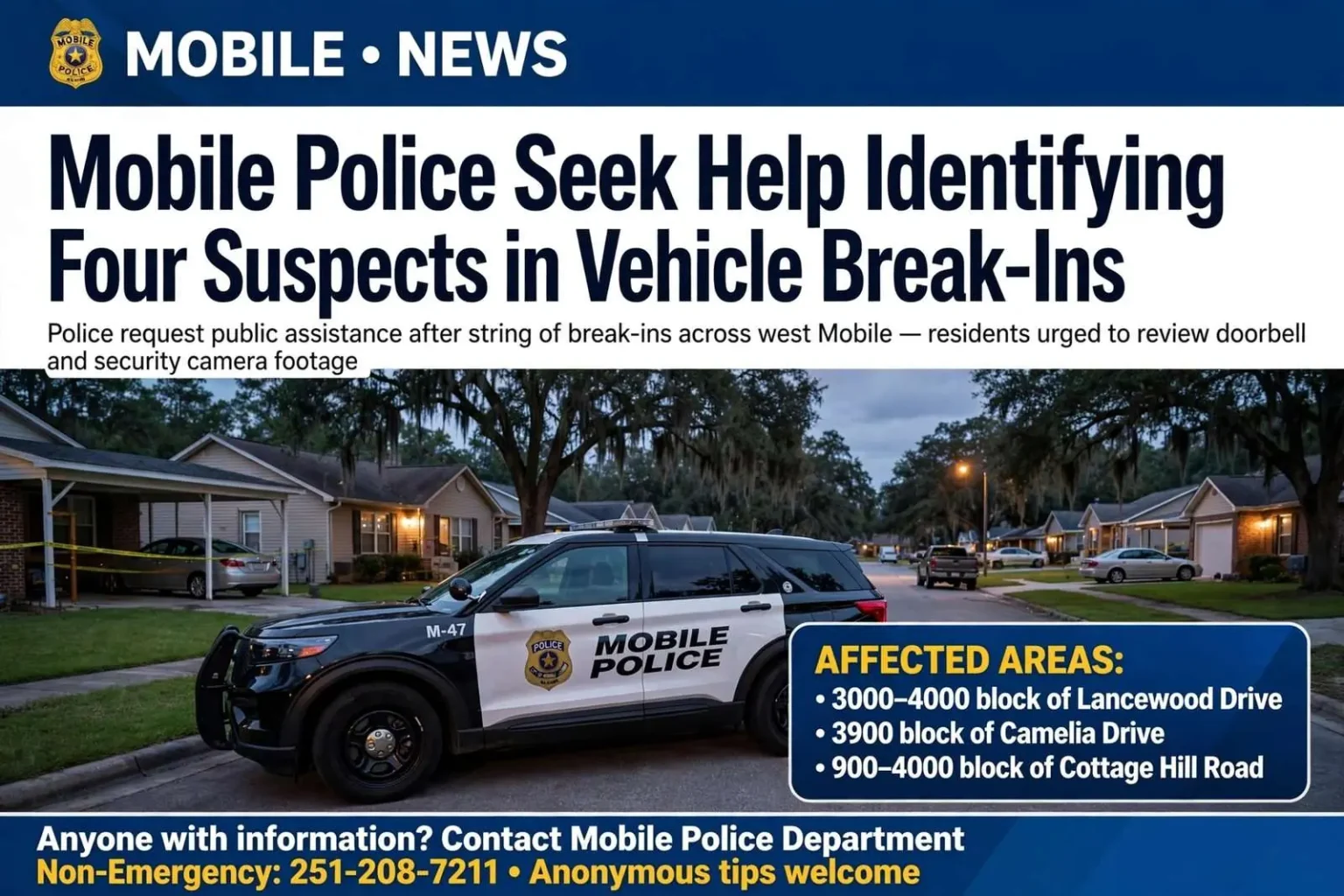
The Mobile Police Department is asking for the public’s help identifying four people believed to be connected to a string of vehicle break-ins reported around the city. Investigators have released few details about the suspects, but the department confirmed the incidents spanned several west Mobile neighborhoods and said residents in the affected areas may hold information or surveillance footage that could move the case forward.
According to police, the break-ins took place in the 3000-4000 block of Lancewood Drive, the 3900 block of Camelia Drive, and the 900-4000 block of Cottage Hill Road. Those streets sit in the western portion of Mobile, a part of the city marked by established residential subdivisions, apartment complexes, and busy commercial corridors. Cottage Hill Road itself is one of the major east-west arteries in west Mobile, running for miles through neighborhoods between Airport Boulevard and Schillinger Road, and its long list of blocks means a wide range of homes and businesses front the street.
Where the Break-Ins Were Reported
Lancewood Drive and Camelia Drive are residential streets in the same general section of the city, lined with single-family homes that have driveways and carports rather than gated parking. That layout is common across west Mobile, and it is also the layout that vehicle burglars tend to exploit. Cars parked in driveways overnight, often unlocked and often holding electronics, wallets, or garage-door openers within easy reach, are repeatedly identified by local law enforcement as the most frequent targets of this kind of crime.
Police have not said exactly how many vehicles were entered, on which of the three locations the incidents were concentrated, or what the four suspects may have taken. Investigators have also not released additional details about when the break-ins occurred. That kind of restraint is typical in the early stages of an identification request, when detectives are still gathering evidence and do not want to publicize specifics that could compromise witness interviews or the integrity of the case file.
What the department has made public is the count of people it is trying to find: four. Asking residents to help identify multiple suspects at once suggests investigators believe the incidents are connected, whether by method, timing, or the areas struck. In property-crime cases like this, a small group working the same neighborhoods over a series of nights is a common pattern, and linking the reports through a single investigation gives detectives a stronger picture of the activity than any one victim’s report would provide on its own.
For people who live along Lancewood Drive, Camelia Drive, or Cottage Hill Road, the announcement is a direct prompt to review their own footage. Doorbell cameras, dash cameras parked in driveways, and home surveillance systems are now widespread in Mobile’s residential areas, and footage from even a passing vehicle can capture a suspect’s face, clothing, or car. Detectives routinely build identification cases from exactly that kind of material, and a single clear clip can shorten an investigation by weeks.
How the Identification Process Works
When the Mobile Police Department asks the public to help identify suspects, the request usually follows a familiar path. Detectives collect reports from the affected blocks, gather any camera footage from homes and businesses nearby, and then release images or descriptions when they have them. Residents who recognize a person in a released image are asked to come forward with what they know, and investigators compare those tips against witness statements and physical evidence collected from the vehicles themselves.
In this case, the department has not released images in the original announcement, which places more weight on resident recollection. Someone who saw unfamiliar people walking through the neighborhood, testing car door handles, or lingering near parked vehicles may hold the detail that connects the four suspects to the locations. Even a partial description of a vehicle, a direction of travel, or a night and time window can help detectives line up the reports with other calls for service in the area.
How to Help
Anyone with information about the break-ins is asked to contact the Mobile Police Department’s non-emergency line at 251-208-7211, or to submit a tip anonymously. The non-emergency line is the correct channel for this kind of report. It routes information to the department without tying up 911 dispatchers, who need that system reserved for emergencies in progress. Callers who prefer to remain unnamed can still provide useful detail, and anonymous submission options exist for people who worry about being identified in connection with a case in their own neighborhood.
When calling, residents can make their information more valuable by organizing it first. Useful items include the date and approximate time something was seen, the block where it happened, a physical description of the people involved, a description and partial plate of any vehicle, and the presence of any camera that might have recorded the activity. Even information that seems minor, such as hearing car doors slam repeatedly late at night or noticing a stranger pulling on door handles, can corroborate another resident’s report and help establish a pattern.
People whose vehicles were actually entered should also make sure a report exists for their specific incident. Individual reports matter even when a string is being investigated as a whole, because each one documents a location, a time, and a loss. Those details are what allow prosecutors to pursue charges that reflect the full scope of the activity rather than a single incident, and they help victims document losses for insurance purposes.
Mobile police regularly remind residents that property-crime investigations move on volume and corroboration. A break-in with no witness and no footage is difficult to solve; a string of them across three locations, supported by residents who noticed something and reported it, gives investigators the threads they need. The department’s decision to publish the affected blocks while the suspects remain unidentified is an invitation for exactly that kind of neighborhood-level participation.
Why Vehicle Break-Ins Persist in the Area
Break-ins targeting unlocked vehicles or those with visible valuables remain among the most common property crimes reported in the Mobile area. The pattern shows up across the Gulf Coast, not just in Mobile, and it follows a simple logic. A vehicle burglary takes seconds, requires little planning, and often leaves few traces when no forced entry occurs. A thief walking down a residential street can try dozens of door handles in a night, and the vehicles that open tend to contain exactly the items that are easy to carry and easy to sell: firearms, electronics, tools, loose change, and personal documents.
Firearms left in vehicles are a particular concern for local agencies. A gun stolen from a car enters the underground market immediately and frequently surfaces later in connection with other crimes, which is why departments across the region treat vehicle burglaries involving weapons as high-priority cases. For residents, the message attached to nearly every one of these investigations is the same: a firearm left overnight in an unlocked vehicle is an unsecured firearm.
The economics of the crime also explain why it clusters in residential areas like the ones named in this case. Subdivisions with long blocks of street parking and driveway parking give a thief a target-rich environment with low visibility late at night, and the same vehicle can be struck in a matter of minutes before any homeowner notices. Groups working together can cover more ground, which is one reason an investigation that identifies four suspects at once is notable.
Under Alabama law, entering another person’s vehicle with intent to commit a theft or other crime is its own offense, and the theft of the items inside carries additional charges whose severity depends on the value of what was taken. A string of related break-ins can therefore add up quickly on a charging document, which is one more reason investigators work to link incidents and identify everyone involved.
Prevention Tips
Police are reminding residents to lock their vehicles every time they park, and to keep valuables out of sight or remove them from the car entirely when they’re not in use. The advice sounds simple, and it is, but it is also the advice that most directly changes outcomes in this category of crime. A locked vehicle defeats the opportunistic handle-pulling that accounts for a large share of vehicle break-ins, because most offenders will move on to the next car rather than risk the noise and time of breaking a window.
Beyond locking up, the standard recommendations are worth repeating in concrete terms. Remove or hide garage-door openers, which are effectively keys to the house. Take in laptops, phones, purses, and bags rather than leaving them under a seat or in a console. Wipe away suction marks and mount leftovers from dash cameras and GPS units, which signal to a thief that something valuable is probably stored in the car. Park in well-lit spots where possible, and if a vehicle has an alarm or a connected-app alert for door or glass sensors, leave those features enabled.
Residents who park on the street can also coordinate informally with neighbors. A row of homes where people report unfamiliar visitors to one another, share camera footage, and keep porch lights on presents a much less attractive target than a street where nobody is watching. Neighborhood associations along the Cottage Hill corridor and elsewhere in west Mobile have long used this model, and police departments generally credit it with shortening the lifespan of break-in sprees.
For people who keep firearms, the regional guidance from law enforcement is blunt: guns belong secured inside the home, not left in a vehicle overnight, and certainly not in an unlocked one. Cable locks, lockboxes, and quick-access safes are inexpensive compared with the consequences of a stolen weapon, and several local agencies have distributed free or low-cost locking devices at community events for exactly this reason.
What Comes Next
The investigation remains open. If investigators develop images or additional descriptions of the four suspects, the department can release them to sharpen the public appeal, and additional locations or incidents can be added to the case as reports come in. Residents in the affected area should stay alert for follow-up announcements from the department and should not hesitate to file a report if they discover evidence their own vehicle was entered, even days after the fact.
The larger takeaway for the rest of the city is the one police attach to nearly every case of this type. Vehicle break-ins are crimes of opportunity, and the single most effective defense available to any resident costs nothing: lock the car, empty the car, and pay attention to who is on the street. Neighborhoods that do those three things consistently see fewer entries, and when break-ins do occur, the camera footage and descriptions those same vigilant residents produce are what allow a case like this one to move from a request for help to an identification and, eventually, an arrest.
Anyone with information about the Lancewood Drive, Camelia Drive, or Cottage Hill Road break-ins can reach the Mobile Police Department’s non-emergency line at 251-208-7211 or submit a tip anonymously.