
Mobile Protesters Rally at Mardi Gras Park for Justice for Jacob Blake
The group Mobile For Us rallied at Mardi Gras Park against racial injustice following the Jacob Blake shooting in Kenosha.
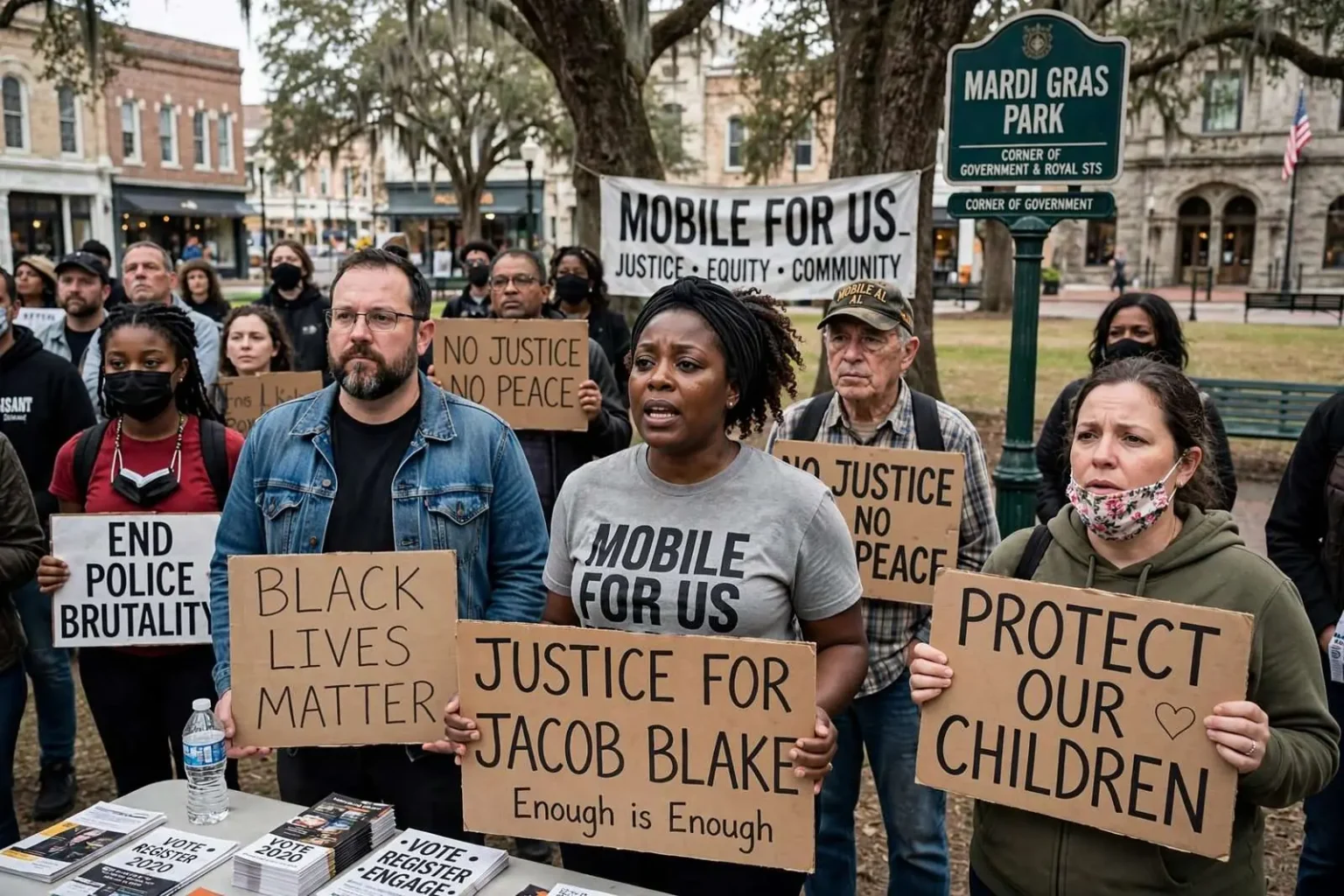
MOBILE, Ala. — The police shooting of a 29-year-old man in Kenosha, Wisconsin, has reignited a national reckoning over race and policing — and in Mobile, local groups took that energy to the streets. The demonstration in downtown Mobile placed the port city among the hundreds of American communities where the shooting’s aftermath prompted people to gather, march and speak out.
The group Mobile For Us organized a demonstration at Mardi Gras Park demanding an end to racial injustice, drawing dozens of residents who said the footage of Jacob Blake’s shooting struck a deep and personal chord. The park, at the corner of Government and Royal streets in the heart of downtown, has quickly become one of the city’s default gathering points for public demonstrations, its open lawn and proximity to Government Street making it both visible and accessible.
Blake was shot by a police officer in Kenosha on Aug. 23, 2020, as officers attempted to arrest him, and cellphone video of the shooting spread within hours, sparking protests in Kenosha that continued for nights and demonstrations in cities across the country. The shooting came roughly three months after the death of George Floyd in Minneapolis police custody, a span in which questions about police use of force against Black Americans moved to the center of national politics.
Local Voices
Demonstrator Deidre Philips said the moment calls for persistence. “I will continue hoping and praying that some things can change for African Americans and how we’re treated in this country,” she said.
For Angel Ready, who has children, the images stirred a parent’s fear. “Anger, sadness, fear, because I have children and I would hate for something like that to happen to one of mine,” Ready said. “I just want to be able to raise my kids in a world that loves one another.”
Those testimonies reflected the texture of the crowd: not professional activists but neighbors, parents and co-workers processing disturbing footage from a city a thousand miles away and connecting it to their own lives in Mobile. Speakers at the event returned repeatedly to that sense of proximity — the feeling that what happened in Kenosha could happen anywhere, including at home.
Mobile For Us had previously demonstrated after the death of George Floyd, and member Jamie Carpenter said the repeated bloodshed has worn thin. “Enough is enough. We’re ready for change, and that’s why we’re here,” Carpenter said. “We all don’t want to grow up in a world where racism is tolerated.”
The reference to the Floyd protests placed the event in a sequence rather than a moment. When Floyd died in late May 2020, Mobile saw some of the largest demonstrations in its recent history, with marches through downtown and gatherings that drew a cross-section of the city. The return to the streets months later signaled that the organizers viewed that earlier energy as unfinished work rather than a completed chapter.
Beyond the Protest
Local organizations focused on racial equality also turned out, and speaker after speaker urged the crowd not to stop at demonstrating. The message from the microphone was consistent: marches express outrage, but the follow-through — voter registration, engagement with city government, support for local organizations — is where participants can turn a moment into a movement.
Ready put it plainly: “If you want your voice to be heard, you have to raise your voice, because closed mouths don’t get fed.”
Organizers of racial justice demonstrations in Mobile have pointed to several local avenues for that follow-through. The city’s own police department operates under a civilian-reviewed structure, and Mobile’s elected officials — from the city council districts that ring downtown to the mayor’s office — set policy on policing, housing and economic opportunity. State legislative races and the county government likewise shape the courts, the schools and the services that justice advocates cite when they talk about racial equity.
The demonstration also highlighted the role that new community groups have come to play in the city’s civic life. Mobile For Us and similar organizations formed in the shadow of the 2020 protests operate largely through social media, turning out crowds on days’ notice and giving younger residents an entry point into activism that established institutions did not always provide.
For the dozens who gathered at the park, the event was part vigil, part rally and part organizing session. Attendees described the footage from Kenosha as painful to watch — particularly for Black parents in the crowd — and said that coming together was itself a form of response, a way of refusing to feel isolated in the fear.
The summer of 2020 reshaped how American cities talk about policing, and Mobile was no exception. In the months after the George Floyd protests, cities across the country reviewed use-of-force policies, reconsidered police budgets and opened public conversations about race that had long been deferred. Mobile’s own response included dialogue between city officials and community groups, with residents pressing for transparency and accountability in how the police department operates.
Kenosha’s Echo in Mobile
Kenosha, a manufacturing city of about 100,000 on Lake Michigan between Milwaukee and Chicago, became the focus of national attention after the shooting, with protests that drew both peaceful marchers and, on successive nights, unrest that included fires and property damage. The events that followed — including a shooting during the unrest in which a teenager was charged with killing two demonstrators — deepened a national argument about violence, guns and protest that played out across cable news and social media.
In Mobile, the demonstration avoided the confrontation that marked some other cities. Participants gathered, heard speakers and dispersed, and the event’s tone was shaped by the organizers’ stated aims: demanding an end to racial injustice and urging the community toward sustained civic engagement rather than a single night of outrage.
The choice of Mardi Gras Park as a venue carried its own resonance. The park sits steps from the Government Street corridor and in view of some of downtown Mobile’s oldest civic buildings, in a city whose Carnival traditions — like the city itself — were shaped by generations of Black Mobilians whose contributions to Mobile’s signature celebration are now part of the historical record the community works to preserve. Gathering there connected the national moment to local ground.
Speakers closed the event with a direct appeal to the crowd: register to vote, show up at city council meetings, support the organizations doing the daily work of racial equality in Mobile, and keep raising their voices. As one speaker put it from the steps, a protest ends when the crowd leaves; a movement continues when it does.
The Kenosha case itself moved forward through the courts and through a state investigation of the officer involved, with prosecutors declining to bring charges against the officer who shot Blake and Blake’s family pursuing a civil suit — developments that continued to generate headlines well after the demonstrations in cities like Mobile had dispersed.
For Mobile’s organizers, the demonstration was also a test of stamina. Movements built on protest faces the same challenge everywhere: keeping volunteers engaged between crises, when the cameras are gone and the work turns to meetings, training and coalition-building. The speakers’ insistence that the crowd do more than march was a recognition of that reality — and of the fact that the issues raised in Kenosha would not be resolved in a news cycle.
What Comes After the Crowd Goes Home
Civic engagement advocates in Mobile point to concrete entry points for residents moved by events like the demonstration: attending city council and county commission meetings, joining the community-police advisory conversations that have met in the city, registering voters ahead of fall elections, and supporting the neighborhood organizations that work year-round on education, housing and youth programs.
The demonstration’s turnout — dozens rather than hundreds — reflected both the group’s organizing reach and the logistical realities of an event announced quickly in response to breaking news. But the participants who did attend represented the constituencies the movement most counts on: young adults, families and members of established local organizations who brought institutional weight to the gathering.
Nationally, the Blake shooting became one of the defining events of a year that transformed the American conversation about race. Corporations, sports leagues and institutions of every kind responded to the protests of 2020 with statements and initiatives, and while skeptics questioned the depth of those commitments, the events themselves — from Minneapolis to Kenosha to downtown Mobile — left a durable mark on local politics and civic life.
In Mobile, the lasting measure of events like the Mardi Gras Park demonstration will be what follows: whether the residents who gathered on a weeknight to hear speakers and shout for change continue to show up — at the polls, at public meetings, in the organizations doing the slower work of reform. That was precisely the appeal the speakers made as the evening wound down, and the one that Ready’s line about raising a voice was meant to carry home.
The group said it intended to remain active, with additional events and organizing efforts to be announced through its channels as the national conversation its members joined continued to unfold.


