Mobile Public Library locations to reopen for ‘In and Out’ service
Mobile Public Library locations will reopen Oct. 5, 2020 for limited 'In and Out' service and computer use, with masks and capacity limits in place.
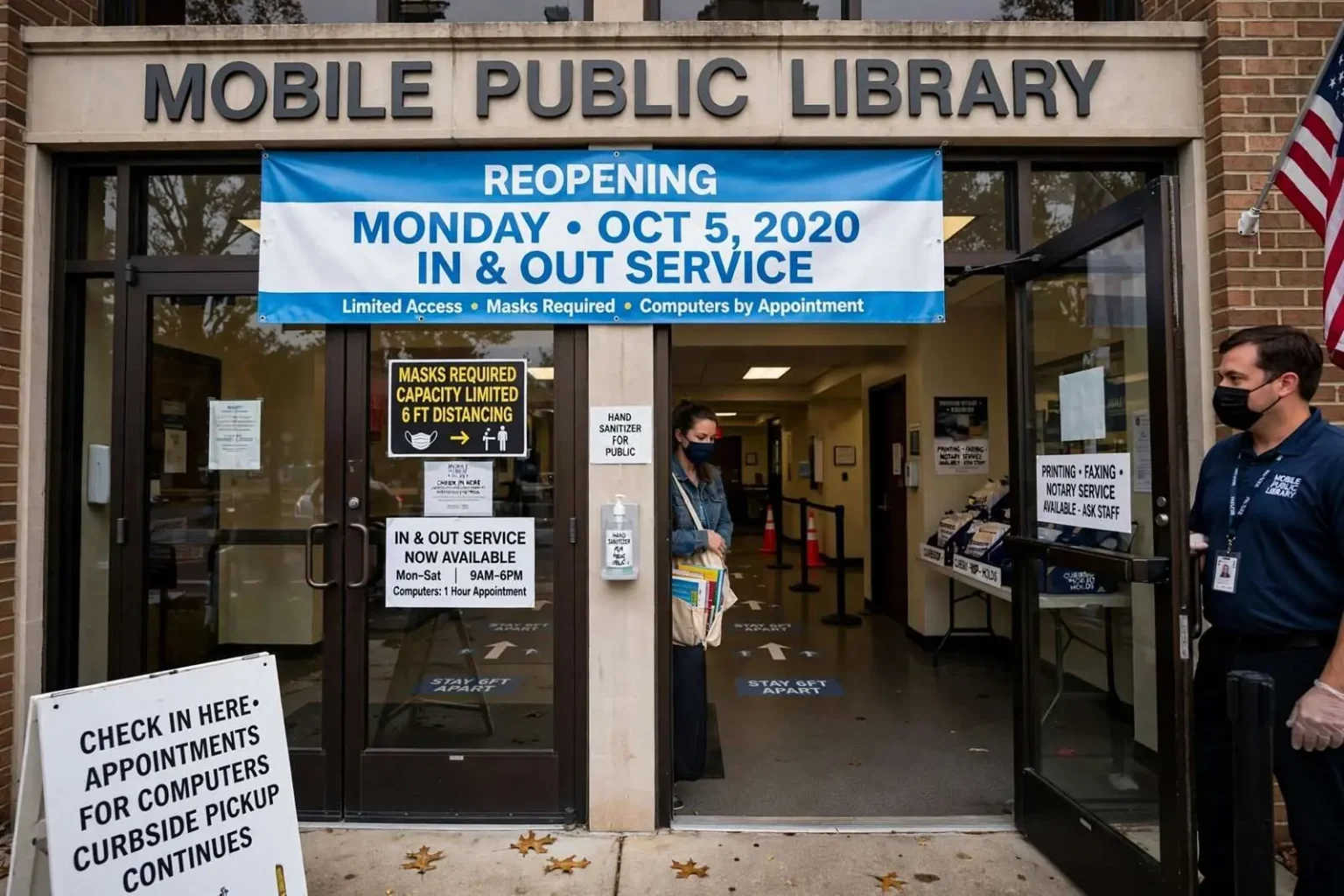
The Mobile Public Library will reopen to the public on Monday, Oct. 5, 2020, for “In and Out” service and limited computer use, ending a months-long closure that kept the city’s library buildings closed to walk-in visitors during the coronavirus pandemic. The phased return brings patrons back inside the system’s locations under strict capacity limits — and resumes services that many residents have been unable to reach any other way, from public computers to printing, faxing and notary help.
Most locations will be open 9 a.m. to 6 p.m. Monday through Saturday for limited building and computer access. The hours give the system six-day coverage while preserving time each morning and evening for cleaning and staffing adjustments. Not every service returns at once: the Local History & Genealogy division will continue to operate by appointment only, reflecting the specialized handling its archival materials require and the close-quarters research its reading room normally hosts.
What “In and Out” Service Means
The “In and Out” label describes the framework precisely. Patrons may enter library buildings to browse shelves, check out materials and use designated services, but the usual amenities that invite people to linger — seating areas, newspapers, magazines and meeting rooms — will not be available. The approach is designed to keep visits short and traffic moving, reducing the number of people in each building at any given time while still restoring access to the collection and core services.
Capacity limits will be posted at entrances, and customers will notice new safety measures throughout the buildings. Masks are required, social distancing should be maintained, and hand sanitizer and gloves will be available for patrons who want them. The measures align with the public health guidance that has governed reopening plans across Alabama’s public institutions, and library staff will help manage occupancy as buildings approach their posted limits.
Computers by Appointment
Public computers return under an appointment system: machines are available for one hour per day, per person, with reservations required. The restriction marks a significant change for a service that operated on a walk-in basis before the pandemic, and it reflects how heavily contested a resource public computers become when their numbers are reduced for spacing.
The computer appointments carry particular weight in Mobile. Residents without internet access are encouraged to use library computers to complete the 2020 Census, and the library’s role in the once-a-decade count has grown more critical as the census moved online. Households that lack home broadband — a population concentrated in older and lower-income neighborhoods across the city — depend on libraries, schools and community centers for the connectivity the count now requires. Every household that responds means federal funding and representation are calculated on complete data, and the library’s reopened machines are one of the few public options available to residents who need them.
Printing, Faxing and Everyday Services
Inside the branches, printing and faxing services will be available — small services by library standards, but essential ones for residents who lack printers at home. Job applications, benefit paperwork, medical forms and government documents still move on paper in many cases, and the library’s return restores a public option for handling them. Combined with the computer appointments, the services make the branches functional workplaces for residents navigating unemployment, benefits applications and school paperwork during the pandemic’s economic disruption.
Curbside material pickup will continue at selected locations starting Oct. 5, giving patrons who prefer not to enter a building a way to collect holds and returns. The curbside model, adopted widely by library systems nationwide during the pandemic, routes requests through the library’s online catalog or by phone, with staff checking items out and delivering them to vehicles at scheduled times. Keeping the service in place alongside the interior reopening lets the system serve two audiences at once — those comfortable browsing inside and those waiting until conditions improve.
Help With IDs and Absentee Ballots
Some locations will offer a free copy of an ID and free notary service for those filing absentee ballot applications, two services with outsized importance as the November 2020 election approached. Alabama’s absentee voting process requires an application, and a copy of a photo identification accompanies it for many voters. For residents without access to a copier or a notary — services that normally carry fees at shipping stores and banks — the library’s offer removes both obstacles at no cost.
The notary service also supports the absentee application itself, which must be witnessed or notarized under Alabama law for certain categories of voters. By providing notaries on site, the library positions itself as a practical bridge between residents and the ballot during an election conducted under pandemic conditions. Combined with the census push, the services underscore how broadly the modern public library’s mission has expanded beyond books — into document access, civic participation and emergency community support.
Local History Goes by Appointment
The Local History & Genealogy division’s continued appointment-only operation reflects its special character. The division safeguards materials — city directories, photographs, manuscripts, family histories and records of Mobile’s long colonial and American past — that cannot be replaced if damaged, and its reading room normally operates as quiet, close-quarters research space. Researchers and family historians can still reach the division, but by scheduling ahead so staff can prepare materials and manage the room’s occupancy. Anyone planning genealogical work during the reopening period should contact the division directly to reserve time.
Libraries Through the Pandemic
The Mobile Public Library’s months-long closure followed the pattern of library systems across Alabama and the nation, which shut buildings in the spring of 2020 as the coronavirus spread and then engineered phased returns as conditions allowed. During the closure, many systems shifted to expanded digital offerings — e-books, online databases and virtual programming — while staff maintained curbside operations where possible. The “In and Out” model represents the next stage: a middle ground between full closure and full service, built to be dialed up or down as public health conditions change.
“Libraries play a pivotal role in our communities,” Library Director Margie Calhoun said. “We are excited that the library is able to continue its mission to support literacy and connect our community.” Calhoun’s framing captures the institutional stakes of the reopening. For many residents, the library is the only source of free internet access, free printing and free notary service within reach, and its buildings double as cooling centers, study halls and de facto community centers. Restoring that access — carefully, with masks and limits — resumes a civic function the pandemic interrupted without ending.
For patrons planning their first visit back, the practical picture is straightforward. Buildings open at 9 a.m. and close at 6 p.m., Monday through Saturday, at most locations. Expect to wear a mask, expect posted capacity limits, and expect that a quick trip rather than a long stay is the model the system is asking for. Computer users should call ahead or book online to secure one of the daily one-hour appointments, since reduced machine counts mean slots will fill. Local History & Genealogy researchers need an appointment before arriving.
What Stays Unavailable
The list of suspended amenities is worth noting so visitors are not caught off guard. Newspapers and magazines — traditionally among the most-used features of library reading rooms — remain unavailable, as do meeting rooms, which under normal conditions host everything from tutoring sessions to homeowners’ association meetings. The suspension of meeting rooms in particular removes a resource that community groups depend on, and groups that met at branches will need alternative arrangements until the system restores room reservations.
Study seating and lounge areas follow the same logic: anything that encourages gathering and lingering is out for now. The system’s message to patrons is that the reopened libraries are service points, not gathering places, at least for the duration of the public health restrictions that shape the “In and Out” framework.
The Digital Divide in Focus
The census deadline gives the computer appointment system a particular urgency. The 2020 Census moved largely online, and households without internet access faced a genuine barrier to a count that determines congressional representation and the distribution of billions in federal funding for roads, schools and health programs. Libraries across Alabama hosted census completion drives before the pandemic; the Mobile Public Library’s reopened computer banks extend that effort under new constraints. Staff assistance, normally available for residents unfamiliar with the online form, will continue within the limits of distancing requirements.
The same digital divide shapes the election services. An absentee application that requires identification copies and notarization is a straightforward errand for a household with a printer and a flexible schedule, and a formidable one for a household with neither. By pairing the two services — ID copies and notary work for absentee filers — some locations have effectively built a one-stop voting access point inside the branch, available at no charge to any resident who needs it.
Looking Toward Full Service
The Oct. 5 reopening does not mark the end of the pandemic’s effect on the library system, and the “In and Out” framework is explicitly temporary. Full service — restored seating, newspapers, meeting rooms, walk-in computers and unlimited visits — returns when public health conditions allow, with each step guided by the capacity limits and safety measures the system has posted. In the meantime, the combination of interior access, curbside pickup, computer appointments and election services restores most of the practical functions residents lost when the buildings closed.
What the reopening restores, above all, is access. A resident who needs to complete the census, print an application, notarize an absentee ballot, pick up a hold from the trunk of a car or simply check out books again will find the doors open Monday, Oct. 5, 2020, from 9 a.m. to 6 p.m., Monday through Saturday, at most locations. As Director Margie Calhoun put it, libraries play a pivotal role in their communities — and with the resumption of “In and Out” service, Mobile’s library system is resuming that role on new terms, one carefully limited visit at a time.