Mobile public safety director in Montgomery to support Aniah’s Law
Mobile Public Safety Director James Barber traveled to Montgomery to support Aniah's Law, a bail-reform amendment that cleared the House Judiciary.
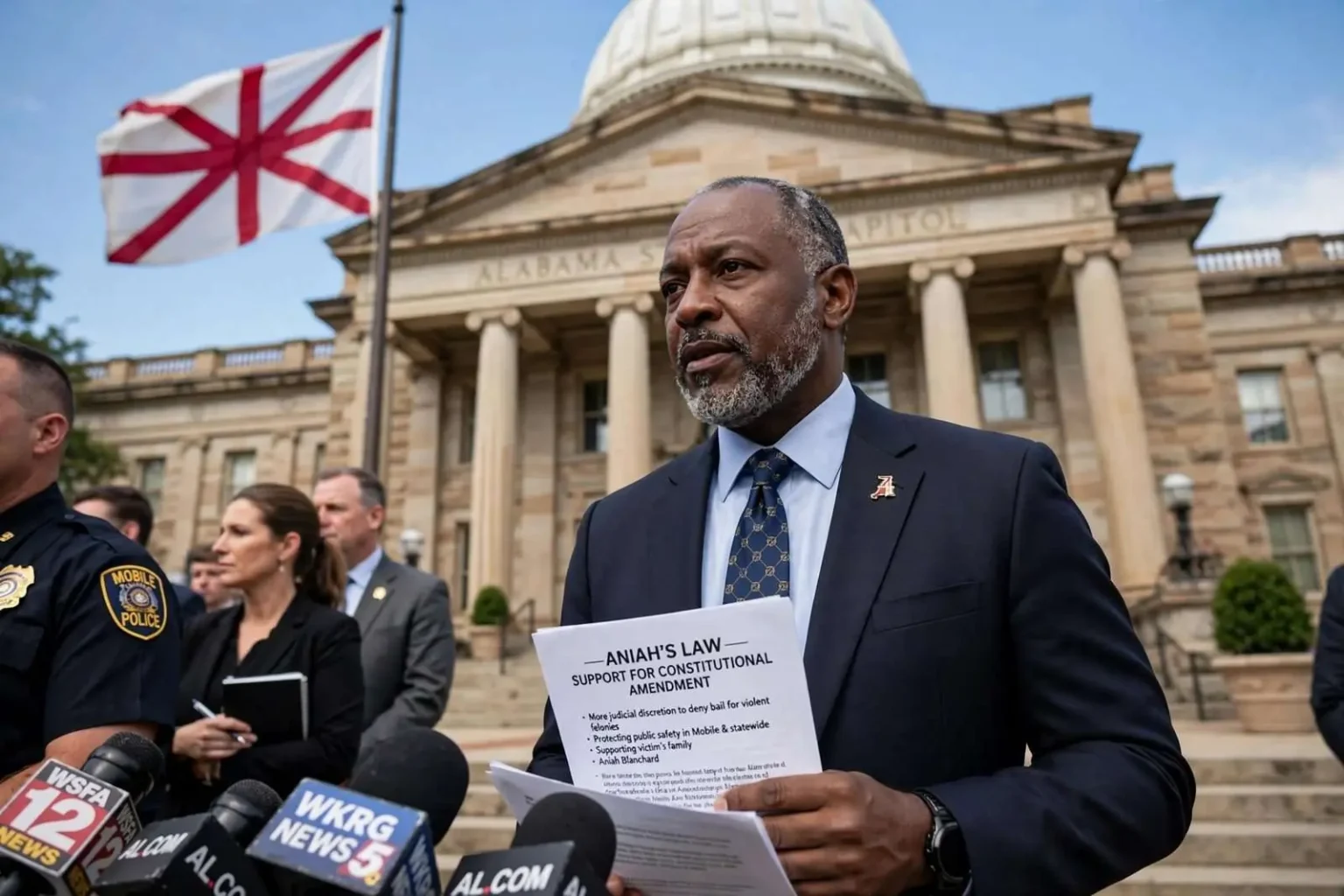
Mobile Public Safety Director James Barber was in Montgomery to show support for Aniah’s Law, a constitutional amendment sponsored by Rep. Chip Brown that would give judges more discretion to deny bail to people charged with some of the most serious crimes on the books. Barber, a former Mobile police chief who now oversees public safety policy for the city, joined law enforcement leaders from around the state in urging lawmakers to close what they describe as a dangerous gap in Alabama’s bail system.
The measure is named after Aniah Blanchard, the 19-year-old Auburn University student who was killed last year. The man charged in her murder was out on bond after being charged with several other crimes — a fact that transformed the case from one family’s tragedy into a statewide argument about who can be held in jail before trial. Under Alabama’s constitution as written for decades, judges could deny bail only in capital cases, leaving even defendants charged with violent felonies legally entitled to bail at a price they could afford.
Aniah’s Law would change that. The constitutional amendment would expand the list of offenses for which a judge may deny bail entirely, adding crimes such as murder, kidnapping, rape, human trafficking, burglary, robbery, arson and terrorism to the capital cases where denial is already allowed. Because the change alters the state constitution rather than a statute, it must pass the Legislature and then be approved by Alabama voters in a statewide election.
The bill cleared its first major hurdle when it passed the House Judiciary Committee with unanimous support, a rare show of complete agreement on a criminal justice question in a body that frequently splits on such issues. Aniah’s family was present for the committee vote and gave emotional testimony about why the change is needed, putting a human face on a legal debate that can otherwise collapse into abstractions about bail schedules and constitutional text.
Why Alabama’s bail system works the way it does
The roots of the debate go back to 1982, when Alabama voters ratified a constitutional amendment that narrowed the circumstances under which a judge could refuse bail. The amendment was written to guarantee that most defendants would not languish in jail while presumed innocent, and it requires bail to be granted in every case except capital offenses, where the prosecution can prove the defendant poses a flight risk or a danger to the community.
For nearly forty years, that framework has meant that a person charged with murder, rape or armed robbery had to be released if they could post bond, no matter how strong the evidence against them appeared to be. Judges could raise bail amounts to reflect the seriousness of the charge, but they could not simply refuse. Prosecutors and police across Alabama have argued for years that the rule ties their hands, particularly with repeat offenders who face new violent charges while out on bond for earlier ones.
Defenders of the current system counter that the right to bail is a safeguard against jailing people without conviction, and that a defendant who has not been tried is legally innocent. Aniah’s Law does not eliminate that principle — it gives judges a discretionary option in the most serious cases, after a hearing, rather than an automatic rule. Supporters stress that judges would still have to consider the facts of each case, including the defendant’s record and the danger the person presents to witnesses and the public.
The case that put a face on the issue
Aniah Blanchard’s disappearance in the fall of 2019 gripped Alabama. The Auburn student and stepdaughter of a well-known mixed martial arts fighter was last seen at a convenience store in Auburn, and her disappearance set off a search that ended with the discovery of her body. Investigators charged a man with her murder — a man who, at the time of the killing, was out of jail on bond for earlier charges including kidnapping charges from another jurisdiction.
The details of that record are what turned grief into legislation. If the law had allowed a judge to deny bail to a defendant facing serious violent charges, the argument goes, Blanchard’s accused killer would have been in custody instead of on the street. Her family has carried that argument to Montgomery personally, testifying before committees and meeting with legislators about the amendment that now bears her name.
Their testimony is a regular feature of the bill’s progress through the Statehouse, and lawmakers from both parties have described it as the most persuasive part of the case. Statistics and policy arguments rarely move a committee the way a mother or father describing their child does, and the Blanchard family’s willingness to relive their loss in public hearings has made Aniah’s Law one of the most recognizable pieces of legislation in the state.
Why law enforcement leaders came to Montgomery
Barber’s presence at the Statehouse reflects the position of police leadership across Alabama’s larger cities. Chiefs and public safety directors have limited influence over state law, but they are the people who manage the consequences when a bonded defendant commits a new crime — and they have become some of the amendment’s most visible advocates.
In Mobile, Barber’s role bridges the police department and City Hall, giving him a platform to weigh in on state criminal justice policy that affects the city’s courts and jails. His argument for Aniah’s Law mirrors what police chiefs in Birmingham, Huntsville and Montgomery have said: the current constitution forces the release of defendants who officers arrested, witnesses identified and prosecutors charged with the most serious offenses, and the public sees the result when those defendants offend again before trial.
The bill’s sponsor, Rep. Chip Brown of Mobile, has carried the legislation with that coalition behind him. Brown’s district takes in parts of Mobile County, and he has framed the amendment as a public safety measure that keeps the worst offenders off the street while leaving the bail system intact for everyone else. The unanimous committee vote suggests the framing worked, at least on first passage.
What happens next in the Legislature
The measure now advances to the House floor, and if it passes there, it would go to the Senate Judiciary Committee — another round of hearings, testimony and possible amendments before any vote by the full Senate. Because it is a constitutional amendment rather than an ordinary bill, the governor’s signature is not part of the process; instead, passage sends the question directly to Alabama voters, who would decide in a statewide election whether to change the constitution.
That structure shapes the politics of the bill. Legislators who might hesitate to vote on bail policy directly can instead vote to let the public decide, and the campaign that follows would put the question in front of every voter in the state. Constitutional amendments in Alabama routinely pass with strong majorities once they reach the ballot, particularly when they carry a name and a story as widely known as Aniah Blanchard’s.
Supporters are watching the Senate committee as closely as the House floor vote, because committee chairs control whether a bill advances at all. If the amendment clears both chambers in the same form, it goes on the next statewide ballot; if the Senate amends it, the two chambers would have to reconcile their versions before the question could go to voters.
The broader debate over bail in America
Aniah’s Law is Alabama’s entry into a national argument about pretrial detention. States across the country are rethinking cash bail — some, like New Jersey and California, moving toward systems that rely less on money and more on risk assessment, and others, like Alabama, moving to expand the categories of defendants who can be held without any bail at all.
The two directions reflect the same underlying tension: how to protect the public and guarantee court appearance without jailing people solely because they are poor. Alabama’s amendment takes the narrow path — it touches only the most serious violent charges and leaves the rest of the system untouched. Critics worry about any expansion of pretrial detention, while supporters argue the amendment is a measured response to a specific, documented failure.
What both sides agree on is that the current constitution’s single exception for capital cases was written for a different era, and that the Legislature is the body positioned to change it. The unanimous House Judiciary Committee vote — with Aniah’s family watching from the room — signaled that, in Alabama at least, the political will to change the constitution’s bail language is finally aligned.
What the amendment would mean for Mobile
For Mobile County, the practical effect of Aniah’s Law would land in the local courts. Judges in the county’s circuit and district courts handle thousands of criminal cases a year, including a steady share of violent felonies. If the amendment is ratified, those judges would gain the authority — after a hearing and a finding of danger or flight risk — to order a defendant charged with murder, rape, kidnapping, robbery, burglary, arson, human trafficking or terrorism held until trial.
Prosecutors would have to build the record for such a hearing: prior charges, failed court appearances, threats to witnesses, evidence strength. Defense attorneys, in turn, would argue for release conditions short of detention — electronic monitoring, no-contact orders, supervised release. The result would be more contested hearings in serious cases and, in a small number of them, defendants who would once have posted bond instead remaining in jail.
Local law enforcement officials have argued the change also sends a message on the street. A defendant who knows that a new violent charge can mean real detention, rather than another bond payment, faces a different calculation than one who expects release as a matter of right. Whether that changes behavior is something judges, police and prosecutors will only be able to measure if voters approve the amendment and it takes effect.
A family’s persistence
Through every step of the legislative process, the Blanchard family has been present — at committee hearings, in meetings with individual legislators, and in public statements that keep the case in front of Alabama news audiences. Their emotional testimony in Montgomery has become the bill’s signature moment, repeated in each chamber as the amendment advances.
Legislation named for victims carries a particular weight in Alabama, where the practice has produced some of the state’s most durable laws. The measure’s supporters say that naming it for Aniah Blanchard is not sentiment but accountability: it attaches the consequences of bail policy to the person who paid for them, and it reminds legislators that a committee vote is not an abstraction.
The family has said their goal is simple — that no other family should learn that the person charged with killing their child was free on bond for other crimes. That sentence, spoken in hearing rooms in Montgomery, is the entire argument for the amendment compressed into a single idea, and it has proven difficult for lawmakers to walk past.
If Aniah’s Law clears the House floor and the Senate in the coming sessions, Alabama voters will have the final word — and the amendment’s chances at the ballot will rest, as they have from the beginning, on a story every Alabamian already knows.