Mobile Rapper B-Dameezy Releases ‘Beast Mode,’ First Album on His Own Label
Mobile hip-hop artist B-Dameezy launches his Icon Entertainment label with debut album 'Beast Mode,' recorded in just 14 days.
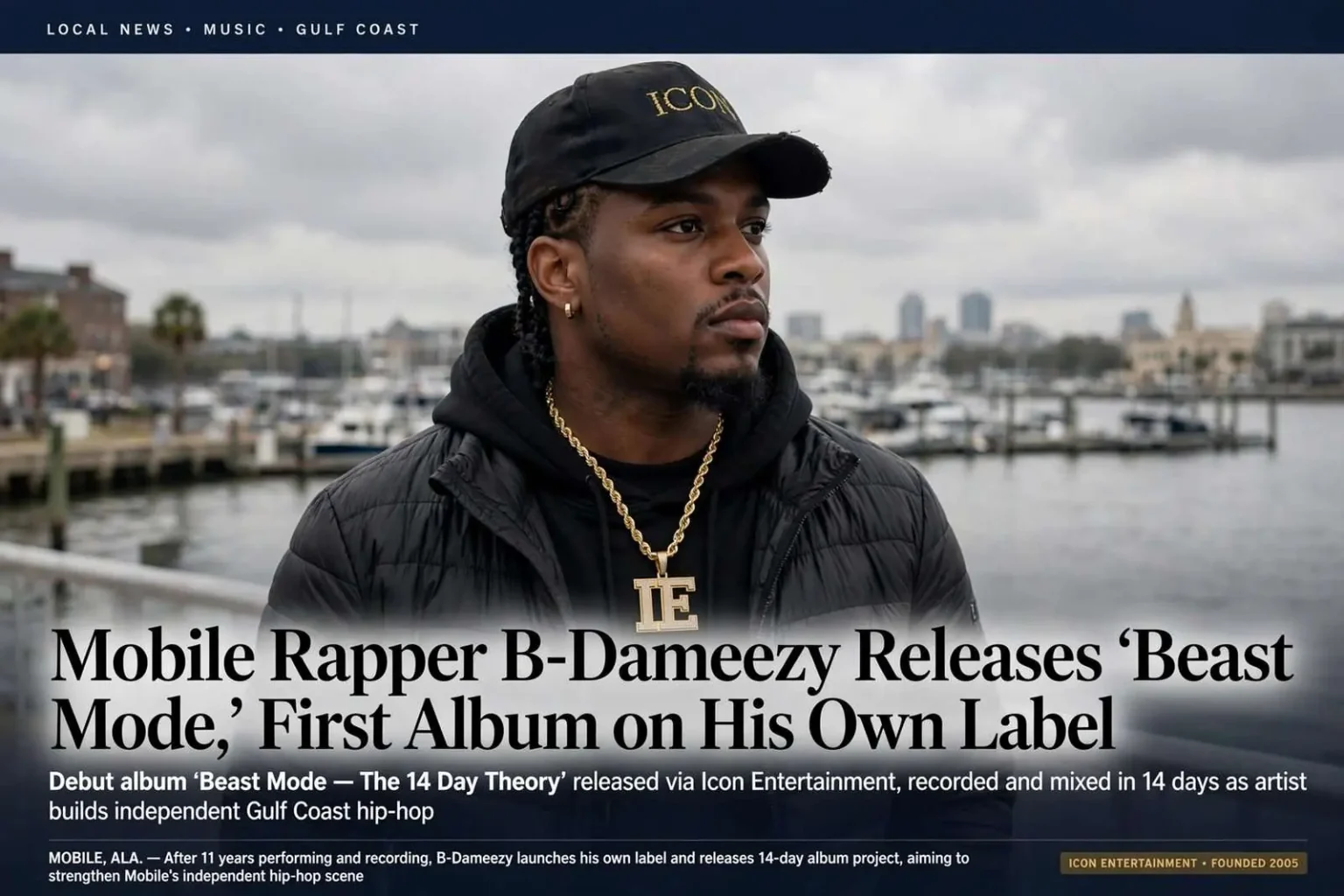
Mobile hip-hop artist B-Dameezy has released “Beast Mode,” the debut album from Icon Entertainment, the independent label he founded in 2005 after several years working with the local D.M.P. imprint.
The release marks a new chapter for the artist, who now controls every stage of his music’s path to listeners — from recording and production to promotion and distribution — under a label he owns outright. Going independent in this way carries both freedom and burden: no outside approval stands between an artist and his release schedule, but no outside budget stands behind the marketing either.
B-Dameezy, who said he has been recording and performing for 11 years, wrote and recorded the entire album in 14 days, a pace that inspired its subtitle, “The 14 Day Theory.”
The compressed timeline is unusual for a full-length album, which independent artists typically assemble over months as studio time and budgets allow. Completing the writing and recording in two weeks required a level of preparation and focus the artist has pointed to as evidence of how fully formed the material was before he entered the studio. The sprint became part of the album’s identity — referenced in the subtitle itself and in the way the artist has talked about the project.
He has described “Beast Mode” as his strongest and most fully realized work to date, blending multiple genres rather than sticking to a single regional hip-hop style. That genre-blending approach reflects both a personal artistic philosophy and the realities of the modern independent market, where artists who can move across styles — incorporating elements of soul, R&B and Southern rap traditions into a hip-hop foundation — reach listeners whose tastes no longer follow strict regional lines.
For an artist whose career has been built in the Gulf Coast scene, the ability to stretch beyond a single sound also signals ambition beyond the local circuit. Regional rap traditions run deep in the South, and artists who distinguish themselves by versatility rather than adherence to a formula have historically found the widest audiences outside their home markets.
Part of a homegrown scene
The album is the latest step in what B-Dameezy has called an effort to help build an independent regional hip-hop movement along the Gulf Coast, where artists have historically had fewer avenues to major-label deals than rappers in larger hubs like Atlanta or Houston.
The geography of the music business has always shaped which artists get heard. Atlanta’s rise as a hip-hop capital rested on infrastructure — labels, studios, radio programmers and club circuits — that gave the city’s artists multiple paths to national audiences. Houston built its own legendary scene on a similarly dense network of independent labels and regional distribution. Cities along the Gulf Coast, including Mobile, have produced talented artists for decades without ever assembling that same machinery, leaving local rappers to build careers through mixtapes, small shows and word of mouth.
Starting his own label lets him control production, promotion and release schedules without waiting on outside investment. In the independent model, the artist functions as his own record company: arranging studio time, funding production, commissioning artwork, booking shows and working radio and digital distribution channels directly. The financial risk sits entirely with the artist, but so does the upside — and the ownership of the masters, the recordings themselves, which in the traditional label model typically belong to the company rather than the creator.
That ownership question has become central to how independent artists think about their careers. Owning masters means an artist’s catalog keeps generating value for him as long as the music finds listeners, rather than enriching a label that funded the recording. For an artist building a movement rather than chasing a single hit, control of the catalog is the foundation the rest is built on.
Mobile’s hip-hop scene has produced a steady stream of independent releases over the years, distributed largely through local mixtape circuits, small shows and word of mouth rather than national radio play. The mixtape economy that sustained Southern hip-hop through the 2000s functioned as both a distribution channel and a proving ground: artists pressed discs, handed them out at shows and barbershops, and let the streets determine which records deserved a follow-up.
Artists like B-Dameezy who build their own labels are often central to keeping that infrastructure alive, giving other local acts a place to record and release music. A functioning indie label in a market without major-label presence does more than release its founder’s work — it becomes a studio, a promotion shop and an informal school for the artists around it, passing along the practical knowledge of how to finish a record and get it heard.
The history of Southern hip-hop is full of examples of this pattern: regional labels started by artists themselves, often with a single act at the center and a roster forming around them, that went on to shape the sound of their cities. The model requires persistence more than capital, and its success depends on the founder’s willingness to keep releasing music regardless of whether outside attention arrives on any particular schedule.
B-Dameezy’s own path through the scene reflects the same progression. His years with the local D.M.P. imprint gave him his introduction to recording and releasing music, the apprenticeship through which he learned the mechanics of the business — how sessions run, how projects get finished, how records find their audiences. Founding Icon Entertainment in 2005 marked the move from artist to owner, applying everything those years had taught him under a banner he controlled.
For listeners, the independent route means the music arrives on the artist’s own terms. There is no label schedule delaying a release until a marketing plan matures, and no commercial pressure steering the sound toward whatever is trending nationally. The tradeoff is reach: without label machinery, independent releases depend on performances, local retail, word of mouth and — increasingly in the era the album was released — digital channels that let regional artists distribute music far beyond their home markets without a label’s permission.
What comes next
B-Dameezy said he plans to follow “Beast Mode” with a sequel mixtape, “Beast Mode Vol. 2,” before working toward a more polished full-length release he has titled “Reinstated.”
The sequencing — a quick follow-up mixtape leading into a more produced album — mirrors the release strategy independent artists have long used to build momentum. The mixtape keeps his name circulating in the local scene while “Beast Mode” makes its rounds, and the promise of a fuller studio album gives listeners a reason to stay engaged. Each project, in this approach, feeds the next.
The planned titles also suggest a narrative arc. “The 14 Day Theory” frames the debut around the intensity of its creation; “Vol. 2” extends it; and “Reinstated” implies a statement about the artist’s standing — a word that suggests reclaiming a position, appropriate for an artist asserting himself and his city within a region working to build its own hip-hop identity.
For Mobile’s scene, every release of this kind adds to the record — literally and figuratively. The city’s hip-hop story has always been written by artists who stayed independent out of necessity and, increasingly, by choice, building the labels, studios and audiences that a scene needs to sustain itself. “Beast Mode” and the projects planned behind it are the latest installments in that continuing effort: an artist with 11 years in the craft, a 14-day burst of creation, and a label of his own carrying the music from the Gulf Coast outward.
The 11 years of recording and performing behind the album place B-Dameezy among the veterans of the Mobile scene rather than its newcomers — an artist who came up through the same mixtape circuits and small venues that generations of Gulf Coast rappers have used as their training ground. That longevity matters in a regional market where careers can stall after a promising start; the artists who last are the ones who keep releasing work and keep showing up on local stages, building a following show by show and project by project.
Independent hip-hop along the Gulf Coast operates on that accumulation. A single release rarely breaks an artist nationally, but a steady catalog — each project adding songs to local rotation and new listeners to the base — compounds over time. The artists who own their labels tend to be the ones who understand this best, because they feel the economics directly: every project funds the next one, and the catalog’s total value grows with each addition.
The genre-blending that B-Dameezy describes on “Beast Mode” also positions the album for a listening landscape that has shifted dramatically during his career. When he began recording, radio formats and retail racks sorted music into rigid categories, and regional artists needed to fit one to get played. Digital distribution and streaming-era listening habits have loosened those boundaries — audiences move between styles freely, and albums that cross genre lines can find listeners who would never have encountered them through traditional channels.
That shift is quietly transformative for markets like Mobile. An artist with a label, a finished album and digital access can reach listeners in any city without relocation, radio connections or a major-label contract — the very barriers that historically kept Gulf Coast talent confined to the regional circuit. The independent movement B-Dameezy describes building is, in part, an effort to make the most of that new access while keeping the scene’s creative control at home.
The label’s debut also arrives with a built-in constituency: the network of listeners, fellow artists and show promoters that 11 years in the scene creates. Independent releases succeed or stall based on how effectively they mobilize that base — the fans who buy the record, the venues that book the shows, and the other artists who lend their voices and platforms. For a founder-artist, that community is simultaneously the label’s market, its talent pipeline and its promotion team.
What “Beast Mode” ultimately represents, in the context of the scene it comes from, is the infrastructure taking another step forward. Mobile has never lacked for rap talent; what it has lacked is the durable machinery — labels, catalogs, release rhythms — that turns talent into a self-sustaining movement. Every independently released album strengthens that machinery a little, and B-Dameezy’s plan to keep the releases coming — “Beast Mode Vol. 2,” then “Reinstated” — reads as an artist deliberately laying bricks in that foundation, one project at a time.