Mobile Rapper Pluto Opens for Rick Ross at the Civic Center
Mobile rapper Pluto (Brent Parker) opened for Rick Ross at the Mobile Civic Center in December 2010, and shared a backstage interview on the hometown show.
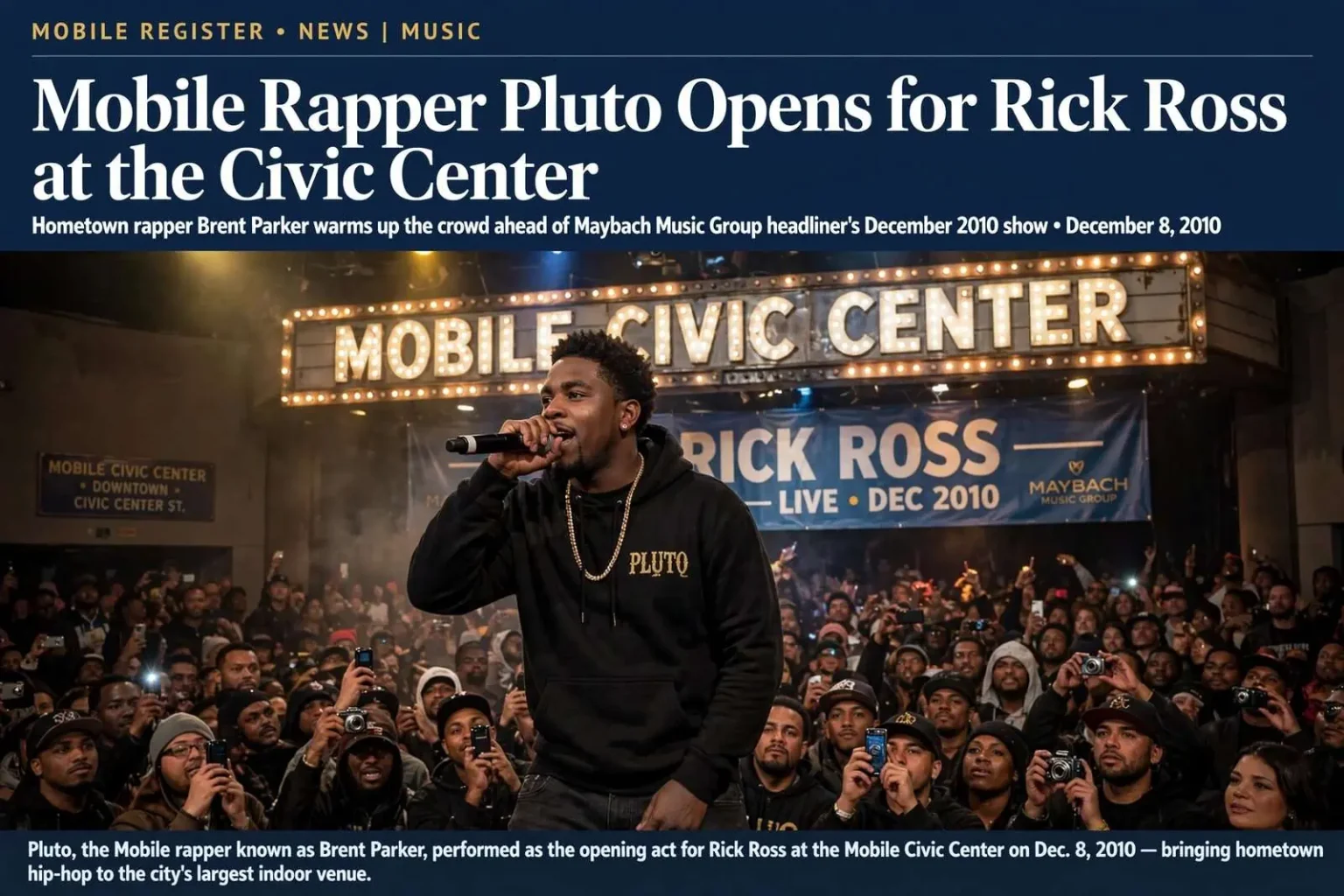
When Rick Ross brought his tour to Mobile in December 2010, the warm-up act belonged to the host city. Pluto, the stage name of Mobile rapper Brent Parker, took the stage at the Mobile Civic Center ahead of the headliner, putting a hometown artist in front of one of the largest crowds a local rapper could reach in that era.
The Civic Center theater has long served as Mobile’s main stop for major touring concerts. Situated downtown on Civic Center Street near the Arthur C. Outlaw Convention Center and the banks of the Mobile River, the venue draws acts that might otherwise skip the Gulf Coast for New Orleans or Pensacola. Landing an opening slot on a national tour there meant exposure to thousands of ticket holders who had come to see one of hip-hop’s biggest names, and for a Mobile artist it meant doing so on home ground.
The hometown showcase
Opening for a headliner of Ross’s stature was no small booking. By December 2010, Ross stood among the most commercially successful figures in rap, with a string of chart-topping albums behind him and his Maybach Music Group imprint building momentum. Tours of that size typically carried only one or two opening acts, and the slots were highly contested among regional artists. For a local rapper, the chance to perform at the Civic Center was a career marker: the room, the production level and the audience size all exceeded anything available at the clubs and small halls where local hip-hop usually lived.
Pluto reflected on the performance in an interview taped backstage at the show, video of which accompanied the original report. Backstage interviews of that kind were a common way for local outlets to capture the immediacy of a major concert night — the energy in the building, the crowd’s reception of the opener, and what the booking meant for a hometown performer’s trajectory.
Mobile’s hip-hop landscape at the time
Mobile’s rap scene in 2010 was active but largely underground. The city had produced regional names over the preceding decade, and Gulf Coast hip-hop more broadly — stretching from Houston through New Orleans and along the Panhandle — had a well-established identity built on Southern production, local pride and a strong club circuit. But Mobile lacked the industry infrastructure of larger Southern cities. There were no major labels headquartered locally, few studios of national caliber, and limited radio support for hometown artists on mainstream stations. Local rappers built followings through mixtapes, club shows, word of mouth and, increasingly by 2010, the internet — MySpace was fading but YouTube and early social media were becoming the primary ways artists reached listeners.
Against that backdrop, a Civic Center stage mattered. The venue represented the divide between local buzz and mainstream visibility. Artists who packed a club on Spring Hill Avenue or near the University of South Alabama were still playing to a few hundred people; the Civic Center held several thousand. An opening set put Pluto in front of an audience that had paid full ticket prices and arrived early enough to watch — a far more attentive crowd than a bar clientele waiting for the headliner’s DJ set.
Why national tours stop in Mobile
Mobile’s place on the touring map has always depended on its venues. The Civic Center, opened in the 1960s, became the standard mid-size stop between New Orleans and Pensacola or Tallahassee. Booking agents routing Southern tours weighed the city’s population base against its distance from larger markets, and Mobile frequently landed shows when a tour needed a Gulf Coast date that did not require a detour. Hip-hop tours of the era followed that logic the same as rock and country tours did, and by 2010 the Civic Center had hosted touring rap acts for more than a decade.
For the city, a major rap tour stop was also a statement about the local market. promoters tracked how tickets moved in secondary Southern markets, and strong sales in Mobile encouraged future bookings. Every sold-out date raised the odds that the next national package tour — and its opening slots — would include a Mobile date.
What an opening slot builds
The economics of an opening slot rarely made the opener rich, but the value was in positioning. Sharing a bill with a platinum-level headliner conferred credibility that local shows could not: it signaled that a national tour considered the artist worth presenting to its audience. Performers used such nights to sell merchandise, grow mailing lists and record footage that would carry their name far beyond the room. In 2010, a well-shot stage clip or backstage interview could circulate for months online, extending the reach of a single night’s work.
For the local scene, the visibility worked the same way. Every Mobile artist who reached a major stage demonstrated to younger rappers in the city that the path existed — that a local performer could go from open mics and club dates to sharing a bill with one of the biggest names in the genre. That demonstration effect mattered in a market where formal industry pipelines were thin.
December 2010’s Civic Center show has since settled into Mobile’s music history as one of those nights when the national touring circuit and the hometown scene briefly overlapped. Pluto opened for Rick Ross on the city’s biggest indoor stage, talked about it backstage on camera, and gave Mobile’s rap community a reference point: a local name, on a national bill, in front of a home crowd.
The night also illustrated how touring packages were assembled in that era. Headliners of Ross’s commercial weight typically had tour support from a major label, and the choice of local openers often fell to a combination of the booking agent, the promoter staging the date, and sometimes the headliner’s own management, who liked giving a regional act a look in each market. A promoter with roots in the city frequently pushed for a hometown opener because it helped sell tickets to casual buyers who recognized a local name alongside the headliner’s. That dynamic gave Mobile artists a recurring, if narrow, path onto major bills: cultivate local demand first, then let the promoter’s ticket-pressure argument carry the request to the tour.
Opening slots also demanded a specific performance skill. A local crowd at a club show shows up to hear the opener’s songs; a touring crowd shows up for the headliner and treats the opener as background until the main event. Winning that room over in a twenty- or thirty-minute set required front-loading energy, keeping banter short and leaning on material with immediate, physical impact. Artists who did it well came away with a new gauge of their own stagecraft, because the Civic Center’s size and sightlines exposed weaknesses that a club’s intimacy would hide.
The Civic Center’s role in the city’s cultural life
By 2010 the Mobile Civic Center had accumulated decades of history as the city’s principal indoor arena and theater complex. It hosted touring concerts, touring Broadway productions, graduations, sporting events and civic gatherings, and for generations of Mobilians it was simply where big shows happened. Its theater configuration, used for concerts that did not need the full arena floor, offered a mid-sized room that suited solo artists and hip-hop tours alike. Generations of local performers measured their careers by whether they had played the building, much as musicians in other mid-sized Southern cities measured themselves by their town’s equivalent hall.
The venue’s downtown location reinforced its centrality. A concert night filled nearby restaurants and bars before and after the show, and the walk from the parking areas to the entrances carried the visual energy of a major event arriving in a city that saw few of them relative to New Orleans two hours west. Local media covered arrivals and soundcheck gossip the way bigger markets covered arena tours, and a December date — in the heart of the holiday season and Mobile’s own carnival build-up — sat on a calendar already crowded with parties and gatherings.
Southern rap’s momentum at the decade’s turn
The timing of the December 2010 date caught Southern hip-hop at a moment of dominance. By then, artists from Georgia, Tennessee, Florida and Louisiana had spent a decade converting regional styles into the commercial center of the genre, and executives in New York and Los Angeles routinely looked to the South for the next wave. Mobile sat geographically inside that corridor even if it remained commercially peripheral. Tour routes along the Gulf Coast connected Houston, New Orleans, Mobile and Pensacola into a strip that Southern artists reliably played, and audiences in those cities responded to the touring acts from their own region with particular intensity.
That regional loyalty shaped the atmosphere inside the Civic Center that night. Gulf Coast audiences treated Southern headliners as their own, and the opener from their hometown benefited from the crowd’s readiness to celebrate anyone on the bill who carried local credentials. Announcing “Mobile’s own” from a Civic Center stage produced the kind of roar that clubs rarely matched, and for the artist on stage it was the clearest possible evidence of how far a hometown reputation could carry.
The performance, the backstage interview and the tour date together capture a specific moment in Mobile’s music history: December 2010, when the national machinery of a major rap tour reached the Gulf Coast, and the city’s own Brent Parker — Pluto — stood on the Civic Center stage as the hometown door through which it entered.