
Mobile Reflects on Hank Aaron’s Legacy as Talk of Renaming the Atlanta Braves Grows
After Hank Aaron's death, talk of renaming the Atlanta Braves the Atlanta Hammers resonates in his hometown of Mobile, where his legacy began.
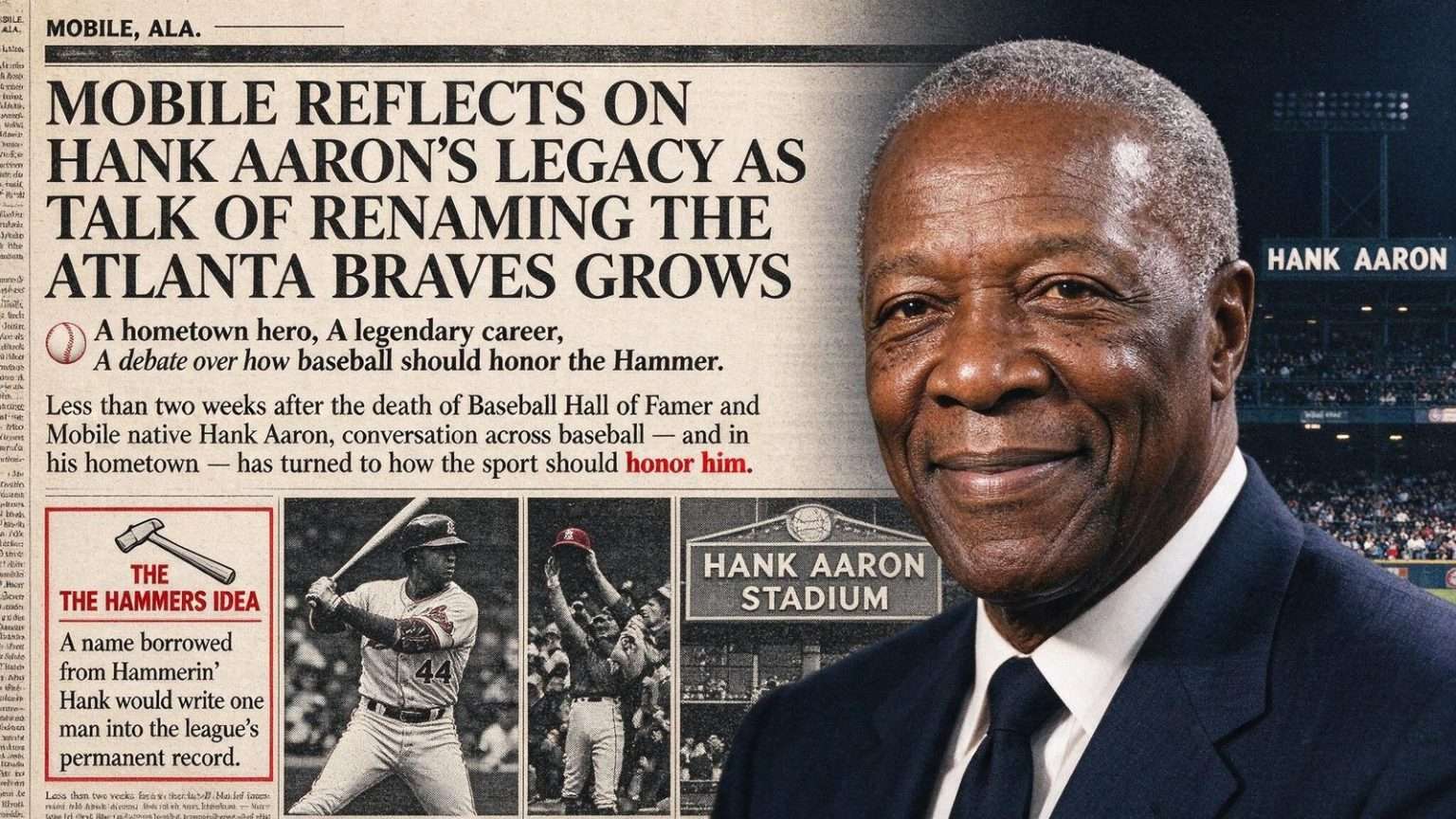
MOBILE, Ala. — Less than two weeks after the death of Baseball Hall of Famer and Mobile native Hank Aaron, conversation across baseball — and in his hometown — has turned to how the sport should honor him, including a proposal making the rounds to rename the Atlanta Braves the “Atlanta Hammers” in tribute to the slugger known forever as “Hammerin’ Hank.”
Aaron, who grew up in Mobile’s Toulminville neighborhood and rose from a sandlot shortstop to baseball’s all-time home run king, died January 22, 2021 at age 86. His passing prompted an outpouring of tributes nationwide and a renewed debate over whether the Braves franchise should go further than any other in tying its identity to the man many consider the greatest player the game produced.
The “Hammers” idea
The “Hammers” idea has struck a chord with fans who note that no active MLB club carries the name of the sport’s most storied home run hitter, and that Atlanta — the team Aaron starred for over two decades — would be the natural home for such a tribute. The nickname writes itself: “Hammerin’ Hank” was the handle that followed Aaron from Milwaukee to Atlanta, and a club called the Hammers would carry his legacy in every scoreline, every merchandise shelf and every broadcast.
Others counter that the organization’s existing commitments, including retiring his number 44 and celebrating his record, are sufficient honor. Franchise renames are rare and complicated undertakings — entangling trademarks, traditions and a fan base’s sense of continuity — and skeptics of the proposal argue that the Braves’ decades of recognition of Aaron already constitute a living memorial.
The debate has played out across talk radio, social media and newspaper columns in both Atlanta and Mobile, and it touches on a broader question baseball faces after Aaron’s death: how to keep the achievements and the example of its passing icons present for fans who never saw them play.
Mobile’s claim on the Hammer
In Mobile, where Aaron’s name adorns the downtown stadium that long hosted the city’s minor league club and where he is remembered as the city’s most famous son, residents have followed the naming discussion with particular interest. Hank Aaron Stadium stands as the most visible civic tribute to the slugger, a reminder that his story — and Mobile’s — are inseparable.
For the Port City, any change in Atlanta would be felt as recognition of a hometown hero whose journey began on the diamonds of Mobile. Aaron came up through Mobile’s sandlot and semi-pro baseball culture alongside a remarkable generation of native sons — a pipeline that made the city one of the most fertile producers of major league talent in American history.
Whatever the franchise ultimately decides, the week’s conversation has underscored how deeply Aaron’s legacy runs — from Toulminville to Atlanta and throughout the sport he redefined.
From Toulminville to the record books
Aaron’s path from the sandlots of Toulminville through the Negro Leagues and on to the major leagues remains one of the defining stories in American sport. He broke in with the Indianapolis Clowns of the Negro Leagues before signing with the Boston and Milwaukee Braves organization, and by the time the franchise moved to Atlanta in 1966, he was already the face of the team he would star for over two decades.
His chase and capture of Babe Ruth’s all-time home run record in 1974 stands among the most consequential achievements in the sport’s history — pursued under intense public pressure and hostility, and completed with a dignity that cemented Aaron’s standing beyond baseball. When he finished his career, his 755 home runs stood as the all-time record, and his totals in runs batted in, extra-base hits and total bases remain benchmarks of sustained excellence.
For Mobile, that career began in a neighborhood just north of downtown where Aaron honed his swing hitting bottle caps and taped balls. The city has claimed that origin story proudly for decades, and his death in January 2021 prompted memorial gatherings and tributes across the city he always called home.
What a rename would mean
Major league franchises have rarely renamed themselves for individuals, which is precisely what makes the “Atlanta Hammers” proposal notable. A team name borrowed from a single player would be unprecedented in the modern era — less a rebrand than a canonization, writing one man into the league’s permanent record in a way no plaque or retired number quite matches.
Supporters of the idea point to the fit between city and name: Aaron spent more seasons in an Atlanta uniform than anywhere else, closed his career with the Braves, and remained a fixture of the organization and the city long after retirement. Retiring number 44, they note, honors him within the team’s history; a rename would place him at the center of its identity.
Critics respond that a franchise’s name belongs to its fans across generations, and that the existing tributes — the retired number, the record celebrations, the stadium and street names bearing his name across Georgia and Alabama — already bind the organization to his memory. The discussion, for now, remains unofficial: a proposal circulating among fans and commentators rather than an announced plan.
A city that produces ballplayers
Aaron’s connection to Mobile is part of a larger story that locals never tire of telling. The city produced, by any fair count, one of the greatest collections of baseball talent any American city has sent to the major leagues: Aaron, Satchel Paige, Willie McCovey, Ozzie Smith, Billy Williams and others all emerged from the same modest geography — sandlots, park leagues and school yards spread across Mobile’s neighborhoods.
Paige, the legendary pitcher whose Negro Leagues career made him one of the sport’s greatest drawing cards before his late major league arrival, grew up in Mobile’s down-the-bay neighborhoods; McCovey and Williams carried the city’s hitting lineage into their own Hall of Fame careers. Baseball historians have long debated what made Mobile so fertile — the climate’s year-round seasons, the dense network of sandlot competition, the town’s industrial-era park system — but the results are beyond dispute.
Within that constellation, Aaron holds a singular place. His rise from Toulminville through the Negro Leagues to the summit of the sport’s record books gave Mobile its most famous son, and the city has honored that claim with the stadium bearing his name and a museum telling his story to visitors.
The week the sport remembered
The days following Aaron’s death on January 22, 2021 brought tributes from every corner of the sport — ballparks lowering flags, former teammates recalling his quiet generosity, and commissioner’s office statements noting his role in breaking barriers as well as records. Aaron’s march past Babe Ruth’s record in 1974 had carried a weight far beyond sport, and the tributes reflected the full measure of the man.
In Atlanta, the discussion of the “Hammers” name joined those tributes as a longer-term question: how should the franchise that employed him for 23 seasons — first in Milwaukee, then in Atlanta — bind his memory to its future? No decision has been announced, and any such change would involve the franchise’s ownership, Major League Baseball and the usual consultation with the Aaron family.
In Mobile, the conversation has been simpler and more personal. The city that watched Henry Louis Aaron grow up knows exactly what his name is worth — it has, after all, been putting it on a stadium sign for decades. Whatever Atlanta decides, Toulminville’s favorite son remains, as one local tribute put it in spirit, the Hammer no matter the city on the jersey.
The proposal’s momentum, whatever its fate, has already accomplished something: it has forced a conversation about how baseball formalizes gratitude toward figures like Aaron, whose contributions exceeded the statistics he compiled. Renames, monuments, museum wings and leaguewide honors all sit on that spectrum, and the week’s debate has laid out the options with unusual clarity.
For the Braves, the decision would carry the weight of a franchise that Aaron defined for two decades — and of a city whose relationship with him spanned his playing career, his business ventures and his decades of civic work after retirement. For Mobile, the name on the team in Atlanta would merely echo what the city has known since the 1950s: that the greatest home run hitter ever to play the game learned his swing here, in Toulminville, on diamonds that still dot the neighborhoods where he grew up.
The sport has honored Aaron in the weeks since his passing with the tools it has at hand — tributes at ballparks, retrospectives on his record chase, and reflections on the barriers he broke along the way. Whether those honors eventually expand to something as sweeping as a franchise rename, the conversation in Mobile and Atlanta alike has made one thing plain: a legacy that runs from Toulminville to Atlanta is not the property of one city or one team, but of the entire game he redefined.


