Mobile River Bridge Project Clears Key Funding Hurdle as Costs Rise to $2.6 Billion
The Mobile Metropolitan Planning Organization approved key funding revisions for the Mobile River bridge Wednesday, pushing the total project cost past $3.5 billion.
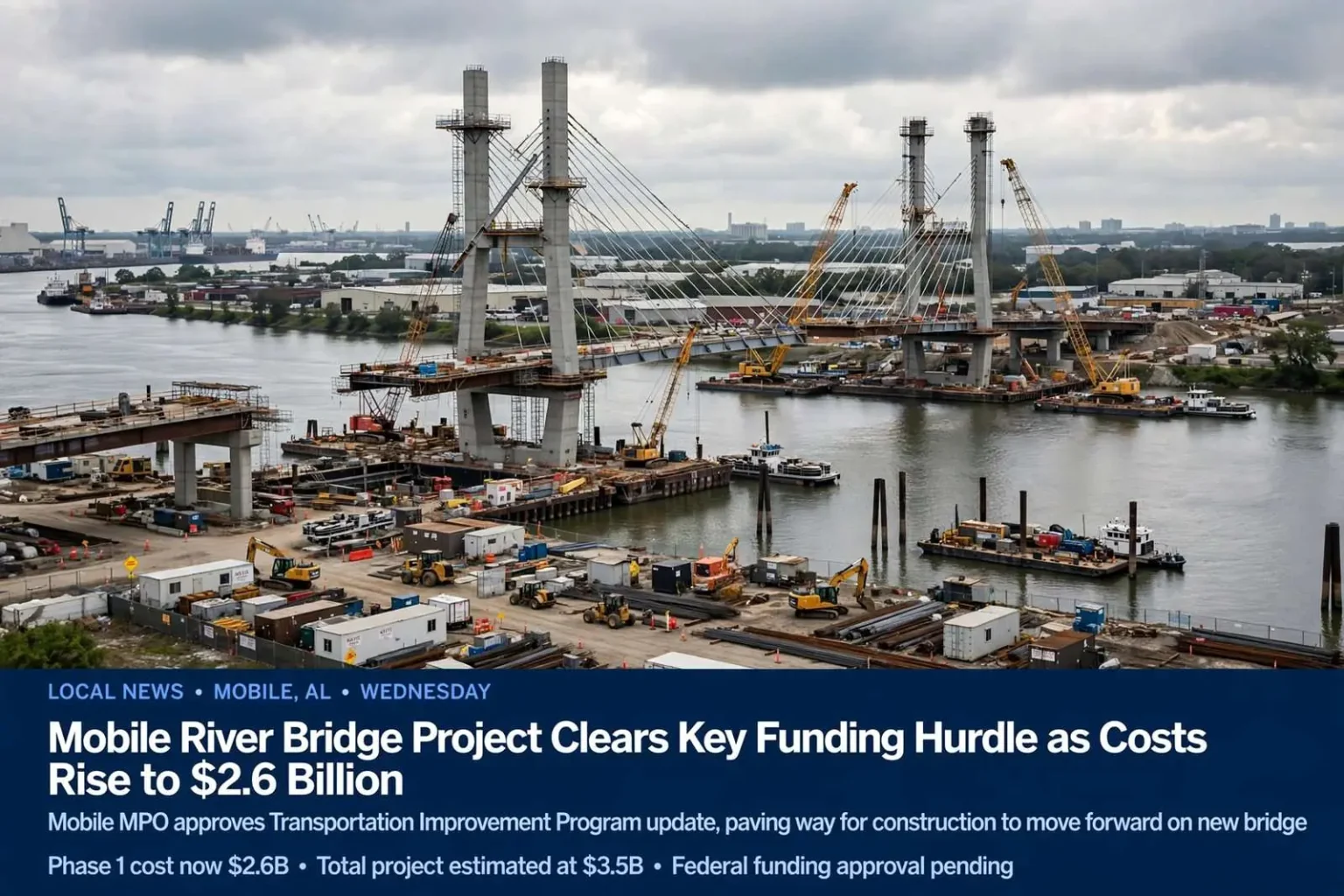
A major hurdle for the long-planned Mobile River bridge fell Wednesday, as the Mobile Metropolitan Planning Organization approved revisions to its Transportation Improvement Program that pave the way for construction to move forward.
The vote, taken with little fanfare, updates the cost and scope of the project — a sharp contrast to a 2019 MPO meeting when angry protesters packed the room to oppose bridge tolls, ultimately killing that version of the plan.
“All of us are really happy that we’re moving this forward,” Mobile County Commissioner and MPO Chairwoman Merceria Ludgood said after the vote.
Road and bridge projects are ineligible for federal funding unless they appear in a region’s Transportation Improvement Program, making Wednesday’s amendment a necessary step before the state can finalize billions of dollars in federal financing.
Costs climb past $3.5 billion
The project has been split into two phases after costs skyrocketed under the original plan, which called for a new bridge and a new bayway built simultaneously. The first phase now includes a cable-stayed bridge rising 215 feet above the Mobile River, carrying three lanes of traffic in each direction. That phase was originally estimated at just under $1.7 billion; Wednesday’s revision raised the figure to roughly $2.6 billion.
A new bayway will be built at a later date. In the meantime, the state plans to restripe the existing bayway span to carry three lanes in each direction, at a cost of more than $888 million. Combined, the total project budget now tops $3.5 billion, including about $3.2 billion the contractor will receive.
Edwin Perry, the Mobile River bridge project director, said the state is finalizing documentation needed to draw down hundreds of millions of dollars in already-awarded federal grants and secure federally backed low-interest loans. “This is kind of the last piece to be able to finalize those documents,” Perry said. “So we’ve submitted a lot of that information, but with this approval, that’s able to continue moving forward.”
Perry said he expects the funding package to be finalized by mid-September, with a notice to proceed issued to contractor Kiewit Massman Traylor in October. The firm already has a temporary office near the Wallace Tunnel and plans to bring in trailers for a field office on state-owned land off Royal Street; crews have already begun driving test pilings into the ground.
A different climate around tolls
Mobile Mayor Spiro Cheriogotis, vice chairman of the Mobile MPO, said the moment is critical for the region. “I hope the message is out that: Look, it’s now or never,” he said. “It is this plan or none.”
Cheriogotis acknowledged that many residents still oppose tolls, but said resistance has been quieter than in 2019 because the proposed rate — $3 per crossing for drivers using ALGO passes — is lower than what was proposed under the earlier plan. He argued the bridge’s importance goes beyond easing traffic for summer beachgoers. “The talking point of this being a military corridor is not just a talking point; that is reality,” Cheriogotis said. “And, you know, when it comes to national safety, I don’t think we can spare any expense.”
Separately, the Alabama Department of Transportation plans to widen Interstate 10 from the Daphne exit to Malbis to maintain three lanes in each direction to Alabama Highway 181. State officials expect to award a roughly $45 million contract for that work by December, with construction slated to begin in spring and take about two years to complete.
What an MPO Does
Federal law requires a metropolitan planning organization for every urbanized area with a population of more than 50,000. MPOs, made up of local elected officials and transportation agencies, set regional transportation priorities and decide which projects are listed in the Transportation Improvement Program. The Mobile MPO covers the Mobile County side of the bay, while the Eastern Shore MPO covers the urbanized area of Baldwin County.