Mobile Rolls Out Red Carpet for Navy Week, with Ship Tours, Parades and Parachute Jump on Schedule
Mobile is hosting Navy Week with ship tours, a parachute jump and Navy Band appearances in several Mardi Gras parades through Feb. 28.
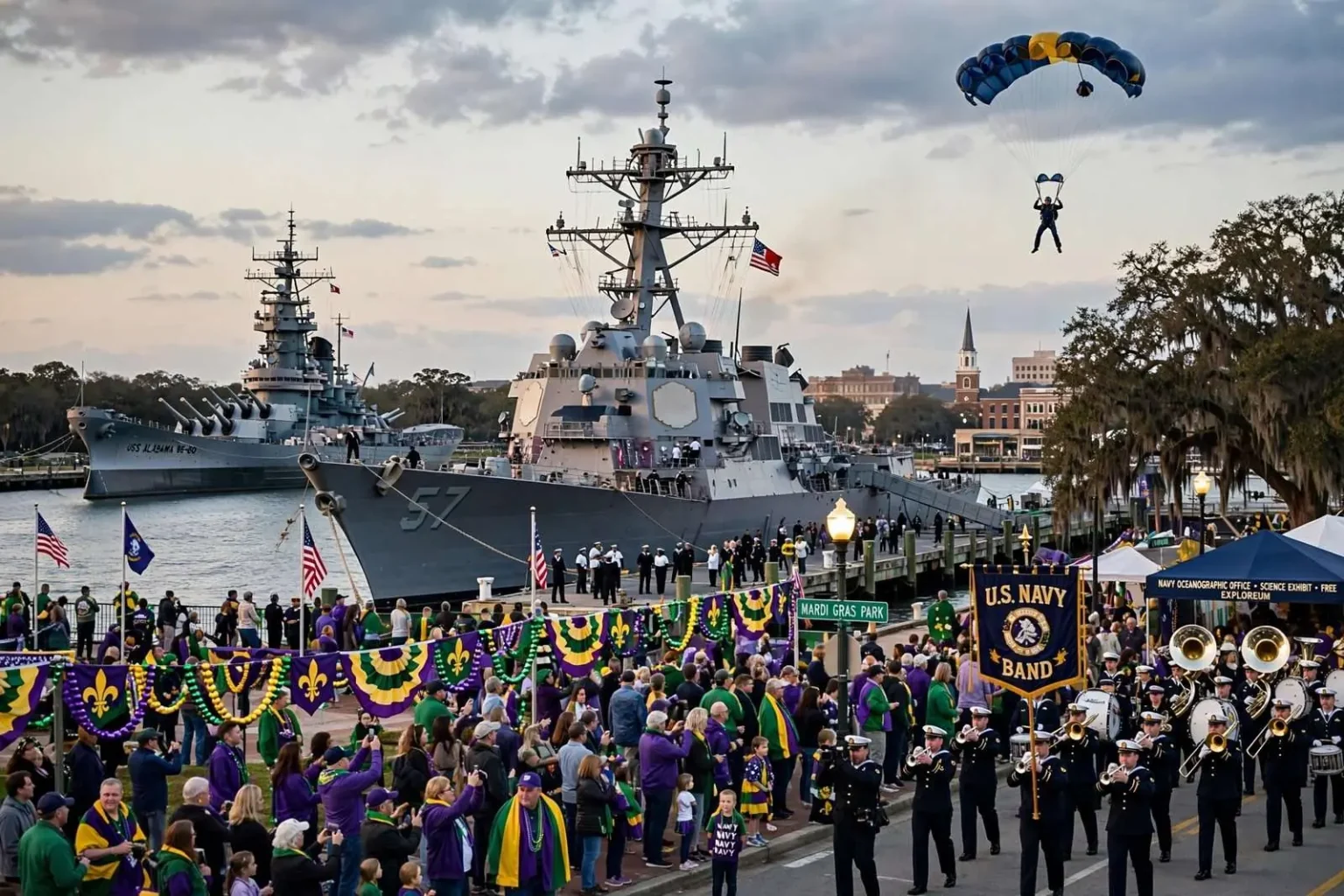
Mobile is one of just 15 cities nationwide selected to host Navy Week this year, and Mayor Sandy Stimpson’s office has released a packed schedule of public events running from Thursday, Feb. 23 through the following Tuesday, giving residents a chance to tour Navy ships, watch a parachute demonstration and catch the Navy Band in several Mardi Gras parades.
“We are honored to be one of the 15 cities selected to host Navy Week, one of the Navy’s signature outreach programs,” Stimpson said in a statement. “I encourage all of our citizens to take advantage of this opportunity to learn about the Navy, its people and its importance to national security. Whether you’re taking a tour of the USS Mitscher, watching the ‘Leap Frogs’ jump to Mardi Gras Park or cheering on the Navy Band during a parade, please welcome our Navy with Mobile’s famous Southern hospitality.”
The Navy Week program exists precisely for cities like Mobile — communities with deep naval and maritime roots but no major Navy base, where most residents rarely encounter the fleet in person. By bringing active ships, sailors and specialty teams to town for a concentrated week of public events, the Navy opens itself to the kind of first-hand contact that a recruiting poster cannot provide, and Mobile’s selection among 15 cities nationwide reflects both its status as a major Gulf Coast port and the city’s long historical ties to the sea services.
The week kicks off at the Battleship
The celebration kicks off Thursday, Feb. 23 with a Navy Week Mobile kickoff event at Battleship Memorial Park at 8:50 a.m., followed that evening by the Navy Parachute Team, known as the “Leap Frogs,” performing a jump into Mardi Gras Park at 5:30 p.m. The pairing of the two venues says much about Mobile’s relationship with the Navy: the park on Mobile Bay is the permanent home of the USS Alabama, the World War II battleship that generations of Mobilians worked to save from the scrapyard in the 1960s, while Mardi Gras Park sits in the heart of downtown, where the city’s carnival traditions play out each winter.
The Leap Frogs are the Navy’s elite parachute demonstration team, drawn from the service’s special warfare community, and their evening jump into a downtown park gives spectators a close-up look at skills the public otherwise sees only in recruitment videos. Free-fall parachutists exits, canopy work and precision landings in a compact urban park demand both skill and favorable weather, and the 5:30 p.m. timing put the performance at dusk when downtown crowds are thickest during the Mardi Gras season.
Friday: service and science
On Friday, Feb. 24, Navy sailors are scheduled to take part in a Habitat for Humanity project, while the Navy Oceanographic Office sets up an exhibit at the Exploreum Science Museum from 10 a.m. to 4 p.m. That evening, the Navy Band will march in the Crewe of Columbus parade starting at 6 p.m.
The Friday pairing captures the two sides of a modern Navy Week. The Habitat build sends sailors into neighborhoods with hammers and saws rather than uniforms and formations — visible community service of the kind that builds goodwill one house at a time. The oceanographic exhibit at the Exploreum, meanwhile, shows the scientific face of the service: the Naval Oceanographic Office maps the world’s oceans, forecasts sea conditions and supports everything from fleet navigation to search-and-rescue, and its displays give students and families a look at the Navy’s less-publicized technical missions.
The Crewe of Columbus parade that evening folds the Navy into Mobile’s oldest civic tradition. Mardi Gras was born in Mobile more than a decade before New Orleans adopted it, and the city’s mystic societies parade through downtown every night of the season in the week before Lent. A military band marching in a Mardi Gras parade reaches an audience that no standalone concert could gather, and it embeds the Navy within celebrations Mobilians already attend in force.
Saturday: ships, divers and concerts
Saturday, Feb. 25 offers residents the chance to tour the USS Mitscher, open to the public from 8 to 10 a.m. and again from 1 to 3 p.m. The Navy Oceanographic Office exhibit continues at the Exploreum throughout the day, while the USS Constitution Color Guard marches in the Floral parade at 10:30 a.m. Navy Explosive Ordnance Disposal technicians and divers will set up a dive tank at Mardi Gras Park from noon to 6 p.m., and the Navy Band performs a concert at the USS Alabama Park Pavilion at 2 p.m. before marching in the Mystics of Time parade that evening at 6 p.m.
The ship tour is the week’s centerpiece. The Mitscher is an Arleigh Burke-class guided-missile destroyer — the workhorse surface combatant of the modern fleet, named for the famed World War II Admiral Marc Mitscher, a pioneer of carrier aviation whose career ties him historically to the very theaters in which the USS Alabama fought. Walking the decks of a destroyer gives Mobile visitors a sense of scale no museum can: a warship more than 500 feet long, manned by a few hundred sailors, packed with sensors, weapons and machinery that keep it underway for months at a time. Tours in two morning and afternoon windows give the public a working window into shipboard life, from the enlisted berthing spaces to the bridge.
The USS Constitution Color Guard connects the modern fleet to its oldest ancestor. “Old Ironsides,” berthed in Boston, is the world’s oldest commissioned warship still afloat, launched in 1797, and its color guard carries the navy’s deepest traditions onto parade routes around the country. Its 10:30 a.m. appearance in the Floral parade placed the nation’s naval past and present on the same downtown streets within a single day — the Constitution’s guard in the morning parade, the Navy Band in the Mystics of Time procession that evening.
The EOD dive tank at Mardi Gras Park is the week’s most hands-on attraction. Navy Explosive Ordnance Disposal technicians — the specialists who neutralize mines, unexploded ordnance and improvised devices — are among the military’s most selective communities, and a public dive tank lets visitors watch divers work, ask questions and see equipment that usually operates far from public view. A six-hour engagement from noon to 6 p.m. meant the display ran through the height of a downtown Saturday, when Mardi Gras crowds fill the streets around the park.
The afternoon concert at the USS Alabama Park Pavilion and the evening march in the Mystics of Time parade bookended the band’s day. Navy musicians log hundreds of performances a year on the Navy Week circuit, and their repertoire runs from ceremonial marches to popular music — a versatility that serves both a pavilion audience at the battleship park and a parade crowd waving for moon pies along Government Street.
A natural fit for the Port City
Mobile’s selection for the Navy Week roster is no accident of geography. The city’s harbor is home to one of the nation’s largest shipbuilding and repair complexes, where thousands of area residents build, convert and overhaul military and commercial vessels; its port ranks among the busiest on the Gulf; and its WWII-era defense industries once employed tens of thousands of workers at facilities like the Alabama Dry Dock and Shipbuilding Company, which built and repaired ships through two world wars. The USS Alabama’s presence at Battleship Memorial Park — a National Historic Landmark visited by hundreds of thousands each year — is itself a monument to the state’s naval tradition.
The Navy Week program and why Mobile matters to it
The Navy Week outreach program dates to 2000, when the service began concentrating public engagement in inland and mid-sized cities where most Americans have no daily contact with naval forces. The idea is straightforward: with fewer than one percent of Americans serving in uniform, and with the fleet concentrated on either coast, the Navy takes ships, bands, divers, parachute teams and sailors into communities that would otherwise never see them. Each Navy Week coordinates dozens of public events — ship tours, school visits, community service projects, concerts and parades — around a single visiting vessel.
Being one of just 15 cities selected in a given year is a competitive distinction. Host cities are chosen for a combination of regional significance, recruiting priorities, maritime heritage and local enthusiasm, and Mobile scores on every count. The city produced generations of Navy and Coast Guard personnel, its shipyards maintain the fleet’s readiness, and its Mardi Gras season offers the Navy Band a parade schedule unlike any other city on the tour — a dozen engagements woven into celebrations that draw hundreds of thousands to downtown streets each February.
The timing also serves both partners. For the Navy, a Mardi Gras parade circuit means daily exposure to dense, enthusiastic crowds during the city’s biggest public season. For Mobile, the visiting units add a patriotic dimension to carnival week that city officials have long valued — a reminder, amid the balls and parades, of the maritime service whose heritage runs through the port’s history from the colonial era through World War II to the present.
What visitors need to know
Every headline event of the week is free and open to the public. The kickoff ceremony at Battleship Memorial Park on Thursday morning, the Leap Frogs’ jump into Mardi Gras Park that evening, the Exploreum exhibits, the ship tours aboard the Mitscher on Saturday morning and afternoon, the EOD dive tank, the pavilion concert and the parade appearances all require nothing more than arriving early enough to find a spot — though ship tours, limited to the posted windows, reward early arrival with shorter lines.
Visitors planning to tour the Mitscher should expect the usual security requirements for boarding an active Navy vessel: photo identification for adults, bag checks, and restrictions on what can be carried aboard. Comfortable shoes help as well — destroyer tours involve companionways and ladders that reflect the ship’s design for war, not convenience.
For families, the week offers something rare: a chance for children to meet sailors and see the tools of their trades up close — to ask an EOD technician what the job is like, to watch a diver work the tank at Mardi Gras Park, to stand on a destroyer’s deck and look down the length of a modern warship. That is the entire point of the Navy Week program, and the reason the mayor’s office has pressed every citizen to take part.
The rest of the week
The schedule released by the mayor’s office runs through Tuesday, Feb. 28, with additional community engagements — school visits, service projects and performances — filling out the days between the weekend’s headline events. Navy Weeks typically conclude with the visiting ship’s departure and a final round of performances, and Mobile’s residents will have one more Mardi Gras-season week in which downtown’s daily crowds include working sailors on liberty, color guards in parade formation and, along the waterfront, a warship open to anyone curious enough to walk her decks.
For a city whose identity is inseparable from the water — the bay, the river delta, the shipways and the port — the week is both a celebration and a homecoming of sorts. The Navy is part of Mobile’s past and its present economy; Navy Week 2017 put its people, ships and skills on public display for the city to welcome, as the mayor put it, with Mobile’s famous Southern hospitality.