
Mobile Steps Up Enforcement of Minor Curfew in Downtown Entertainment District
Mobile police will check IDs and enforce the downtown entertainment district's minor curfew nightly from 10 p.m. to 5 a.m., in effect since 2011.
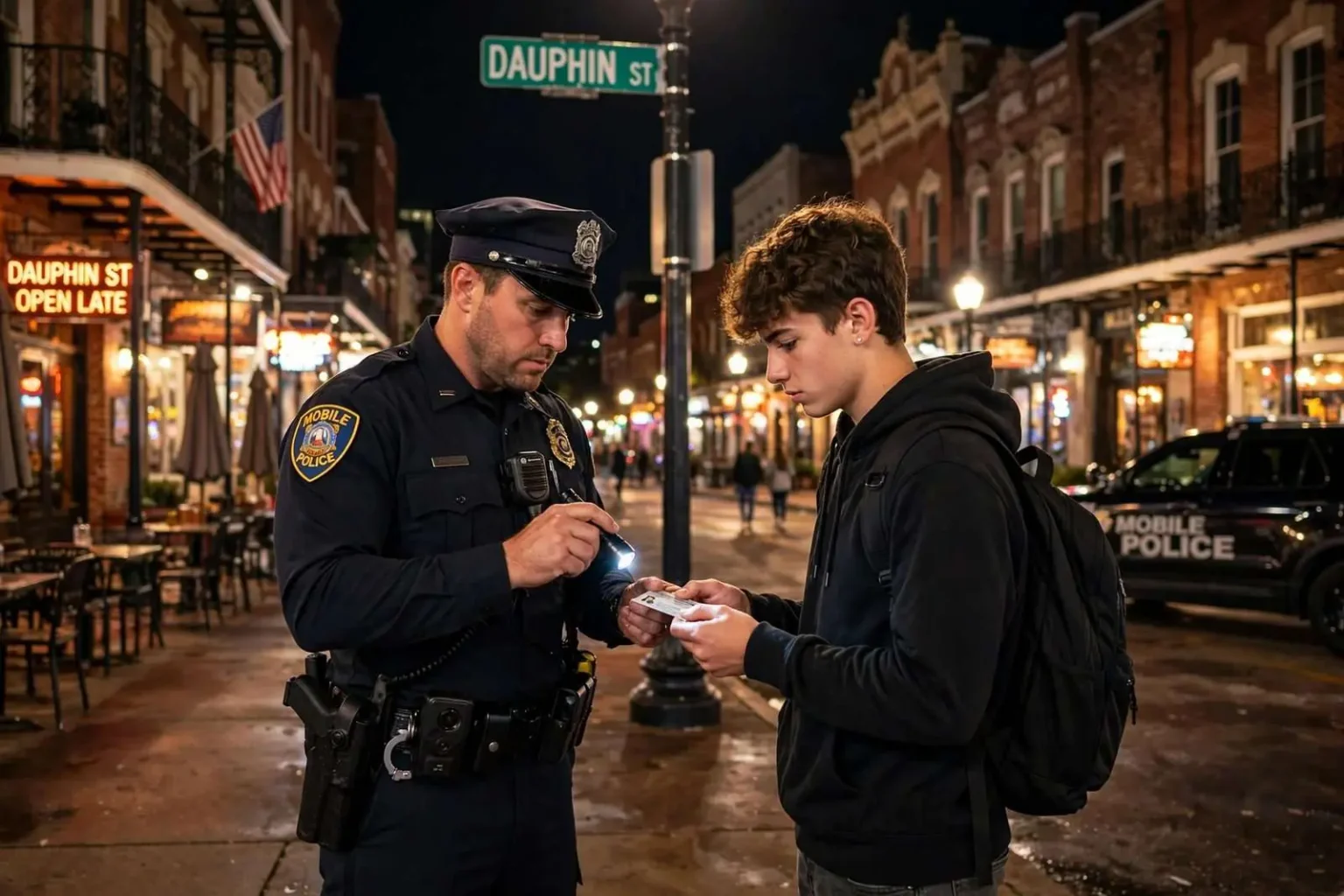
The City of Mobile is reminding families that its long-standing curfew for minors in the Downtown Entertainment District will be strictly enforced, with police checking IDs during overnight hours.
Under the ordinance, which has been on the books since 2011, it is unlawful for anyone 18 or younger to be in the district between 10 p.m. and 5 a.m. Officials said the curfew will be heavily enforced during those hours, and police will conduct ID checks.
Minors found in the district during restricted hours face being taken into custody, particularly when a parent or guardian is not present.
Where the curfew applies
The Downtown Entertainment District covers the heart of Mobile’s nightlife corridor. Its boundaries run along Government Street from Water Street to Dearborn Street, up Dearborn to Conti Street, east along Conti to Washington Avenue, with Water Street forming the eastern edge down to St. Joseph Street, St. Joseph and St. Louis streets forming the northern boundary, and Washington Avenue closing the loop on the west.
In practical terms, the zone takes in the blocks that most Mobile residents picture when they think of downtown nightlife: the bars, restaurants and music venues clustered along Dauphin Street and the surrounding grid of historic commercial buildings. On weekend nights, and especially during the Mardi Gras season that Mobile celebrates as the home of America’s original Carnival, the district draws crowds that range from college students to families attending parades and events.
That mix is precisely the point of the reminder. City officials have long balanced two goals downtown — supporting an entertainment economy that fills restaurants, venues and hotels, and keeping the district safe for the residents and visitors who move through it. A curfew aimed at minors during the late-night hours is one of the tools the city adopted more than a decade ago toward the second goal.
How the ordinance works
The curfew’s hours run from 10 p.m. to 5 a.m., a window that covers the peak of the district’s nightlife activity. Anyone 18 or younger within the boundaries during those hours is in violation of the ordinance, regardless of whether that person is doing anything else wrong.
Enforcement begins with identification. Police officers working the district during restricted hours will conduct ID checks on people who appear to be minors, and the reminder from city officials makes clear that those checks will be a regular feature of overnight policing downtown rather than an occasional sweep.
The consequences escalate when a parent or guardian is not present. Minors found in the district during restricted hours face being taken into custody in that situation, meaning an encounter that starts with an ID check can end with a young person in police care and a call to parents in the middle of the night.
Curfew ordinances of this kind are common across American cities, and they generally rest on a simple rationale: late-night entertainment districts present risks — traffic, alcohol-saturated crowds, altercations — that are disproportionate for minors, and cities lawfully may restrict minors’ presence during those hours while leaving adults free to come and go.
Why the city put a curfew on the books in 2011
Mobile’s ordinance dates to 2011, a period when downtown was in the midst of a transformation that continues today. The entertainment district along Dauphin Street had grown into the city’s nightlife center, drawing larger and younger crowds on weekends, and city leaders adopted the curfew as part of a broader strategy of downtown management.
The district’s design since then has included coordinated policing, private security partnerships and infrastructure improvements, all aimed at keeping the area’s growth from outpacing public safety. The curfew reminder fits that pattern: rather than a new restriction, officials are dusting off an existing rule and telling the public it will be applied consistently.
For downtown businesses, the enforcement message is a double-edged matter. Venues that serve alcohol have every incentive to keep minors out during late hours, and consistent ID enforcement downtown protects them from the liabilities and violations that underage presence can create. Families, meanwhile, are the audience for the reminder — the city’s message is aimed at making sure parents know the rules before a teenager’s night downtown becomes a police encounter.
What parents and teens should know
The practical takeaway for families is straightforward: after 10 p.m., anyone 18 or younger needs to be outside the district’s boundaries or risk an encounter with Mobile police. The boundaries are compact but specific, and they include more than just the Dauphin Street strip — the loop runs along Government, Dearborn, Conti, Water, St. Joseph, St. Louis and Washington streets, an area that covers several blocks of the central business district.
Teens who work downtown, attend events or simply cut through the area on foot should be aware that the ordinance applies to presence in the district, not to any particular activity. An ID check that shows a 17-year-old inside the boundaries at 11 p.m. is enough to trigger enforcement under the rule officials say will be strictly applied.
Parents of minors taken into custody under the ordinance should expect to be contacted by police, and picking up a teenager from an overnight police encounter is the outcome the city says it wants to avoid through advance notice. The reminder itself, officials indicated, is intended to prevent violations rather than fill the detention log.
Curfew rules also interact with special events. Downtown Mobile hosts festivals, parades and seasonal celebrations that draw families with children in the evening hours, and the ordinance’s application during such events depends on the hours those events run. Families attending early-evening festivals that end before 10 p.m. are unaffected; the restricted window begins when the clock does.
Mobile’s downtown policing context
The curfew enforcement reminder comes from the Mobile Police Department’s ongoing management of the entertainment district, a responsibility that has grown along with downtown itself. The department stations officers in the district during peak hours, and the ID checks announced will be performed by the officers already working overnight shifts in the zone.
Downtown policing in Mobile has evolved alongside the district’s popularity. What began as a handful of bars along a few blocks of Dauphin Street has expanded into a corridor of restaurants, music venues, breweries and event spaces spanning much of the historic core. Larger crowds bring larger demands — traffic control, crowd management during Mardi Gras, and the ordinary calls for service that any busy district generates.
Mobile is, by its own promotional tradition, the home of America’s first Mardi Gras, and the city’s downtown calendar is among the busiest on the Gulf Coast. The months between Carnival seasons carry their own event load, from food festivals to concerts, and the entertainment district functions as the anchor for most of them.
Against that backdrop, a 2011-era curfew ordinance is one of the quieter tools in the city’s kit. It attracts less attention than parade routes or road closures, but officials’ decision to remind the public of strict enforcement signals that the rule remains an active part of how the district is managed.
How other cities handle the same problem
Mobile is far from alone in restricting minors from nightlife zones during late hours. Cities across the country have adopted entertainment-district curfews, typically with the same structure Mobile uses: defined boundaries, defined hours and enforcement through ID checks, with consequences for minors found inside the zone who are not accompanied by a parent or guardian.
The rationale courts have generally accepted is that municipalities have a legitimate interest in protecting minors and in maintaining order in districts where alcohol is the central business. The ordinances are challenged from time to time on constitutional grounds, but age-based curfews tied to specific zones and hours have largely survived when drawn narrowly — and Mobile’s has been on the books, unremarked, for well over a decade.
What changes over time is enforcement emphasis. Ordinances like Mobile’s tend to cycle between quiet periods, when officers address violations as they arise, and active-enforcement campaigns like the one now being announced, when the city publicizes the rule in advance.
The boundaries, block by block
Because the ordinance turns entirely on geography, the boundaries deserve a closer reading. The district begins along Government Street from Water Street to Dearborn Street — a stretch that runs through the southern edge of the core. From Dearborn, the boundary runs north to Conti Street, then heads east along Conti to Washington Avenue.
Water Street forms the eastern edge, running down to St. Joseph Street, and St. Joseph and St. Louis streets together form the northern boundary. Washington Avenue closes the loop on the west. The result is a compact rectangle of the downtown grid that takes in the bulk of the city’s nightlife venues.
Streets and blocks just outside the loop are not covered, which matters for teens and parents calculating where the line falls. The ordinance is a zone rule, not a citywide curfew for minors — elsewhere in Mobile, minors’ late-night movements are governed by other laws and parental decisions, not this ordinance.
Visitors should note that downtown’s one-way grid and the placement of parking decks can make the boundaries less intuitive on foot than on a map. The practical advice from the city’s reminder is simple: if a member of your group is 18 or younger and the hour is past 10 p.m., move outside the loop.
The enforcement message
City officials’ language was direct: the curfew will be heavily enforced during restricted hours, and police will conduct ID checks. That phrasing signals a proactive posture — officers are expected to ask, not merely to respond when something goes wrong.
For minors, the consequence of a violation can be being taken into custody, particularly when a parent or guardian is not present. That outcome transforms a night out into a police record and a family inconvenience, and it is exactly the scenario the advance reminder is designed to prevent.
For parents, the message carries a logistical warning as well. A teenager downtown after 10 p.m. without an adult may require a parent to come downtown to retrieve them — or, if custody is involved, to handle the follow-up that police custody entails. Either way, the evening ends at a police station rather than a restaurant.
The city’s reminder closes the loop on a rule that has been part of downtown governance since 2011. The entertainment district remains open to adults at all hours the venues themselves operate; the curfew simply draws a line around who can be inside it after 10 p.m., and Mobile police say they will be checking IDs to hold that line.
Families with questions about the ordinance can direct them to the city, and the boundaries are public information available through the city’s communications. The enforcement campaign itself, officials said, is aimed at the overnight hours when the district’s crowds are thickest and the risks to minors are greatest — the hours when, in the city’s view, anyone under 18 or younger is better off at home.


