
Mobile Studying Curbside Recycling and a Countywide Partnership to Expand Service
A state-funded study explores curbside recycling for Mobile and possible partnerships with Saraland, Satsuma and other Mobile County cities.
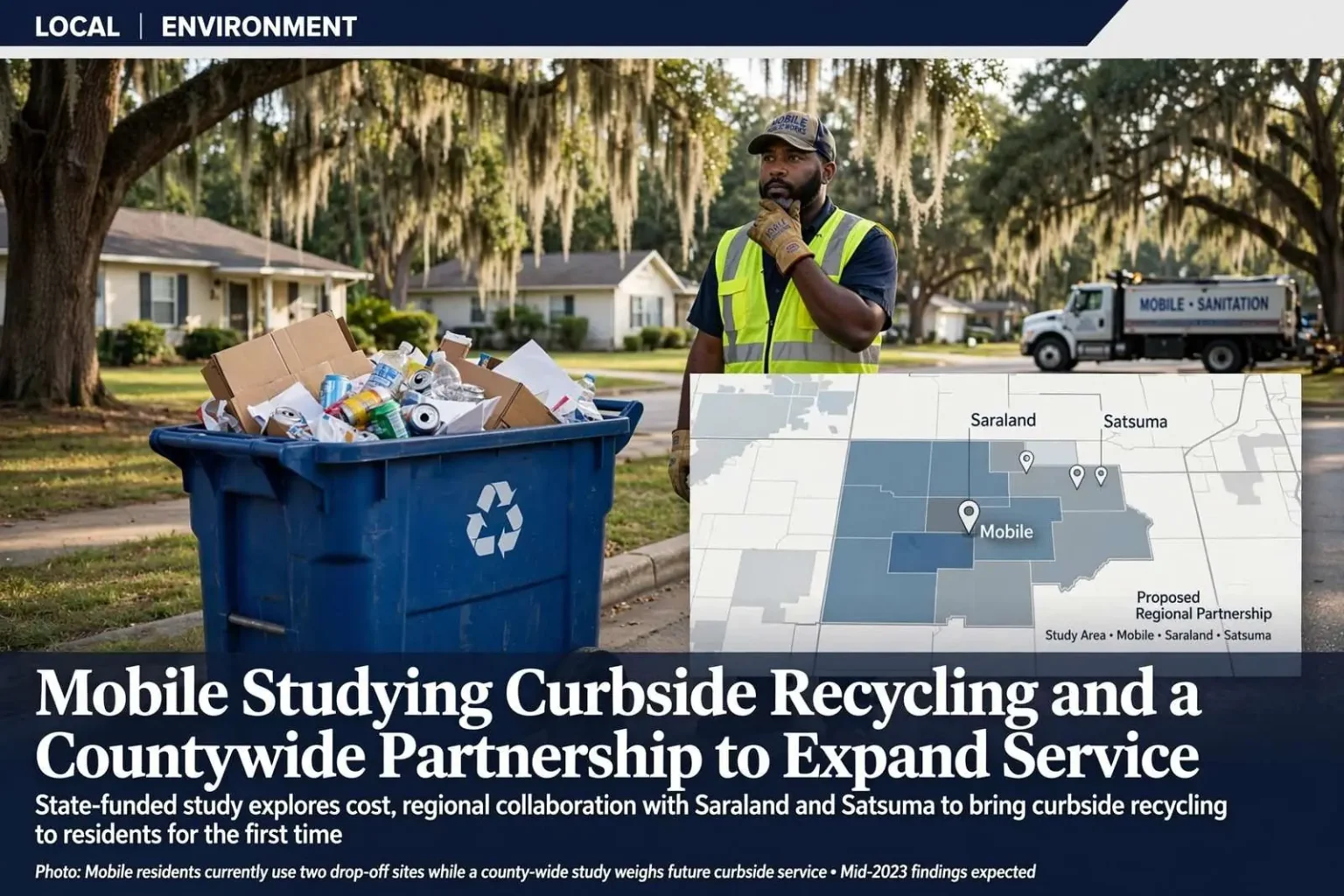
Curbside recycling has never been available in Mobile — a gap that sets the city apart from most of its peers and leaves residents who want to recycle with just two drop-off sites in the city limits, where they must sort and haul their own materials. A new study, funded by a state grant and approved by the Mobile City Council, will examine whether that can change, and whether the answer lies within the city’s borders or in a partnership reaching across Mobile County.
The study marks the city’s most serious examination yet of how a curbside program would work, what it would cost, and who might share in it. For a city of Mobile’s size, the absence of curbside service is unusual: comparable Southern cities have run residential recycling programs for years, and the question before Mobile is less whether recycling can be done than what it would cost, who would pay, and how the material would be processed once it left the curb.
Looking beyond city limits, the study takes stock of recycling infrastructure across all of Mobile County and explores whether municipalities such as Saraland and Satsuma could partner with the city to share costs. “How much would curbside recycling cost if we brought it to the city of Mobile or the city of Mobile, Saraland, Satsuma — how many of us could do it, and if we did it together would that bring the cost down?” asked Casi Callaway, the city’s Chief Resilience Officer.
The Regional Math of Recycling
The partnership question matters because recycling is an economics problem as much as an environmental one. Curbside programs carry heavy fixed costs — collection trucks, carts, drivers, routing and administration — and those costs are spread thinner when more households share them. A regional program serving Mobile, Saraland, Satsuma and potentially other municipalities could divide expenses across a much larger customer base, potentially bringing per-household costs down to a level each city’s budget and ratepayers could tolerate.
Saraland and Satsuma, growing cities in north Mobile County, already provide municipal services their residents rely on, and their participation would extend any collection system into neighborhoods the city of Mobile cannot reach on its own. Shared service agreements among Alabama municipalities have a track record in utilities and emergency services, and recycling — where scale determines cost — is a natural candidate for the same model.
A survey released earlier in the year found most Mobilians consider recycling important — and many said they would be willing to pay for curbside service. That willingness-to-pay finding is significant for elected officials weighing a new recurring expense: a curbside program would almost certainly require either a dedicated fee or a reallocation of existing sanitation funding, and knowing that residents are prepared to pay for the service changes the political calculus considerably.
Local recyclers welcomed the idea. “It would save me a trip, save some gas and I think it would get more people to recycle,” said Josh Crowley, a recycler who currently hauls his own materials. His reasoning captures the core problem with drop-off systems: every step of friction — sorting, storing, loading and driving — loses participants, and the people who make it to a drop-off site are the most committed recyclers already.
The Pensacola Question
Another open issue is where Mobile’s recyclables should be processed. The city currently trucks its recyclables to the Emerald Coast Utilities Authority facility in Pensacola, an arrangement that carries shipping costs and forces Mobile’s recycling program to shut down whenever ECUA closes. The arrangement ties one city’s program to another city’s operations across a state line, leaving Mobile dependent on a processor it does not control.
The dependence shapes operations in ways residents see directly. When ECUA closes for holidays, maintenance or emergencies, Mobile’s collections pause, since there is nowhere to take the material. The haul to Pensacola adds transportation costs to every load and embeds Mobile’s recycling economics in fuel prices and out-of-state schedules. A processing facility closer to home — or capacity secured within the county — would shorten that supply line and give the program more control over its own continuity.
Building or attracting regional processing capacity is the kind of question the study is designed to inform. Processing facilities require steady volumes of clean material to be economically viable, and a countywide program — Mobile’s population combined with Saraland, Satsuma and other municipalities — is the kind of scale that makes a local facility pencil out. The study’s inventory of existing infrastructure across Mobile County will establish what already exists, what could be expanded, and where the gaps are.
What the Study Will Examine
The state grant funding the study reflects a broader push in Alabama to raise recycling rates, which historically have lagged behind the national average. State environmental agencies have used grant programs to help municipalities plan recycling systems, buy equipment and expand public access, on the theory that recycling saves landfill space, reduces illegal dumping and conserves the energy and raw materials embedded in aluminum, paper, plastics and glass.
For Mobile, the stakes extend beyond household convenience. The city’s two drop-off sites process a fraction of the recyclable material residents generate, and much of the rest flows to the landfill with the regular trash. A curbside program that captured even part of that stream would divert tons of material from burial while answering the demand expressed in the city’s own survey — that residents want to recycle and are prepared to pay a modest amount to do it conveniently.
Findings from the study are expected around mid-2023, giving the city council and partner municipalities a data-driven basis for deciding whether to launch curbside service, what it would cost per household, and whether a countywide partnership or a mobile processing arrangement offers the best value. Whatever the recommendation, the study itself represents a milestone: for the first time, Mobile is approaching recycling not as a question of whether residents want it — the survey answered that — but as an operational and financial question that can be answered with data.
What Curbside Would Mean for Residents
If the city moves forward, residents would most likely see a system resembling those in comparable Southern cities: wheeled carts distributed to households, collection on a regular schedule alongside trash pickup, and a defined list of accepted materials. Programs of that type ask less of residents than drop-off systems do — no sorting bins in the garage, no monthly trip across town, no waiting on a site’s open hours — which is precisely why curbside participation rates run far higher than drop-off participation wherever both options have been studied.
The convenience dividend compounds over time. Curbside programs routinely capture participation from households that will never haul materials to a drop-off site, including elderly residents, renters and busy families — populations that drop-off models miss almost entirely. Crowder’s observation that curbside “would get more people to recycle” reflects the consistent finding that access drives participation: the easier a program is to use, the more of the community it reaches.
Program design choices would shape the cost and the contamination rate alike. Cities choose between single-stream collection, where all recyclables go into one cart, and sorted systems that require residents to separate materials; single-stream maximizes convenience but demands more processing capacity and better screening, while sorted systems yield cleaner material at the price of participant effort. The study’s cost modeling is expected to inform those choices along with the fundamental go/no-go decision.
Looking Toward a Decision
The mid-2023 timeline gives the city time to act deliberately. The council’s approval of the study — funded by state money rather than local tax dollars — positions elected officials to make a decision with real numbers in hand rather than estimates, and to present any proposal to residents with an honest accounting of what it costs and what it delivers. The partnership conversations with Saraland and Satsuma, meanwhile, will determine whether Mobile’s answer is a city program or a countywide one.
Callaway’s framing of the question — how many of the county’s municipalities could do it together, and whether doing it together brings the cost down — sets the terms for the debate that will follow the study’s release. If regional cooperation can shave the per-household cost enough to make the service affordable, the odds improve that Mobile will finally close the gap that has left it without curbside recycling since the practice became standard elsewhere.
In the meantime, the two drop-off sites remain the only option within the city limits, and the residents who use them — people like Josh Crowley, who save gas money and salvage value by hauling their own materials — continue to carry a program that most American cities deliver to the curb. Whether that remains necessary after mid-2023 is now, for the first time, a question Mobile is formally studying, with state support, countywide scope and a resident survey backing the effort to bring the city’s recycling options into line with its neighbors.


