University of South Alabama Mobile
Mobile Symphony Marks 20th Season with Mammoth Mahler Performance, While Opera and Exploreum Round Out Spring Arts Calendar
The Mobile Symphony Orchestra celebrates its 20th season with a large-scale performance of Mahler's Resurrection Symphony at the Saenger Theatre, while Mobile Opera stages La Boheme and the Gulf Coast Exploreum debuts a prehistoric creatures exhibit.
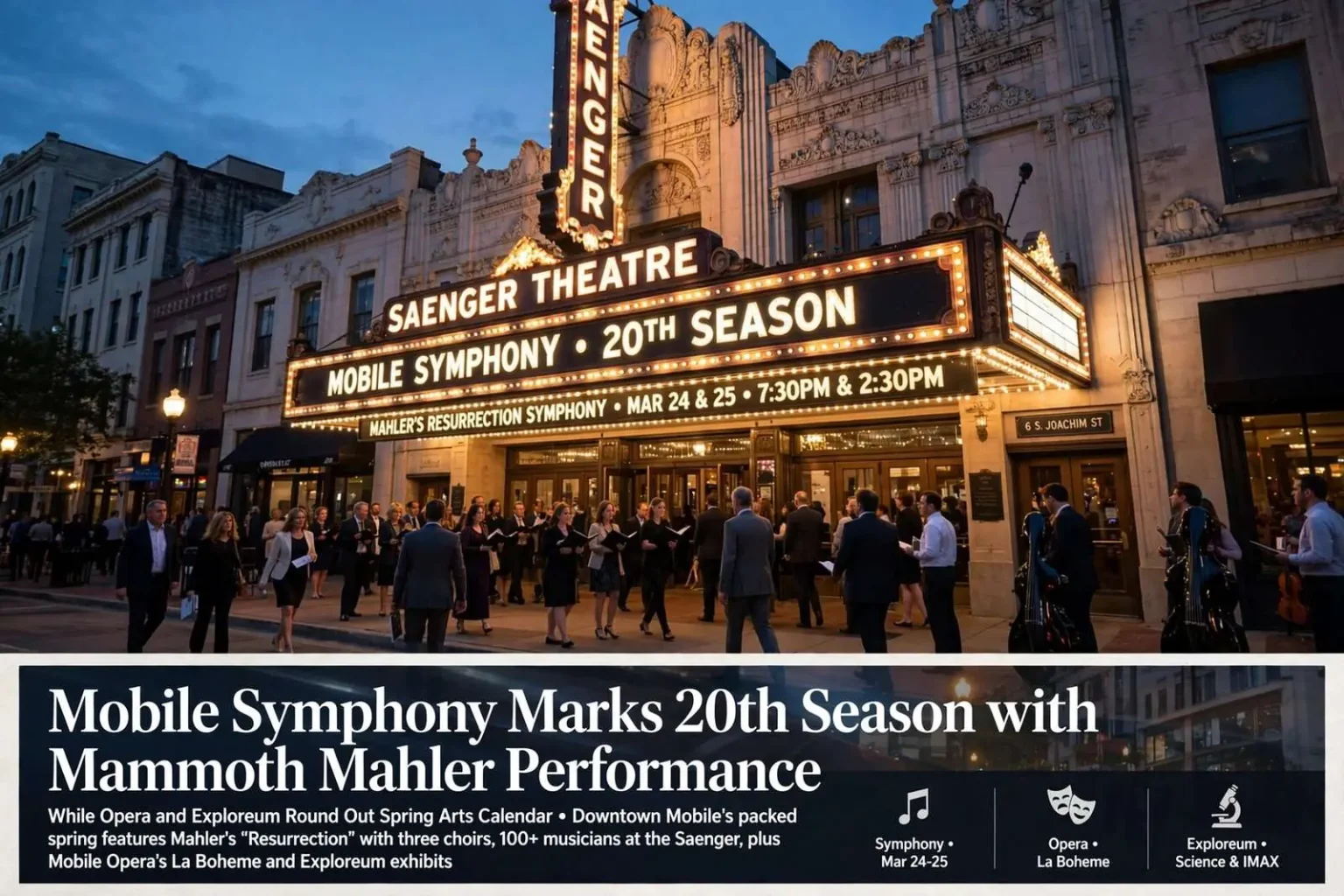
Downtown Mobile’s arts scene is set for a packed stretch this spring, headlined by an ambitious symphony performance that will push the Saenger Theatre’s stage to its limits. The Mobile Symphony Orchestra is marking its 20th anniversary season with its first-ever staging of Gustav Mahler’s “Resurrection Symphony,” a massive undertaking that will bring together three choirs, two vocal soloists and roughly 100 orchestra musicians inside the Saenger Theatre at 6 S. Joachim St.
Fitting that many performers onto one stage is no small feat, and organizers say the sheer scale of the piece makes it a fitting choice for a milestone season. The performance’s scheduling, landing the weekend of March 24 and 25, a week before Easter, appears to be intentional, given the symphony’s title and its themes.
Mahler’s Second Symphony, known universally as the “Resurrection,” is among the largest works in the orchestral repertoire — a piece of nearly an hour and a half that moves from a brooding funeral march through moments of terror, longing and dance before arriving at its overwhelming choral finale. It calls for forces far beyond a standard orchestra, which is why it is programmed rarely and why its performances tend to become civic events. The Mobile Symphony’s production, with its combined choirs and expanded stage, will be the first time the orchestra has mounted the work in its history.
Joining the Mobile Symphony Orchestra for the performance are the University of South Alabama Concert Choir, the Mobile Opera Chorus and the Eastern Shore Choral Society, along with soprano Martha Guth and mezzo-soprano Susan Platts. The three choirs, drawn from institutions on both sides of Mobile Bay, together field the massed voices the finale demands, and their singers will join the orchestra only in the final movement — the moment the symphony has been building toward for 80 minutes.
Tickets and Details
Saturday’s performance begins at 7:30 p.m., with a Sunday matinee starting at 2:30 p.m. Tickets range from $15 to $75 and can be purchased by phone, online at mobilesymphony.org, or in person at the symphony’s box office at 257 Dauphin St. Student tickets are available for $10.
Alabama Power sponsors the symphony’s Big Red Ticket program, which allows students in grades K-12 to attend the Sunday performance for free when accompanied by a paying adult. The program has become one of the cornerstones of the orchestra’s education outreach, opening the concert hall to families who might otherwise never bring children into a symphony performance, and for a work as overwhelming as the “Resurrection” it offers young listeners an introduction to orchestral music at its most monumental.
For the anniversary season, the choice of the Mahler sends a statement about the orchestra’s ambitions. Two decades after its founding, the Mobile Symphony is programming the works that major orchestras reserve for special occasions, and doing so with local forces — university singers, opera choristers and community choral societies — rather than imported ensembles. The performance doubles as a showcase for the depth of choral singing that exists across Mobile and Baldwin counties.
‘La Boheme’ Continues the Puccini Project
Elsewhere downtown, Mobile Opera is continuing its multi-year effort to stage the complete works of Giacomo Puccini with a production of “La Boheme,” one of the composer’s most beloved operas. The story follows a group of impoverished poets, painters and musicians in Paris whose romantic entanglements play out against a backdrop of poverty and hardship, themes that have resonated with audiences for more than a century.
“La Boheme” will be the sixth production in Mobile Opera’s Puccini Project, the company’s systematic march through the composer’s catalog. The project has given the company a programming identity — each season adding another installment — and has introduced Gulf Coast audiences to works beyond the standard favorites. “La Boheme” itself needs little introduction; its music supplies some of the most recognized melodies in all of opera, and its story of young artists in a cold garret inspired the modern musical “Rent” for a new generation.
The opera’s appeal has always rested on that blend of intimacy and melody. Four young friends scrape through winter in a Paris garret; a seamstress named Mimi and a poet fall in love; illness and poverty exact the price the era’s audiences knew was coming. Puccini’s score tracks every turn with music of such directness that even first-time opera goers leave humming, which is precisely why companies count on it to fill seats and why it anchors so many seasons.
The company’s home in the Mobile Civic Center Theater has hosted the Puccini Project’s installments, and the productions have relied on a mix of national principal singers and regional talent, giving local performers stage time alongside established professionals. For a city of Mobile’s size, sustaining a professional opera company at all — much less one committed to a composer’s complete works — puts it in select company among Gulf Coast cities.
The Project’s approach has also built an audience that follows the catalog from production to production. Subscribers who began the cycle with the early works have followed the company through the composer’s middle period toward the late masterpieces, and “La Boheme” — the second of Puccini’s operas, and the one that made his reputation — occupies a special place in the sequence as the work every other installment is measured against.
The Exploreum Rounds Out the Season
The third pillar of downtown’s spring calendar is the Gulf Coast Exploreum Science Center, the hands-on museum at the corner of Government and Royal streets whose IMAX dome and traveling exhibits draw families from across the central Gulf Coast. The Exploreum’s rotating exhibitions supplement its permanent galleries, and its downtown location places it within a few blocks’ walk of both the Saenger and the Civic Center, making an arts weekend in downtown Mobile easy to assemble.
Together the three institutions form the core of a downtown cultural district that city leaders have spent decades cultivating. The Saenger Theatre, a restored 1920s movie palace on Joachim Street, anchors the district as the orchestra’s home and the city’s premier mid-size performance hall; the Civic Center hosts the large-scale events; and the Exploreum provides the family anchor that keeps foot traffic on the streets during daytime hours.
For residents of Mobile, Baldwin and the surrounding counties, the concentration matters practically. A single weekend can now hold a Mahler symphony, a Puccini opera and a museum visit without leaving a ten-block stretch of downtown, and the restaurants of Dauphin Street and the revived blocks around it have grown up to serve exactly that crowd.
The Mahler weekend itself poses a logistical test for the Saenger. The theater, built as a vaudeville and movie house in the late 1920s and restored in 2000, was not designed for a stage holding 100 musicians plus a combined choir of well over a hundred singers, and staging the “Resurrection” requires rearranging orchestra seating, extending risers and coordinating entrances for forces that will outnumber the audience rows they face. Organizers describe the engineering as part of the appeal — a milestone performance that visibly fills every inch of a beloved hall.
The timing, one week before Easter, gives the programming a devotional resonance as well. Mahler built his finale around the “Resurrection” hymn text, setting a vision of rising from the grave to eternal light, and the themes of death and renewal land differently in a sanctuary-minded season. Whether listeners come for the music or the moment, the orchestra has placed its 20th anniversary statement where the calendar amplifies it.
For the local singers, the weekend is a career event in miniature. Community and university choristers rarely get to perform the repertoire’s largest works, and the combined forces of the USA Concert Choir, Mobile Opera Chorus and Eastern Shore Choral Society will have exactly two performances to get the piece right. Their music directors have been preparing them for months; the rehearsal arithmetic alone — three ensembles, separate rehearsal schedules, a single combined week — explains why orchestras attempt Mahler’s Second so rarely.
Tickets for both performances, at the range from $15 to $75 with $10 student admission, are structured to fill the house rather than ration it, and the Big Red Ticket program ensures the Sunday matinee will include a generation of young listeners seeing their first massive orchestral production. Together, the symphony’s Mahler, the opera’s “La Boheme” and the Exploreum’s exhibits make the coming stretch the fullest the downtown calendar has offered in recent memory — a season that says a city of Mobile’s size can, in fact, stage the repertoire’s biggest works and fill the seats to hear them.
One practical note for concertgoers planning the weekend: downtown parking near the Saenger fills early on performance nights, and the theater’s location on Joachim Street places it among the blocks where restaurants book solid before major productions. Patrons who plan dinner and a concert in the same evening are advised to reserve both early — the Mahler weekend, with its combined choirs bringing hundreds of family members into town on both sides of the bay, will be among the busiest nights of the spring downtown.
The anniversary milestone also invites a look back at how far the orchestra has traveled. Two decades ago, the Mobile Symphony was a smaller community ensemble with modest seasons; today it occupies the restored Saenger, runs education programs that reach students across the region, and programs its season with the confidence of an orchestra that knows its audience. The Mahler is the boldest expression yet of that trajectory, and its successful staging — with singers from the university, the opera and the community performing beside professional musicians — is the kind of civic achievement cities twice Mobile’s size rarely manage.
Music lovers on the Eastern Shore get a nod in the production as well, through the participation of the Eastern Shore Choral Society, the Fairhope-based ensemble whose singers will cross the bay to join the finale. The collaboration is a reminder that the region’s cultural life already operates as one ecosystem — rehearsals on both shores, audiences from both counties, and institutions that treat the bay as a connector rather than a border.