Mobile Symphony to Feature Pianist Awadagin Pratt in Beethoven and Blue Jeans Concerts
Awadagin Pratt joins the Mobile Symphony for Beethoven and Blue Jeans concerts Nov. 12-13 at Mobile's Saenger Theatre, featuring the Emperor Piano Concerto.
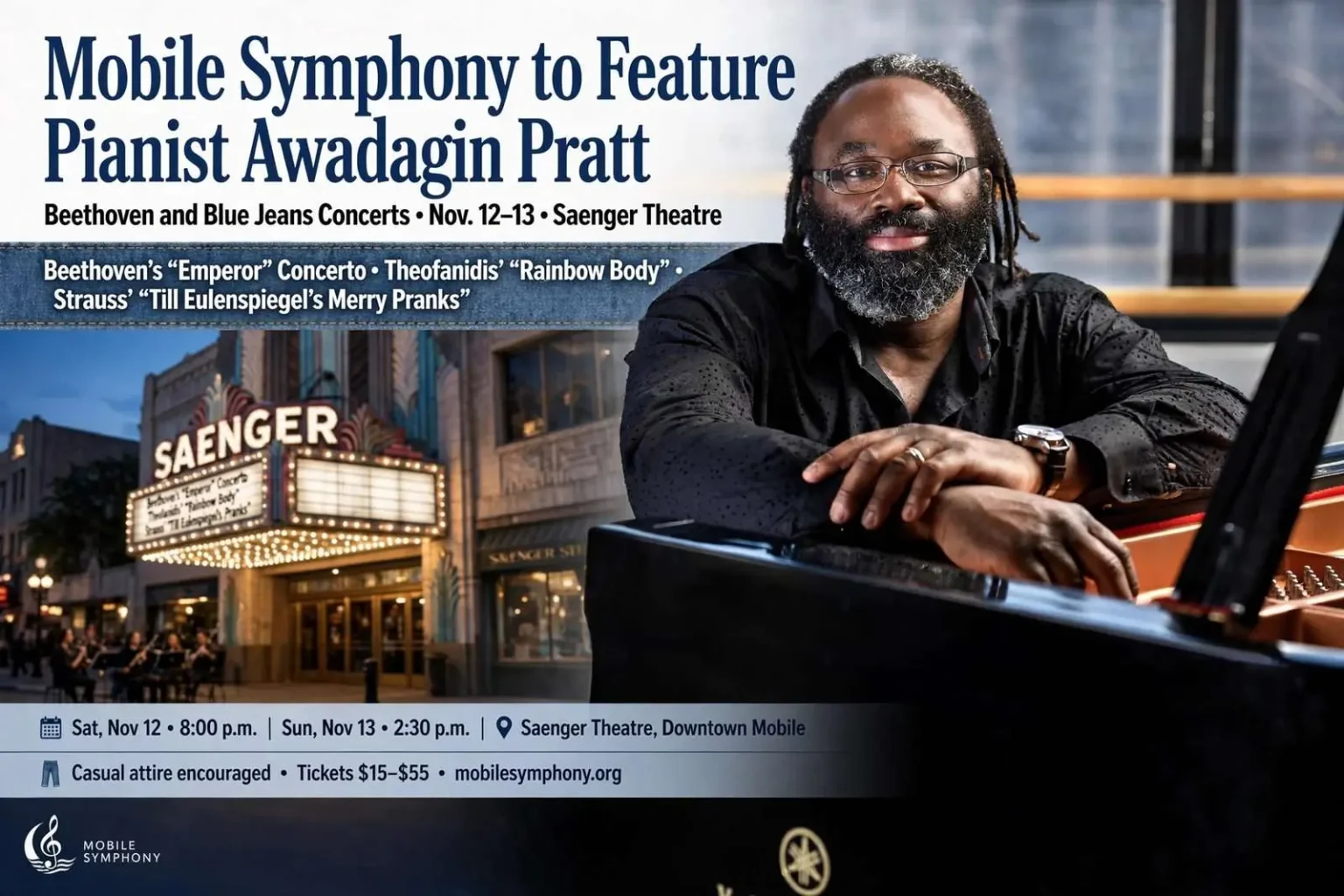
The Mobile Symphony will present its annual Beethoven and Blue Jeans concerts Saturday, Nov. 12, at 8 p.m., and Sunday, Nov. 13, at 2:30 p.m., at the Saenger Theatre in downtown Mobile. The weekend pairs the orchestra’s formal concert dress with the relaxed, denim-friendly atmosphere that has made the series a Gulf Coast tradition — a standing invitation for newcomers and longtime subscribers alike to hear world-class music without worrying about a tie.
Guest pianist Awadagin Pratt will perform Beethoven’s Piano Concerto No. 5 in E-flat, the “Emperor,” a work of heroic breadth that gives the soloist one of the most demanding and exhilarating parts in the piano repertoire. Pratt is one of the most recognized American pianists of his generation, known for a powerful, individual style and a career that has taken him to major orchestras and recital stages across the country and around the world.
“Awadagin Pratt plays with incredible power,” said Mobile Symphony Music Director Scott Speck. “So much so, that it will be a challenge for the orchestra to be heard. He is a very unusual and exciting musician.”
Beethoven’s “Emperor” Concerto
The Piano Concerto No. 5 is the largest and last of Beethoven’s piano concertos, written as Napoleon’s forces bombarded Vienna and composed while the composer’s deafness was advancing. Its opening — a flourish from the soloist before the orchestra even states the theme — was a bold departure for its time, and the concerto’s nickname has stuck for two centuries even though Beethoven himself never used it. The slow movement, one of the most serene stretches in all of Beethoven, leads without pause into a finale of irrepressible energy, and together the three movements demand both stamina and poetry from whoever sits at the keyboard.
For audiences hearing it live, the “Emperor” is the kind of work that converts casual concertgoers into subscribers. Placing it at the center of the Beethoven and Blue Jeans program is a deliberate choice: it is a crowd-pleaser with genuine depth, familiar enough to relax into and substantial enough to reward close listening.
The concerts also include Christopher Theofanidis’ soulful “Rainbow Body” and Richard Strauss’ kaleidoscopic tone poem “Till Eulenspiegel’s Merry Pranks.” Theofanidis’ piece, built from a chant by the medieval mystic Hildegard of Bingen, has become one of the most frequently performed American orchestral works of the past two decades, glowing with a warmth that balances the program. Strauss’ “Till Eulenspiegel,” by contrast, is pure mischief — a musical portrait of the legendary trickster, darting through one escapade after another and ending with a wink from the violins.
Pratt’s path to the concert stage is itself part of his story. A Baltimore-trained musician who studied piano, violin, and conducting at the Peabody Conservatory, he won the Naumburg International Piano Competition in 1992 — one of the most prestigious prizes in American classical music — and built from there a career spanning solo recitals, orchestral engagements, and chamber music. His performances are known for a physical, deeply committed style, and his recordings range from Bach to contemporary American works. That versatility is one reason his appearance with the Mobile Symphony carries the weight of an event rather than a routine guest slot.
The program’s bookends also give the weekend shape. Opening with Theofanidis’ “Rainbow Body” sends the audience out of the gate with music that shimmers rather than announces — a smart choice before the monumental concerto that follows. After intermission, “Till Eulenspiegel’s Merry Pranks” lets the orchestra flex its virtuosity and its sense of humor at once, with horn calls, darting woodwinds, and the famous closing flourish that Strauss wrote as the trickster himself, still laughing on his way to the gallows.
Concertgoers planning the weekend should note the timing difference between the two performances. The Saturday 8 p.m. concert runs on the traditional evening schedule, while the Sunday 2:30 p.m. matinee ends in daylight and pairs naturally with dinner downtown afterward. Either way, parking around the Saenger and the Dauphin Street corridor fills quickly on symphony nights, so arriving early remains the standard advice.
The weekend also lands at a moment when the orchestra’s education mission is most visible. Beyond the Big Red Ticket seats at the matinee, the symphony’s programs reach students across Mobile and Baldwin counties throughout the year, and concerts like these double as a showcase for that work — a hall full of young people seeing, many for the first time, what a professional orchestra and a world-class soloist can do in the same room.
The Beethoven and Blue Jeans Tradition
The Blue Jeans format has become one of the orchestra’s signature events for a simple reason: it lowers the barrier for people who like music but find the concert hall intimidating. Attendees wear jeans instead of evening wear, the atmosphere is easygoing, and the programming leans toward works with immediate appeal. For families, students, and first-timers, it is often the doorway into a lifelong habit of attending the symphony.
The venue adds its own character. The Saenger Theatre on Joachim Street is one of downtown Mobile’s landmark buildings, a grand movie palace of the 1920s that has survived demolition threats, hurricane damage, and decades of downtown’s ups and downs to become the city’s premier stage for touring Broadway shows, concerts, comedy, and the symphony itself. Its restored interior — with the scale and acoustics of a golden-age theater — gives orchestral music a warmth that modern halls rarely match, and hearing the “Emperor” concerto there puts the audience close enough to watch the soloist’s hands.
Tickets and the Big Red Ticket Program
Individual tickets are $15 to $55 and may be purchased online at www.mobilesymphony.org, by phone at 251-432-2010, or at the Mobile Symphony box office at 257 Dauphin Street in Mobile. The range keeps the concerts accessible at every budget, and weekend performances at 8 p.m. Saturday and 2:30 p.m. Sunday give audiences two distinct options — a night out on Saturday or a matinee with family on Sunday afternoon.
Students in kindergarten through 12th grade can qualify for a limited number of free tickets to the Sunday matinee when accompanied by a paying adult, through the symphony’s Big Red Ticket program. The program reflects a priority the orchestra has built its education efforts around: getting young people into the hall early, so that their first experience of live orchestral music comes in a welcoming, affordable setting rather than not at all. For parents weighing whether a child is ready for a full concert, the Blue Jeans atmosphere and the Sunday afternoon timing are designed to make that first concert easy.
The concerts are sponsored by Richard Dorman, Alabama Power and Morgan Stanley Smith Barney. Corporate and individual sponsorships of this kind underwrite much of what makes the season possible — guest artists of Pratt’s caliber, education programs like the Big Red Ticket initiative, and ticket prices that keep the hall open to the whole community.
The Orchestra’s Role on the Gulf Coast
The Mobile Symphony anchors the classical music scene along the central Gulf Coast, drawing players and audiences from Mobile, Baldwin County, and the Mississippi Gulf Coast for a season that runs from fall through spring. Its home weekends at the Saenger sit alongside education concerts for schoolchildren, chamber performances, and community events that together make the orchestra one of the region’s principal cultural institutions. In a city that has long punched above its weight in the arts — from the Mobile Museum of Art to the historic venues downtown — the symphony’s season is a fixture of the civic calendar.
Music Director Scott Speck has been the public face of that effort, known for programming that pairs the core repertoire with approachable commentary from the podium and for guest soloists chosen to connect with Gulf Coast audiences. His remark about Pratt’s power — the joke about the orchestra struggling to be heard — reflects the relationship regular concertgoers have come to expect: world-class music delivered without pretense.
For Pratt, the Mobile dates fit a career built on breaking down the distance between the stage and the seats. The pianist has performed with many of the country’s leading orchestras and appeared at the White House, and he is also known as an educator, having directed piano studies at the University of Cincinnati’s College-Conservatory of Music. Audiences who come for the denim and stay for the concerto tend to leave with a new favorite pianist — which is precisely what the Beethoven and Blue Jeans formula is built to accomplish.
Whether this weekend marks a first symphony concert or the latest in decades of season subscriptions, the combination on offer is a strong one: Beethoven at his most heroic, a living American composer at his most lyrical, Strauss at his most playful, and a soloist the music director warns may drown out the whole orchestra. Doors at the Saenger open well before downbeat, and the jeans are — as always — entirely optional, but strongly encouraged.