Mobile Theatre Guild stages Edward Albee’s ‘Who’s Afraid of Virginia Woolf?’ this August
Mobile Theatre Guild brings Edward Albee's Who's Afraid of Virginia Woolf? to the stage Aug. 18-27, directed by Joe Fuselli.
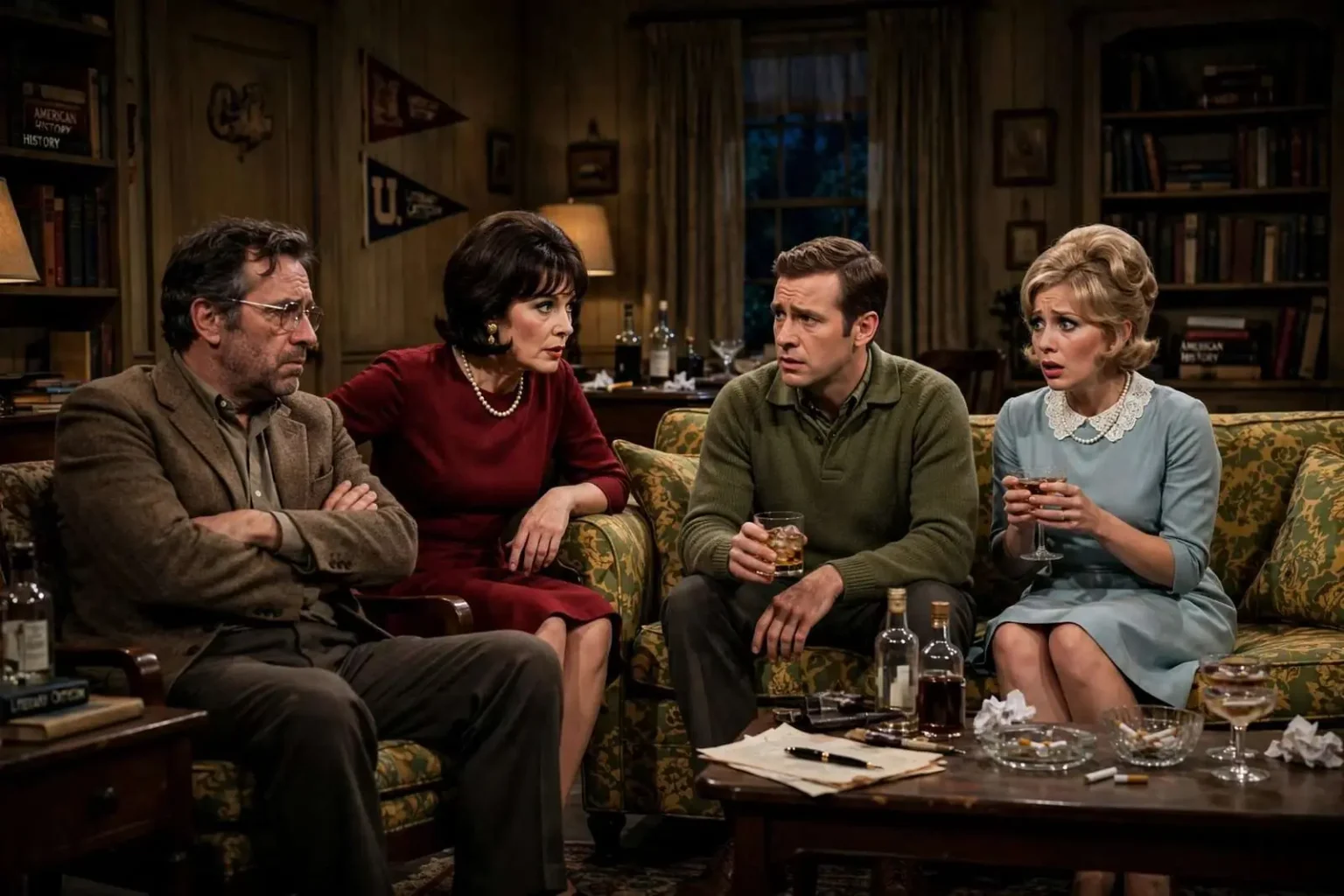
Mobile Theatre Guild will open its production of Edward Albee’s landmark drama “Who’s Afraid of Virginia Woolf?” with performances beginning Aug. 18 at the company’s downtown Mobile playhouse at 14 N. Lafayette St. The production brings one of the most celebrated — and most demanding — plays of the American stage to the Port City for a two-week run.
First staged on Broadway in 1962 and a winner of the Tony Award for Best Play, “Who’s Afraid of Virginia Woolf?” is a darkly comedic and often brutal look at marriage, ambition and self-deception. The story follows George, a mid-level college professor, and his wife, Martha, late one night after a university function, as a younger colleague and his wife, Nick and Honey, become unwilling participants in the older couple’s corrosive games. What begins as an awkward social evening deepens into a long night of verbal warfare, wine-soaked confessions and games with names like Humiliate the Host and Hump the Hostess, as the four characters strip away the fictions that hold their lives together.
Albee wrote the play in the early 1960s as a response to what he saw as the dishonest optimism of American theater and American life, and audiences and critics recognized immediately that something had shifted. The original Broadway production ran for more than a year and earned the Tony for Best Play, and the 1966 film adaptation starring Richard Burton and Elizabeth Taylor carried the story to an even wider audience. More than six decades later, the play remains a fixture of regional and community theaters, prized for the depth it offers actors and the raw, all-hands experience it delivers to audiences.
Directed by Joe Fuselli, the Mobile Theatre Guild production features Timothy Guy and Jo Ann Olivera as George and Martha, with Brendan Cooke and Victoria Johnson as Nick and Honey. The four-person cast carries the entire evening, which unfolds in real time across a single set — a living room at the college town home George and Martha share — with no intermission-style escapes from the escalating confrontations.
That single-setting, real-time structure is part of what has kept the play vital on stages across the country. There is no scenery change to relieve the tension and no lapse in time to soften what has been said; the audience sits through the same unbroken night the characters do. Directors staging the work face a double challenge of sustaining momentum while letting the play’s darker turns land, and Fuselli’s production arrives with the Guild’s stage resources devoted entirely to the four performances and the room they inhabit.
George and Martha’s games — the ritualized cruelties they have built around their marriage — give the play its structure and its title’s dark joke, a parody of the nursery song sung at the start of the evening. As the night’s games escalate from Humiliate the Host to the devastating final round, the line between performance and confession dissolves, and the younger couple discovers that the older pair’s battles are not entertainment but survival. The final scene, one of the most quietly devastating in American drama, recontextualizes everything that came before it.
A demanding play for actors and audiences alike
“Who’s Afraid of Virginia Woolf?” is famously one of the most challenging roles an actor can take on. George and Martha are on stage for virtually the entire play, trading some of the sharpest dialogue ever written for the American theater, and the emotional range the script demands — from flirtatious banter to open cruelty to unexpected tenderness — leaves no room for coasting. The roles of Nick and Honey carry their own arc, as the younger couple’s polished surfaces crack over the course of the night and their own marriage comes into view.
The play is also a technical exercise for the company staging it. The action unfolds continuously through a single long night, so pacing becomes everything: the actors must sustain tension across hours of stage time, building from tipsy banter to exhaustion and revelation without letting the energy flag. Community theater companies that take on Albee’s script tend to treat it as a statement production for their season, and Mobile Theatre Guild’s choice to mount it continues that tradition among the region’s theaters.
The play contains strong adult language and themes, including alcohol use, and is not recommended for young children. The advisory reflects the material itself — the play’s verbal ferocity and drinking-driven narrative were controversial enough in 1962 that the Pulitzer Prize committee’s drama jury recommended it for the prize, only to have the advisory board reject the recommendation, a dispute that became part of the play’s history. Contemporary audiences will find the honesty of the script rather than its shock value to be the point.
For patrons planning an evening around the production, the content advisory is worth taking seriously as guidance rather than deterrence. The play is an adults’ night out in the fullest sense: sharp, funny in a dark register, and emotionally demanding. Theatergoers who know the film should note that the stage script runs longer and hits harder, preserving passages of dialogue and character history that the screen version trimmed, and the Guild’s staging restores the full architecture of Albee’s night for anyone who has only seen the 1966 adaptation.
About Mobile Theatre Guild
Mobile Theatre Guild is one of the oldest continuously operating community theaters in the region, staging a full season of plays at its downtown Mobile playhouse at 14 N. Lafayette St. The guild’s seasons typically mix comedies, dramas and musicals, and its productions are staged by local directors and performed by local actors, giving Gulf Coast performers a home for serious theatrical work close to home. Community theaters like the guild occupy a distinctive place in the cultural life of a city like Mobile: they make live theater accessible at a price families can manage, they train new generations of performers and crew, and they take creative risks that larger venues often cannot.
The guild’s downtown location also puts it within reach of Mobile’s growing downtown entertainment district, making a night of theater an easy addition to a dinner out in the city center. For longtime subscribers and first-time attendees alike, the playhouse’s intimate setting means there are no bad seats — audiences are close enough to catch every glance that passes between George and Martha, which with this particular play is both a privilege and, by the final curtain, a bruise.
Performance schedule and tickets
Evening performances are set for 7:30 p.m. Friday and Saturday, with a 2 p.m. Sunday matinee. The run continues through Aug. 27.
Tickets are $20 general admission and $16 for students, seniors and military personnel. Seats are available at the door, with payment by cash or check. For more information, call 251-433-7513 or visit mobiletheatreguild.org.
The pricing keeps live theater within reach across the community — the discounted rate for students, seniors and military personnel reflects the guild’s long-standing effort to serve all of Mobile rather than only its avid theatergoers. Because seats are sold at the door rather than reserved in advance, arriving early on performance nights is a sensible plan, particularly for a production like this one that tends to draw the region’s most engaged theater audiences.
The two-week run also gives Mobile audiences unusual flexibility for a show of this scale. Weekend-only scheduling across consecutive weekends means theatergoers can pick the night that fits — a Friday or Saturday evening for the full downtown night out, or the Sunday matinee for an afternoon at the playhouse. Community theater runs in Mobile historically draw their strongest houses on closing weekend, and with a play of this reputation the final performances tend to fill quickly, making early attendance in the run the safer bet for anyone wanting a good seat.
Why this play, and why now
Every community theater season includes programming decisions that signal what a company wants to be, and “Who’s Afraid of Virginia Woolf?” is a signal. It is a play that asks four actors to carry nearly three hours of relentless dialogue, that offers the director no place to hide, and that trusts the audience to sit with discomfort rather than resolve it neatly. A company willing to mount it is a company investing in the craft of its people.
The play’s endurance says something as well. Six decades after its Broadway debut, the questions Albee put on stage — about the difference between the stories couples tell and the lives they live, about ambition that curdles into resentment, about the games people play to survive their own disappointments — have lost none of their bite. Each generation of actors rediscovers the script and finds it waiting, sharper than expected.
For Mobile audiences, the production offers a chance to see that material handled close to home, in a playhouse where the fourth wall is thin and the acting is close enough to feel. Whether a theatergoer knows the play from the film, from a college syllabus, or not at all, the Guild’s staging promises the essential experience of the script: a long night among four people who cannot stop telling the truth at exactly the wrong moment, and an audience that cannot look away.