Mobile-to-New Orleans Rail Corridor Passed Over in First Round of Federal High-Speed Rail Grants
The Mobile-to-New Orleans passenger rail corridor missed out on $8 billion in federal high-speed rail grants announced in January 2010.
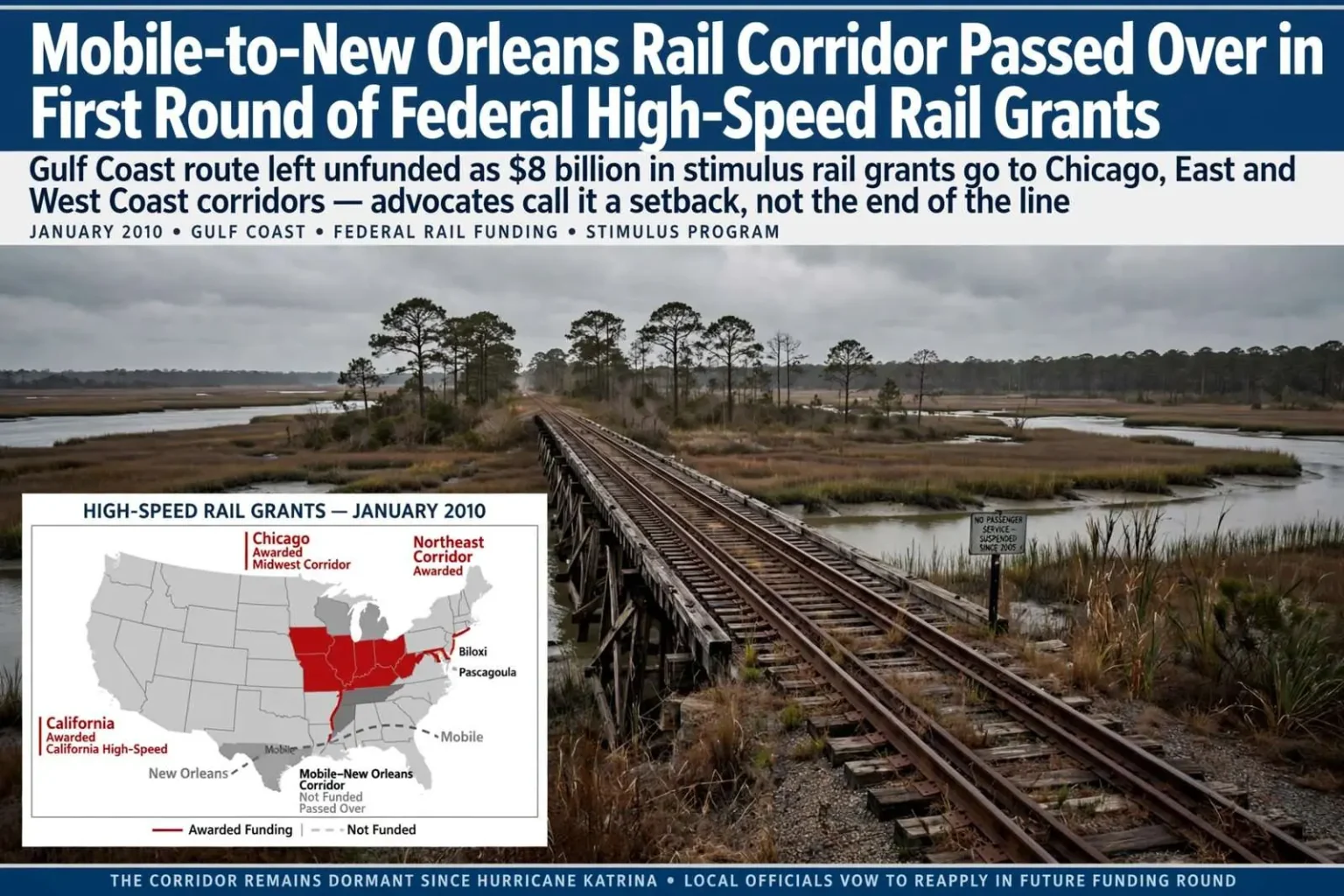
A long-discussed passenger rail line linking Mobile to New Orleans did not receive a share of the $8 billion in high-speed rail grants the White House announced in late January 2010, leaving the Gulf Coast corridor without federal backing in the program’s first funding round. The decision placed Mobile and the coastal communities between it and New Orleans on the outside of what transportation officials described as the most significant federal investment in intercity passenger rail in a generation. For boosters who had spent years promoting a return of trains to the Gulf Coast, the announcement was a disappointment, though not the final word on the corridor’s prospects.
The money, drawn from the American Recovery and Reinvestment Act stimulus package, was distributed through the Federal Railroad Administration to rail corridors around the country. The Recovery Act had set aside the funding specifically to jump-start passenger rail development, and applications poured in from states hoping to capture a piece of the program. The Federal Railroad Administration, the agency within the U.S. Department of Transportation that oversees intercity rail, evaluated the applications and awarded the grants in a single high-profile rollout that drew national attention to the prospect of faster, more modern train service in regions that had long lacked it.
The bulk of the funding went to projects centered on Chicago and to corridors along the East and West Coasts, including California’s planned high-speed line and upgrades in the Northeast and Pacific Northwest. Midwestern routes radiating from Chicago captured a large share of the awards, while Florida and other emerging corridors also landed grants. A map released alongside the announcement marked funded routes in red and passed-over routes, including the Gulf Coast line, in gray. That visual made the outcome plain: while much of the nation’s coastline lit up with promised investment, the stretch along the northern Gulf of Mexico was left uncolored and unfunded.
A Corridor Still Recovering From Katrina
The proposed Mobile-to-New Orleans route would have restored a passenger rail link along a stretch of the Gulf Coast that lost regular service after Hurricane Katrina damaged tracks and infrastructure in 2005. The hurricane, which came ashore near the mouth of the Pearl River and devastated communities across southeastern Louisiana and coastal Mississippi, wrecked rail lines, bridges, signals and station facilities along the route. While freight traffic gradually returned as the damaged lines were rebuilt, passenger service never resumed on the affected segment, leaving one of the region’s key pre-storm transportation links dormant.
Amtrak’s Sunset Limited, which once ran between New Orleans and Florida through Mobile, was suspended along that eastern segment following the storm and has not returned to regular service since. The long-distance train, which traces its schedule back to the earliest days of American rail travel and connects New Orleans with points west toward Texas and the Pacific coast, had carried travelers through Mobile on its way to destinations across the Deep South. Since the suspension, riders in Mobile and along the Mississippi and Alabama coasts who want to travel by rail have had no practical option other than driving to a station served by the national passenger railroad, a trip that can add hours to a journey.
The loss of the route has been felt most acutely in the small cities along the way — communities such as Pascagoula and Biloxi in Mississippi, whose stations once gave residents direct access to New Orleans and the wider national network. Civic leaders in those towns, along with counterparts in Mobile, have repeatedly called for restoration of service, arguing that the tracks themselves have been repaired and that the main obstacles now are institutional and financial rather than physical. The federal grant program had been seen by many of those advocates as the most promising path in years to finally close that gap.
Why Boosters Wanted the Line
The push for restoration has been organized largely through local advocacy rather than a single agency. Mobile’s city government and area business groups have periodically raised the issue with federal representatives, and passenger rail supporters along the coast have kept pressure on state transportation departments in Alabama, Mississippi and Louisiana to coordinate on a shared position. Because the corridor crosses three states, any future application would need to show a unified regional commitment — a requirement that has historically complicated funding bids for multi-state routes but that advocates say reflects the way the Gulf Coast actually functions as a single travel market.
Local and regional boosters had pointed to high-speed rail funding as a potential avenue for reviving passenger service along the corridor, arguing it would give travelers an alternative to Interstate 10 and strengthen economic ties between Mobile and New Orleans. The interstate, the principal east-west highway along the Gulf Coast, carries heavy volumes of commuter, tourist and freight traffic between the two port cities, and its congestion has grown with the region’s economy. A rail link would offer an alternative for travelers moving between the metropolitan areas, and would also connect Mobile with the casino resorts, shipbuilding centers and military installations that line the Mississippi coast.
Proponents also framed the corridor in economic development terms. Mobile has invested heavily in its port and in heavy industry along the Mobile River in recent years, while New Orleans has rebuilt its tourism and convention economy since Katrina. A passenger connection between the two, supporters argued, would knit together labor markets and visitor traffic across the central Gulf Coast, tying together a chain of waterfront cities that share history, economy and transportation infrastructure. Regional planning organizations along the coast had included rail restoration in long-range transportation discussions, and chambers of commerce on both sides of the state line had lobbied for the corridor’s inclusion in the federal program.
The case for the route rested in part on the simple fact that the infrastructure foundation remained. The CSX and Norfolk Southern freight routes that parallel the coast are active, and track capacity, while constrained, exists. Advocates noted that restoring a passenger timetable over repaired freight lines is far cheaper than building dedicated high-speed rights-of-way from scratch — one reason they believed the Gulf Coast application was a natural fit for a federal program aimed at establishing new intercity service. The gray shading on the federal map, however, indicated that reviewers were not persuaded, at least not this time.
What Comes Next for the Corridor
Missing out on this round of funding does not end that push, but it does mean the corridor will have to compete again in future federal funding cycles or rely on other funding sources to move forward. The Recovery Act grant program was structured with the expectation of additional rounds, and the Federal Railroad administration signaled that states could reapply as more money became available. That gives Mobile-area officials a decision to make about how hard to press the corridor’s case in the next competition, and whether to bring state and local dollars to the table to strengthen the application.
The stakes extend beyond convenience for travelers. Port cities on the Gulf Coast compete for workers, tourists and investment with interior metros that are already connected by reliable intercity transportation, and the absence of passenger rail is often cited in regional planning documents as a gap in the area’s mobility network. Restoring the line would also factor into hurricane-resilience planning: in evacuations and post-storm recovery, when highways are gridlocked or damaged, functioning rail lines have historically offered an additional movement option for coastal residents. Those arguments featured prominently in the region’s application materials and will likely anchor any resubmission.
Other funding avenues also remain open. Passenger rail projects can be pursued through annual federal transportation appropriations, through state-supported corridor programs, and through partnerships in which host freight railroads agree to improved passenger operations. None of those routes offers the kind of lump-sum investment the stimulus program provided, but advocates argue that a corridor with repaired infrastructure and demonstrated public interest is well positioned for any of them. The experience of competing this first time around also gives planners a clearer picture of what the federal evaluation process rewards, information they can use to sharpen a future bid.
The announcement was part of a broader nationwide rollout of high-speed rail investment intended to jump-start passenger rail development in regions without existing high-speed service. Administration officials cast the $8 billion as down payment on a national network, with follow-on funding proposed in future budgets, and the winning corridors were chosen to spread investment across the country while concentrating on routes with strong projected ridership. The success of the funded projects is expected to influence how future rounds are judged, something Gulf Coast advocates are watching closely.
For South Alabama, it marked an early setback in what would become a years-long campaign by local officials and rail advocates to bring passenger trains back to the Gulf Coast. The corridor’s supporters emerged from the first round with no federal dollars but with their argument intact: the tracks run, the cities are willing hosts, and the demand between Mobile and New Orleans — two of the central Gulf Coast’s largest economies — has never disappeared. Whether that case proves persuasive in the next funding cycle will determine how long the route stays gray on the federal map.