
Mobile Unveils Vision for Overhauling Langan Municipal Park
Mobile unveils a revitalization vision for Langan Municipal Park with playgrounds, a boathouse and amphitheater funded by RESTORE Act money.
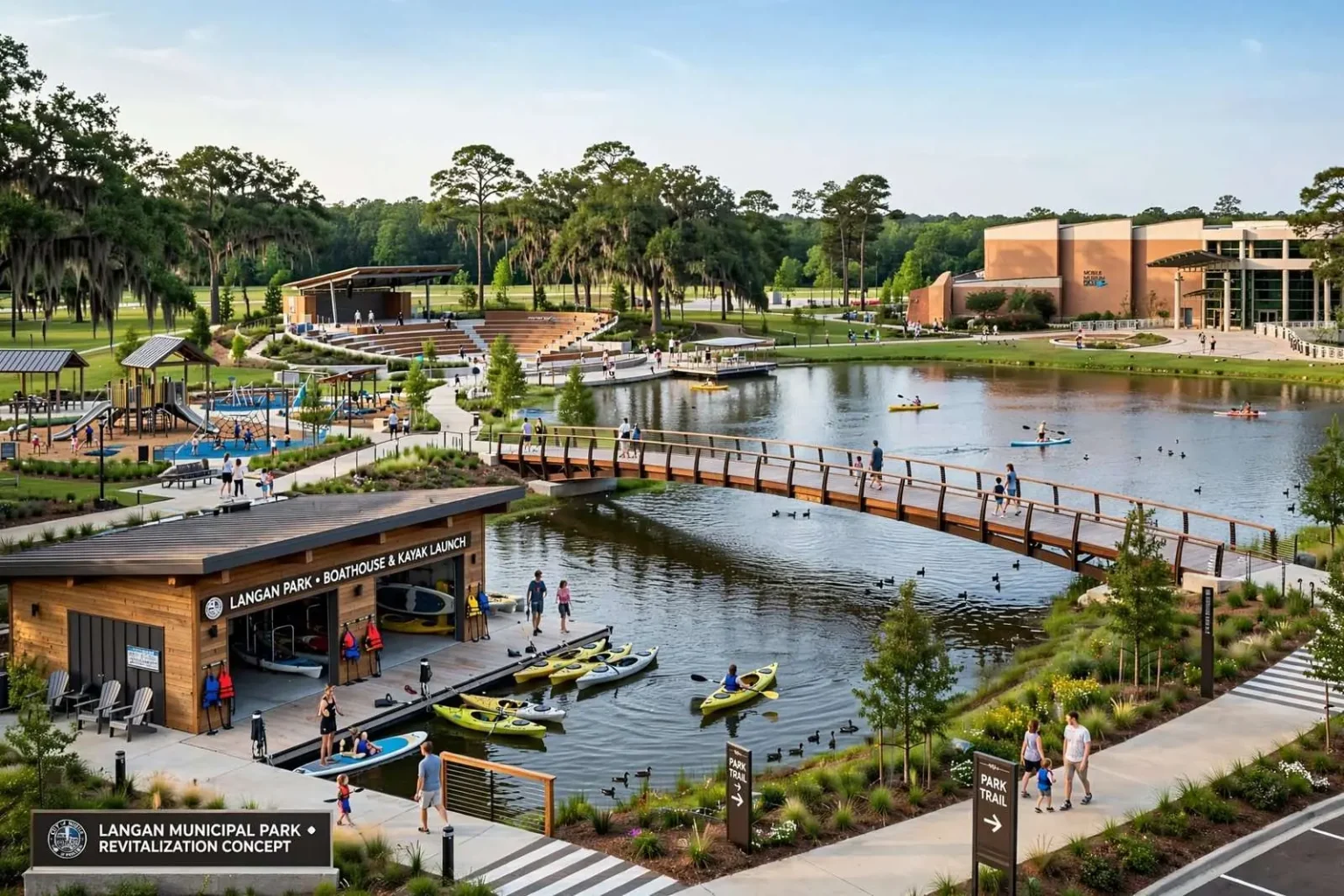
MOBILE, Ala. — The City of Mobile on Tuesday offered its first detailed look at the future of Langan Municipal Park, releasing a video laying out a sweeping revitalization concept for one of the city’s largest green spaces. The presentation gives residents the clearest picture yet of what a reinvented Langan Park could look like — and, just as importantly, a preview of the public process that will decide how much of the vision becomes real.
The vision includes new playgrounds, a boathouse with boating access, a new amphitheater, redesigned traffic patterns, fresh signage and crosswalks, and a bridge crossing the lake to the Mobile Museum of Art. Taken together, the elements sketch a park designed less as a place to pass through than as a destination: a waterfront where families launch kayaks, an amphitheater where evening crowds gather for performances, and safer, clearer connections for pedestrians moving between the park’s amenities. The proposed bridge over the lake to the museum is perhaps the most striking piece, physically joining two of west Mobile’s cultural anchors and turning the lake from a barrier into a centerpiece.
A park with deep roots in the city
Langan Municipal Park spans hundreds of acres in west Mobile, anchored by a large central lake and the Mobile Museum of Art on its shore. For decades it has served as the city’s everyday park — the place where softball leagues play under the lights, families rent picnic shelters on weekends, joggers circle the lake and children feed ducks from its banks. The park also hosts the Mobile Botanical Gardens on its western edge, adding cultivated gardens and native plant trails to the natural landscape. Its sheer size has made it a repository of citywide recreational life, even as parts of its infrastructure show the age of decades of use.
Signs of wear are precisely what the new concept addresses. Playground equipment added in different eras sits at different standards; roadways and parking areas inside the park were laid out for traffic patterns that have shifted as west Mobile grew; and the lake, the park’s defining feature, is less accessible for boating than modern park design would make it. The proposed overhaul treats those gaps as opportunities — consolidating play areas, untangling vehicle and pedestrian circulation, and putting people on the water rather than just beside it.
City officials stressed the video is only a starting point — what one press release called “the beginning of a long and collaborative process.” Work sessions, surveys and focus groups will shape the final plan. That framing is deliberate. Park master plans drawn without public input tend to encounter resistance at the budget stage; plans built with it tend to carry a constituency that shows up when the city council is asked to fund them. The city’s approach signals that residents will see their fingerprints on the finished design, from the selection of playground features to the placement of trails and event spaces.
RESTORE Act money and what it means
No cost estimate has been attached to the project yet, but it is expected to draw on federal RESTORE Act funds — money flowing to Gulf Coast communities from BP’s settlement over the 2010 Deepwater Horizon disaster. The RESTORE Act, passed by Congress in 2012, directs the bulk of the Clean Water Act civil penalties paid by BP to the five Gulf states for restoration and economic recovery. Alabama’s share is divided among the state and coastal counties, with a portion allocated through a council that approves projects aimed at restoring the environment and the economy of the Gulf region.
That funding mechanism explains why a park project can ride on oil spill money. Under the law, eligible projects include those that restore and protect natural resources — and parks that improve public access to and enjoyment of coastal ecosystems can qualify. Langan Park’s lake, trails and green space make the case: restoring the park’s natural features while expanding the public’s ability to use them fits the statute’s purpose of reconnecting Gulf Coast residents with the environment the spill damaged. The process is competitive and deliberate, with projects proposed, reviewed and approved through public meetings, so residents will have further chances to weigh in as the funding picture develops.
The absence of a cost estimate reflects the stage of the work. Early concept documents precede engineering: until surveys, drainage studies and design drawings exist, any number would be a guess. What residents can expect in the coming months is a sequence — public input rounds, a refined master plan, then cost estimates attached to specific phases, then decisions about which pieces are funded first. Cities typically phase projects like this over several years, starting with the most visible and least disruptive elements while planning larger construction efforts around seasonal use.
Why parks matter to a growing city
The reinvestment in Langan Park arrives as Mobile works to compete for residents and visitors with peer cities that have made signature parks central to their identities. Urban planners consistently find that quality parks raise surrounding property values, attract families deciding where to live, improve public health through recreation, and give communities shared spaces that cut across neighborhood lines. A revitalized Langan — with an amphitheater drawing evening crowds and a boathouse putting people on the lake — would give west Mobile a civic gathering place of a scale the city currently lacks on that side of town.
For the neighborhoods around the park, the redesign of traffic patterns and crosswalks may prove as meaningful as the headline attractions. Parks that are hard to walk into get driven to; parks that connect safely to surrounding streets get used daily. The proposed signage and circulation changes acknowledge that reality, aiming to make a trip to the museum, the playground or the lake feel less like navigating a road network and more like visiting a single, coherent place.
The long collaborative process the city promises will now test the public’s appetite and priorities. Some residents will push for the boathouse and the bridge; others will argue for trails, fields or trees. The strength of the concept released Tuesday lies in its breadth — a vision generous enough to contain many of those hopes at once — and in the city’s stated willingness to let the community shape what gets built first. Mobile’s largest park is about to be redesigned in public, and the city wants everyone watching to have a hand in it.
How the public will shape the plan
The work sessions, surveys and focus groups the city has promised are the standard architecture of a modern park master plan, and each format captures a different slice of public opinion. Work sessions — usually held at council district meetings or planning commission gatherings — give residents a chance to see the concept up close, ask questions of the design team and voice support or objections in person. Surveys extend the conversation to the thousands of park users who will never attend a weeknight meeting, capturing preferences on everything from playground equipment to the hours facilities should stay open. Focus groups, smaller and more targeted, let planners dig into the needs of specific users: youth sports leagues, seniors, people with disabilities, museum patrons and neighbors who live along the park’s edges.
Residents who want to influence the outcome do not need to wait for a formal invitation, either. Public comments at city council meetings, messages to district council members and participation in the survey process all feed into how priorities get set. Experience in other cities suggests the loudest early decisions tend to involve phasing: which elements are built first, and whether the community would rather see a signature piece like the amphitheater rise early or the basics — parking, restrooms, lighting — addressed before amenities are added.
The lake, the museum and a different kind of connection
The proposed bridge across the lake to the Mobile Museum of Art deserves particular attention, because it reframes the park’s geography. The museum, which holds a collection spanning centuries and cultures and hosts traveling exhibitions that draw visitors from across the Gulf Coast, has always sat inside the park yet slightly apart from it — reachable by car along park roads, but not woven into the everyday flow of park visitors. A pedestrian bridge would change that, letting someone rent a boat, stroll the shore, cross the lake on foot and wander into the galleries as part of a single outing. Museums nationwide have found that improving walkability and visibility increases casual visitation, especially among families who might not otherwise think of an art museum as a spontaneous destination.
The boathouse and boating access would similarly activate the lake itself. Langan’s lake has long been admired more than used — a scenic backdrop for picnics and photographs rather than a recreational resource. Modern park design treats urban water bodies as infrastructure for kayaks, paddleboards and canoe rentals, often paired with the kind of boathouse concession that makes those activities accessible to people who own no equipment. If the concept advances, the lake could shift from ornamental to central, drawing a regular crowd of paddlers and giving the amphitheater a waterfront setting for evening events.
All of it remains, for now, a proposal — a video and a vision awaiting the give and take of a real planning process. But cities that have rebuilt their signature parks consistently report that the release of a bold first concept is the moment the community’s imagination catches fire. Mobile’s leaders have chosen to start big, with playgrounds, a boathouse, an amphitheater and a bridge, and to let the public work down from there. What emerges from the work sessions and surveys will be Mobile’s answer, in bricks and board feet, to the question of what its largest park should mean for the next generation.


