
Mobile Woman Found Dead Outside Burning Home; Teenage Son Charged as Daughter Grapples With Case
Danica Barney was found dead outside her burning Mobile home. Her 16-year-old brother faces murder and arson charges; bond set at $175,000.
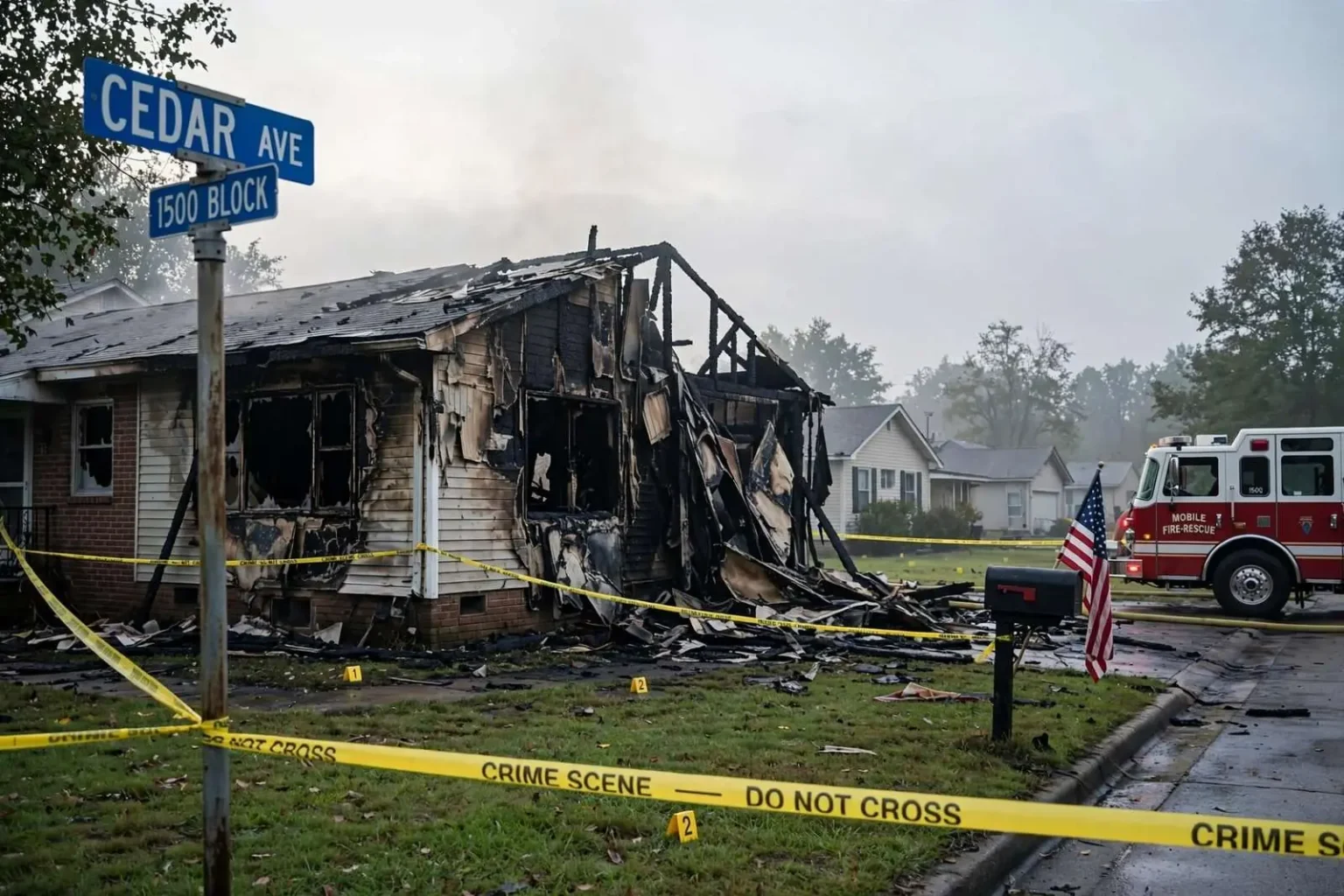
A Mobile family is reeling after a woman was found dead outside her burning Cedar Avenue home — and her 16-year-old brother was charged with her murder. Firefighters responded to the home early Tuesday morning after reports of a fire, with flames visible from the back of the house. After knocking the fire down, crews discovered Danica “Pebbles” Barney’s body outside.
Hours later, police arrested her son, Terrance Barney Jr., charging him with murder and arson. His bond was set at $175,000. The arrest of a 16-year-old in connection with his own sister’s death has stunned the Cedar Avenue neighborhood, where the family had lived among longtime residents for years.
Daughter questions what happened
Barney’s daughter, Kristen Howard, said she is struggling to reconcile the charges with the brother she knows. “How did we allow this to happen? God forbid it is my brother, that it was him that did this, how did we miss the signs of the help that he needed?” Howard said.
Howard recently learned her brother had been diagnosed with schizophrenia and had stopped taking his medication, though she stressed it is unclear whether his mental health played any role in what happened to their mother. The diagnosis came as news to much of the family, which has left them sorting through what they knew, what they did not, and whether anything could have been done differently in the months before the fire.
According to Howard, investigators told the family that Barney was killed in a bedroom, dragged out the back door and set on fire, which caused the blaze. She said police also told her Terrance had blood on his clothes when interviewed. He has maintained his innocence.
“There are a lot of things that don’t add up,” Howard said, while acknowledging that her work as a social worker with patients who have schizophrenia gave her a sober view of what her brother might be capable of.
How the investigation unfolded
The early-morning fire drew a response from fire crews who reported flames showing from the rear of the Cedar Avenue house when they arrived. Because the blaze was already burning when crews knocked it down, investigators faced the difficult task of separating what the fire destroyed from what it may have been set to hide — a determination that in cases like this one draws on burn-pattern analysis, accelerant detection, and the medical examiner’s findings.
Fire scenes in which a body is found are treated as potential crime scenes from the first moments, with firefighters preserving the area as best they can while attacking the flames. Once the fire is out, the scene passes to fire investigators and homicide detectives working jointly, and the medical examiner’s autopsy becomes the document that establishes cause and manner of death. In this case, the discovery of Barney’s body outside the burning structure — combined with the account investigators later shared with the family — pointed authorities toward a homicide rather than a fire victim overcome by smoke.
The dual charges of murder and arson reflect that sequence: prosecutors allege the fire was set to conceal or accompany the killing, which under Alabama law supports the separate arson count alongside the murder charge. An arson charge can apply not only when a fire endangers occupants of a building but when a structure is intentionally set alight, as investigators allege happened here after the fatal attack.
Schizophrenia, medication, and the family’s questions
Howard’s account of her brother’s diagnosis and lapsed medication touches on one of the most difficult realities families of people with schizophrenia face. The condition, which affects a small fraction of the population, is a treatable chronic illness, but its course depends heavily on consistent medication and support. When treatment stops, symptoms can return gradually or suddenly, and family members are often the ones left to recognize the change — sometimes without any training to know what they are seeing.
Research and clinical experience both emphasize that people with schizophrenia are far more likely to be victims of violence than perpetrators of it, and a diagnosis alone says nothing about what a person has done or will do. Howard’s professional background as a social worker gave her a sharper awareness of both sides of that reality — the limitations of the prediction anyone can make about a person in crisis, and the gravity of what her brother stands accused of.
Her question — how the family missed the signs of the help he needed — is one that mental health advocates in Mobile County hear constantly. Community mental health services, crisis lines, and mobile crisis teams exist in the region, but families frequently report that connecting a reluctant or ill loved one with those services is a struggle, particularly when the person does not believe they are ill or resists treatment.
Because Terrance Barney Jr. is 16, his case moves through the juvenile justice system, which operates differently from adult court even for the gravest charges. Juvenile proceedings in Alabama are generally closed to the public, records are sealed, and the emphasis of the system is nominally on rehabilitation — though for serious offenses like murder and arson, prosecutors can seek to have a juvenile transferred to adult court, where the case would proceed under the same criminal statutes that govern adult defendants. Any such transfer decision would come after hearings in which a judge weighs the youth’s age, background, the nature of the offense, and the prospects for rehabilitation within the juvenile system.
The $175,000 bond figure, in a case involving a juvenile charged with murder, reflects the court’s weighing of the same factors that govern bond in any criminal case — the seriousness of the allegations, ties to the community, and public safety. Whether a juvenile defendant is even eligible for bond in a murder case, and under what conditions, is itself determined by the court’s handling of the transfer and detention questions.
A family divided by one event
Howard said she remains supportive of her brother: if he is responsible, she wants him to get the help he needs; if not, she hopes police will clear his name by finding whoever is responsible. That dual position — grief for her mother, loyalty to her brother, and doubt about the account investigators have described — captures the position in which the fire placed everyone who loved Danica Barney.
“There are a lot of things that don’t add up,” she repeated, a phrase that has become her shorthand for a case she sees from inside a family that has lost a mother, gained a set of criminal charges against a teenager, and is still waiting for answers that only the investigation and the courts can supply.
Barney’s autopsy results were still pending. Until the medical examiner’s office issues its findings, the full forensic picture — cause of death, the timing relative to the fire, and the physical evidence gathered from the scene — remains incomplete, and both the prosecution’s case and any defense will ultimately be built on what those results show.
In the Cedar Avenue neighborhood, where the house’s burned rear facade remains a visible marker of Tuesday morning, residents have been left to process an event that touched a family many of them knew personally. For now, the case moves forward on the charges as filed: murder and arson against a 16-year-old, a family asking how it came to this, and an autopsy report still to come.
The sequence that investigators described to the family — a killing inside the house, the body moved out the back door, and a fire set to cover it — represents the kind of case that strains every forensic discipline at once. Fire consumes evidence, but it also creates patterns, and trained investigators read those patterns the way document examiners read handwriting: where the burn started, how fast it moved, whether an accelerant sped it along, and whether the damage is consistent with an accidental ignition source such as a space heater, faulty wiring, or cooking. When the burn pattern points to a deliberately set fire in a room where a violent death occurred, the criminal investigation takes over completely.
Mobile’s first responders have handled scenes of this kind across the city in recent years, and the coordination between the fire department’s investigators and the police department’s homicide unit is a standing arrangement: the fire determines whether a crime scene exists, and the detectives then own everything inside the tape. Neighborhood canvassing, interviews with relatives, and physical evidence from the residence all feed the file that prosecutors will eventually review before the case goes to court.
What the charges mean procedurally
Murder under Alabama law is a Class A felony, and arson involving an occupied dwelling is charged nearly as seriously. The combination of charges in a single case is uncommon and signals prosecutors’ view that the fire was not a separate misfortune but part of the same criminal event. Each charge carries its own elements the state must prove — for murder, that the death was caused intentionally or during the commission of another violent crime, and for arson, that the fire was set willfully — and a defense can challenge them separately even if the cases share all their facts.
The pending autopsy will anchor both charges. Cause and manner of death, the presence of any injuries predating the fire, and toxicology results will establish the timeline that the state’s theory depends on. Defense counsel, whoever is appointed to represent the teenager, will scrutinize that same report for anything inconsistent with the account investigators have described — and Howard’s public doubts make clear that the family itself is looking for exactly that kind of scrutiny.
For a 16-year-old facing charges of this gravity, the appointment of counsel and the question of competency and mental health evaluation come early in the process. Courts handling juvenile defendants with diagnosed psychotic disorders typically order their own evaluations before proceeding, which can add months to the timeline even as the underlying investigation continues.
The family, meanwhile, is planning a funeral while those questions wait. The burned house on Cedar Avenue stands as the neighborhood’s most visible reminder of the Tuesday morning events, and the case now moves forward on the charges as filed: murder and arson against a 16-year-old, a daughter asking how it came to this, and an autopsy report still to come.


