
Mobile Women’s March rallies for voting and women’s rights
The Women's March Mobile drew dozens to Memorial Park to focus on voting and women's rights, with speakers citing the Amy Coney Barrett nomination.
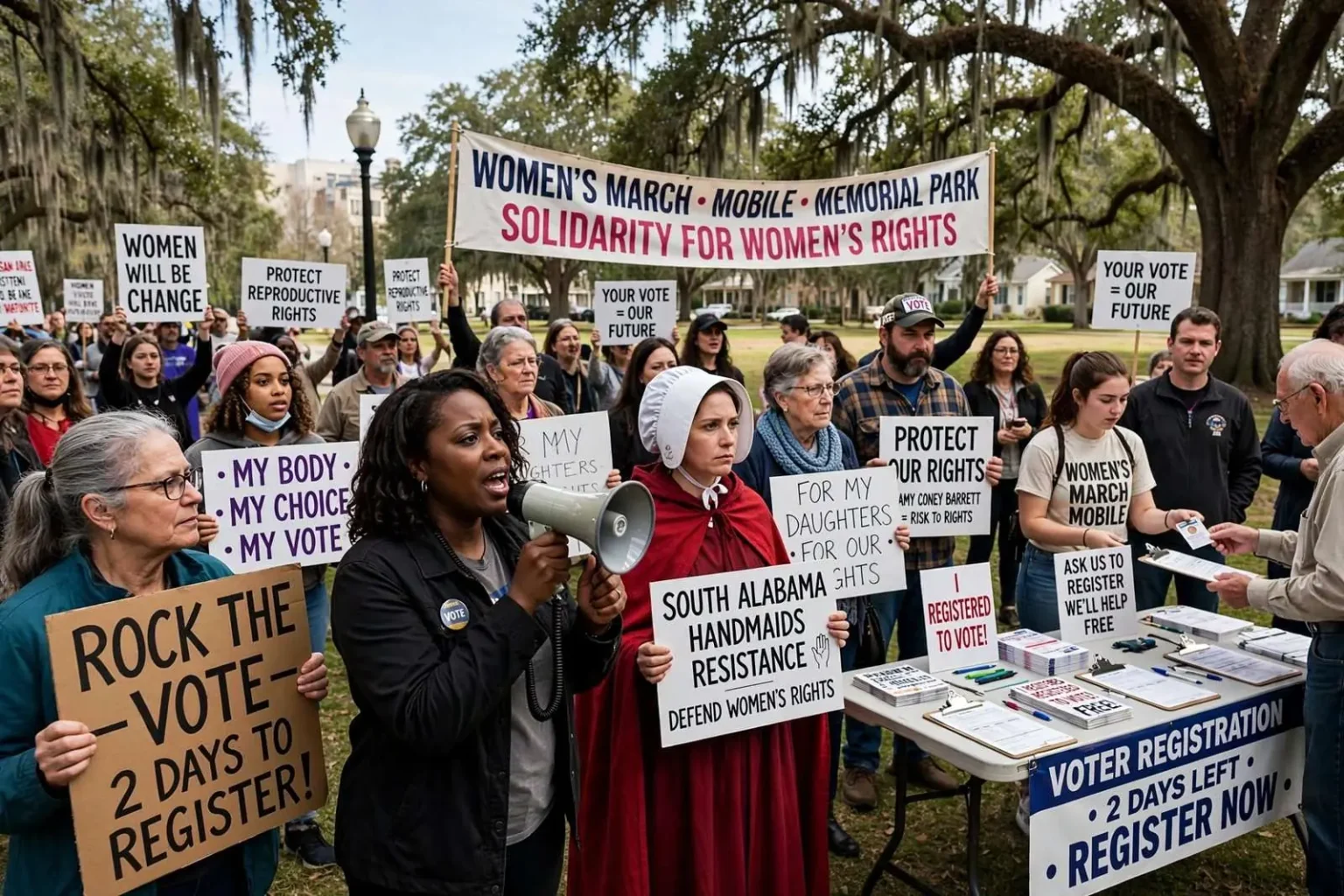
Mobile advocates for women stood in solidarity with supporters across the nation Saturday for the Women’s March. The Women’s March Mobile was held at Memorial Park, where dozens gathered to focus on women’s rights and the importance of voting — a message aimed squarely at the election calendar, with registration closing within days.
“This is necessary, we need people to rock the vote, we need people to go vote. We need change and women are going to be that change,” organizer Kalla Etheredge said. Fellow marchgoer Suzette Brooks agreed, saying, “It’s absolutely key — young women, old women, all women need to protect our rights.”
The Saturday gathering placed Mobile inside a national frame. Since the first Women’s March drew record crowds to Washington and hundreds of sister cities in early 2017, the movement has recurred in election seasons across the country, and the Mobile iteration follows the model: a local park, local organizers, national signs and slogans, and a schedule deliberately timed to the political calendar.
Memorial Park, in the heart of Midtown Mobile, gave the event an established public setting. The park’s open lawn and central location have made it a regular site for Mobile’s civic gatherings — vigils, festivals and demonstrations among them — close enough to downtown to draw attention and accessible enough for the dozens of participants who filled it Saturday.
Voting at the Center
The Supreme Court nomination of Judge Amy Coney Barrett was also a focus of many conversations and speeches. Barrett’s nomination was moving through the Senate on an accelerated timeline during those weeks, and for the activists in the park the fight over the seat was inseparable from the issue of women’s rights — the Court’s pending docket included cases that organizers argued would land differently depending on who held the seat.
Michele Harmon with the South Alabama Handmaids Resistance Coalition said she believed the new judicial appointment put women’s rights at risk. The coalition, whose name borrows the red-cloaked imagery of “The Handmaid’s Tale” — a novel and television series that had become a visual shorthand for reproductive-rights activism — was among the organized groups present, and its presence tied the Mobile event to the iconography of the national movement.
Although the event centered on women, plenty of men were present to show support. Another organizer, Alexis Bell, said protecting her two Black daughters’ health and wellness is her duty. “Standing here and showing my appreciation and support, I feel is my duty,” she said — framing the march not only as protest but as obligation, and connecting the event’s women’s-rights message to the overlapping concerns of Black families in Alabama.
The speakers’ themes converged on the same practical instruction: register, and vote. Etheredge’s “rock the vote” framing was the event’s call to action, and the timing gave it teeth — the march fell within days of Alabama’s voter registration deadline, making the park gathering one of the last organized pushes to add new voters before the books closed.
A March Around the Park
The event closed with a march around the park, with participants chanting and calling for a different future. The lap around Memorial Park gave the gathering its visual signature — signs, banners and chants moving past the surrounding neighborhood — and it followed the format that Women’s March events have standardized nationwide: a program of speeches first, then a march to put the crowd on public view.
Voting remained the main focus, with two days left to register to vote in Alabama. That countdown put a deadline behind every speech. Alabama closes registration ahead of each election, so a rally held this close to the deadline was aimed at the last eligible holdouts — Alabamians who had not yet registered and would otherwise sit out an election that included federal, state and local contests.
The registration emphasis also reflected how mobilization works in practice. Organizers know that a rally’s energy dissipates unless it converts into transactions — completed registration forms, verified registrations, plans to vote early or on Election Day. The speeches at Memorial Park were built to end with clipboard and phone in hand, and the march itself doubled as a final recruiting walk through a neighborhood days from the deadline.
Mobile’s Year of Rallies
For Mobile, the event was part of a stretch in which the city’s activist community organized repeatedly around national flashpoints — demonstrations in downtown parks, courthouse gatherings and marches that followed the same civic choreography. Memorial Park’s Saturday gathering fit that pattern and gave it a local face: Mobile organizers, Mobile speakers and a Mobile crowd, marching to a national rhythm.
The presence of organized groups like the South Alabama Handmaids Resistance Coalition alongside individual speakers showed the coalition-style structure that modern demonstrations run on. A single rally typically draws its energy from several organizations at once — each contributing members, messages and logistics — and the shared platform keeps the event’s messaging unified even as its participants arrive from different directions.
The multigenerational appeal Brooks described was visible in the crowd as well. Women’s March events draw from a wide age range — veterans of earlier civil-rights organizing standing alongside first-time protesters — and the movement’s voting-centered framing in this election cycle gave both ends of that range the same practical task: make sure everyone they know is registered, and get them to the polls.
The messages the crowd carried out of the park were the ones its speakers had sharpened all morning. Etheredge’s call for women to “be that change,” Brooks’ insistence that all women need to protect their rights, and Bell’s framing of the work as a duty were the event’s takeaways — delivered to a park full of voters with two days left to make the registration deadline, and an election ahead that the organizers intended them to vote in.
Why Barrett’s Nomination Animated the Crowd
The speed of Barrett’s confirmation fight gave the park gathering its urgency. Nominated to fill the seat of Justice Ruth Bader Ginsburg — a figure whose decades on the Court had made her a symbol of women’s advancement in American law — Barrett’s rapid path to confirmation concentrated the national women’s-rights debate into a matter of weeks. For activists, the question was not only who would sit on the Court but what the Court would do on health care, on civil rights protections and on the long list of cases approaching its docket.
That is why a rally built around voting spent so much of its program on a judicial nomination. The connection the speakers drew was structural: courts decide the cases that determine the reach of women’s rights, presidents nominate the judges, and the Senate confirms them — which makes every election, including the one two weeks out, a decision about the judiciary itself. The argument gave voters who came for a march a reason to treat the ballot as the most direct tool at hand.
The red-robed imagery of the Handmaids Resistance groups nationwide had already made that argument visually for years. Borrowing from Margaret Atwood’s dystopia, the costumes turned a policy debate into a picture — one that reads instantly in photographs and broadcasts, and that has made the groups’ presence at rallies among the most recognizable iconography in modern protest. In Mobile’s Memorial Park, that iconography stood alongside homemade signs and campaign-era slogans.
What Organizers Hope Sticks
Every rally organizer works against the same decay curve: the energy in a park on Saturday afternoon, by Monday, becomes a memory unless something converts it. The Women’s March Mobile answered that problem the way the national movement does — by making the event’s single ask unmistakable. Not a petition, not a fundraiser: a registration deadline. Two days. The instruction was concrete enough to survive the ride home.
The solidarity frame mattered locally too. Mobile’s activists organized in a state where single-party dominance makes general elections feel foregone to some voters, and the counterargument the march pressed was that down-ballot races, amendments and turnout itself carry consequences regardless of the top of the ticket. “Rock the vote” in that context means something more granular than the slogan suggests — register, verify, and show up for the whole ballot.
The march’s closing loop around Memorial Park also served the practical work of community building. Demonstrations recruit the next event’s organizers; participants meet each other, exchange contact information and join groups like the ones represented Saturday. In a city the size of Mobile, where activist networks run on personal ties, that after-march circulation is as much a function of the gathering as the speeches themselves.
What remains from a Saturday like this one is the deadline it was built around. The speeches end, the marchers disperse, and the calendar does the rest — two days to register, then an election in which the organizers who filled Memorial Park intended their neighbors to take part, carrying the messages they had heard about rights, duty and change.


