
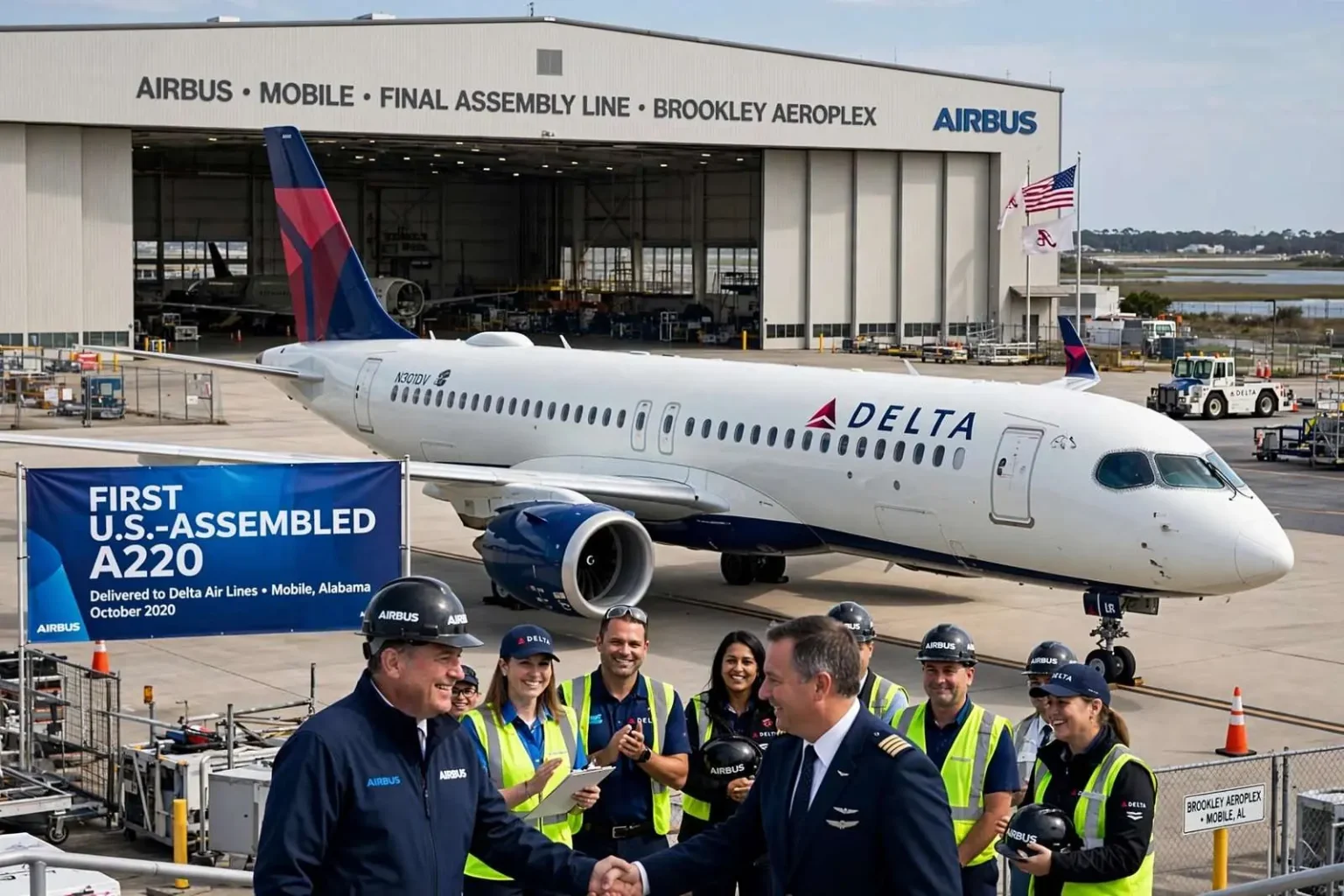
Airbus has delivered the first A220 jet assembled in the United States, rolling the narrowbody out of the company’s Mobile final assembly line and handing it over to Delta Air Lines in a milestone that formally makes the Port City a production hub for a second Airbus aircraft family. The delivery closes out a year of aggressive ramp-up at the Brookley Aeroplex, where A220 assembly now proceeds alongside the long-running A320 family lines that have anchored commercial aircraft manufacturing in Mobile since 2015.
Company executives called the delivery a historic moment for Airbus’ growing North American footprint, and for the Gulf Coast workforce that built the jet. The A220 program came to Mobile after Airbus took majority control of the aircraft from Canada’s Bombardier, a transaction that shifted the jet originally developed as the C Series under the Airbus umbrella and set the stage for a second U.S. final assembly line at Brookley.
A Program Assembled in Under Two Years
The speed of the Alabama launch was notable even by the standards of commercial aerospace. Groundbreaking on the Mobile A220 line came in January 2019, production start followed that August, and the first U.S.-assembled aircraft completed its inaugural flight in June. In roughly eighteen months, a vacant site on the aeroplex became an operating assembly line capable of delivering customer jets.
Roughly 400 U.S. employees have now been trained on A220 production, according to the company. A number of those workers trained at the program’s original final assembly line in Mirabel, Quebec, before returning to Alabama to staff the Mobile operation, carrying with them the build processes and quality standards developed on the Canadian line.
The Mobile A220 line operates within the same Brookley complex as Airbus’ A320 family assembly operation, which opened in 2015 as the company’s first U.S. manufacturing site. Sharing a campus allows the two programs to draw on common logistics, supplier relationships, and a workforce that already knew Airbus’ production system — an advantage few greenfield aircraft plants enjoy.
Delta Takes the First U.S.-Built A220
Delta Air Lines received the first jet, a fitting customer for the milestone. Delta is the largest A220 customer in the world, with 95 of the aircraft on order, and becomes the first operator in the Americas to fly both the A220-100 and the larger A220-300 variant. The Atlanta-based carrier has been integrating the type into its network as a replacement for older, less efficient narrowbodies on shorter and medium-length routes.
For Mobile, the delivery is more than a symbolic one. The A220 line adds a second aircraft family to the city’s industrial base, diversifying the work performed at Brookley and deepening the skill set of the local aerospace labor pool. Workers certified on A220 structures, systems installation, and cabin outfitting can move between programs as production rates change, and suppliers across the region now ship to two Airbus lines instead of one.
Why the A220 Matters to Airlines
The A220 is the smallest aircraft in the Airbus commercial lineup, seating roughly 100 to 150 passengers depending on variant, and it was designed from the start as a clean-sheet competitor in the market segment between large regional jets and the smallest A320 models. Airbus says the A220 burns 25 percent less fuel per seat than previous-generation aircraft, a figure that has made the type attractive to carriers facing pressure to cut operating costs and reduce emissions on high-frequency domestic routes.
That efficiency claim is central to the business case for both the program and its customers. Fuel is among the largest single line items in an airline’s operating budget, and a jet that sips notably less of it per seat allows carriers to profitably serve midsize cities that cannot fill a larger narrowbody. For a network airline like Delta, the A220’s range and economics make it a tool for both replacing aging aircraft and opening thinner routes that would otherwise be flown by regional equipment.
Worldwide, the program has gained steady traction since Airbus took control. The company says the A220 has delivered 123 aircraft to seven operators as of the end of September 2020, a fleet that now spans North America, Europe, the Middle East, and Asia. Each new operator adds service bulletins, spare parts demand, and training requirements — the ecosystem that turns a promising design into a durable product line.
From Bombardier Bet to Airbus Workhorse
The aircraft’s path to Mobile runs through one of the more dramatic storylines in recent aviation history. Bombardier launched the C Series with expectations of challenging the established duopoly in the 100-to-150-seat market, but the program was weighed down by development costs, delivery delays, and a trade dispute in the United States that threatened to close off its largest potential market.
Airbus’ majority stake changed the trajectory. Renamed the A220, the aircraft gained the purchasing power, supplier network, and customer relationships of the world’s largest aircraft maker, and orders followed. Bringing final assembly to the United States — inside a facility already proven by five years of A320 production — addressed remaining concerns among U.S. carriers about acquiring an aircraft assembled abroad.
What the Milestone Means for Mobile
The Mobile Bay region has spent two decades building itself into a recognized aerospace cluster, and the A220 delivery adds a marquee proof point. The Port City’s aerospace employment now spans final assembly, engineering, component manufacturing, and maintenance work spread across Brookley and the surrounding industrial corridors. Each expansion of the Airbus operation pulls more suppliers and support firms into the region, from composite materials processors to specialized tooling shops.
The economic effect ripples beyond direct aerospace payroll. A second aircraft line means more contract labor during ramp-up periods, more demand for the hotels, restaurants, and services that support visiting airline and supplier personnel, and more stability for the vocational and engineering pipelines that local schools and colleges have built around the industry. For city and county officials who spent years courting aerospace investment, a first U.S.-built A220 walking out the door is tangible evidence that the strategy is compounding.
It also matters for Delta, which now holds the distinction of being the launch customer for U.S.-assembled A220s. The airline has committed heavily to the type across its fleet plan, and deliveries from Mobile shorten the logistics chain for North American operators — a practical advantage when a jet needs a modification or an early-life fix handled close to the customer.
Looking Ahead for the Brookley Line
The first delivery is the starting gun, not the finish line. Production on the Mobile A220 line is expected to climb steadily as the trained workforce matures and the supply chain supporting the program in the United States expands, mirroring the ramp pattern that the A320 family lines followed after their own 2015 start. Airbus has continued to add A220 customers across the globe, and having final assembly capacity on two continents gives the company flexibility to match production to demand in its largest markets.
For residents of Mobile and the surrounding Gulf Coast, the milestone is easiest to grasp in concrete terms: an airliner that will carry paying passengers for Delta was built by neighbors, at a plant visible from the roads around Brookley Aeroplex, with parts from a growing network of regional suppliers. The site, once home to Brookley Air Force Base until its closure in the 1960s, has become one of the more unlikely industrial revival stories in the South, hosting everything from Airbus assembly halls to flight-line support companies and aviation training operations.
The A220’s arrival also positions Mobile for the next generation of narrowbody activity. Airbus has signaled continued investment in the Alabama site, and the presence of two active aircraft programs gives the company options as fleets renew through the 2020s. Airlines replacing older aircraft are weighing the same efficiency arguments that drove Delta to the A220, and a U.S. assembly line removes one more barrier for American carriers considering the type.
A Second Family, A Broader Future
Five years ago, Mobile’s aerospace bet rested on a single program. Today, the city builds two of the most modern jet families in commercial service, supports a supplier base that stretches across Alabama and the Gulf Coast, and trains hundreds of workers on processes that exist nowhere else in the country. The first U.S.-assembled A220 delivered to Delta is the visible marker of that shift.
Executives with the company framed the delivery as a historic moment for Airbus’ North American footprint, but for Mobile it may be better understood as a threshold. The Port City is no longer an experiment in U.S. aircraft manufacturing; it is one of the small number of places on Earth where commercial airliners are assembled at scale, and with the A220 line now delivering, that role has grown substantially harder to replicate.
As production rates rise and more Alabama-built A220s enter service with Delta and other North American operators, the Brookley campus is set to remain one of the region’s most important economic engines — a former Air Force base that now sends brand-new airliners into the skies over Mobile Bay, bound for routes across the United States and beyond.