Mobile’s AJ McCarron saw Tua Tagovailoa’s moment coming long before it happened
Mobile's AJ McCarron saw Tua Tagovailoa's moment coming long before it happened Reported by South Alabama News from local coverage of the Mobile and.
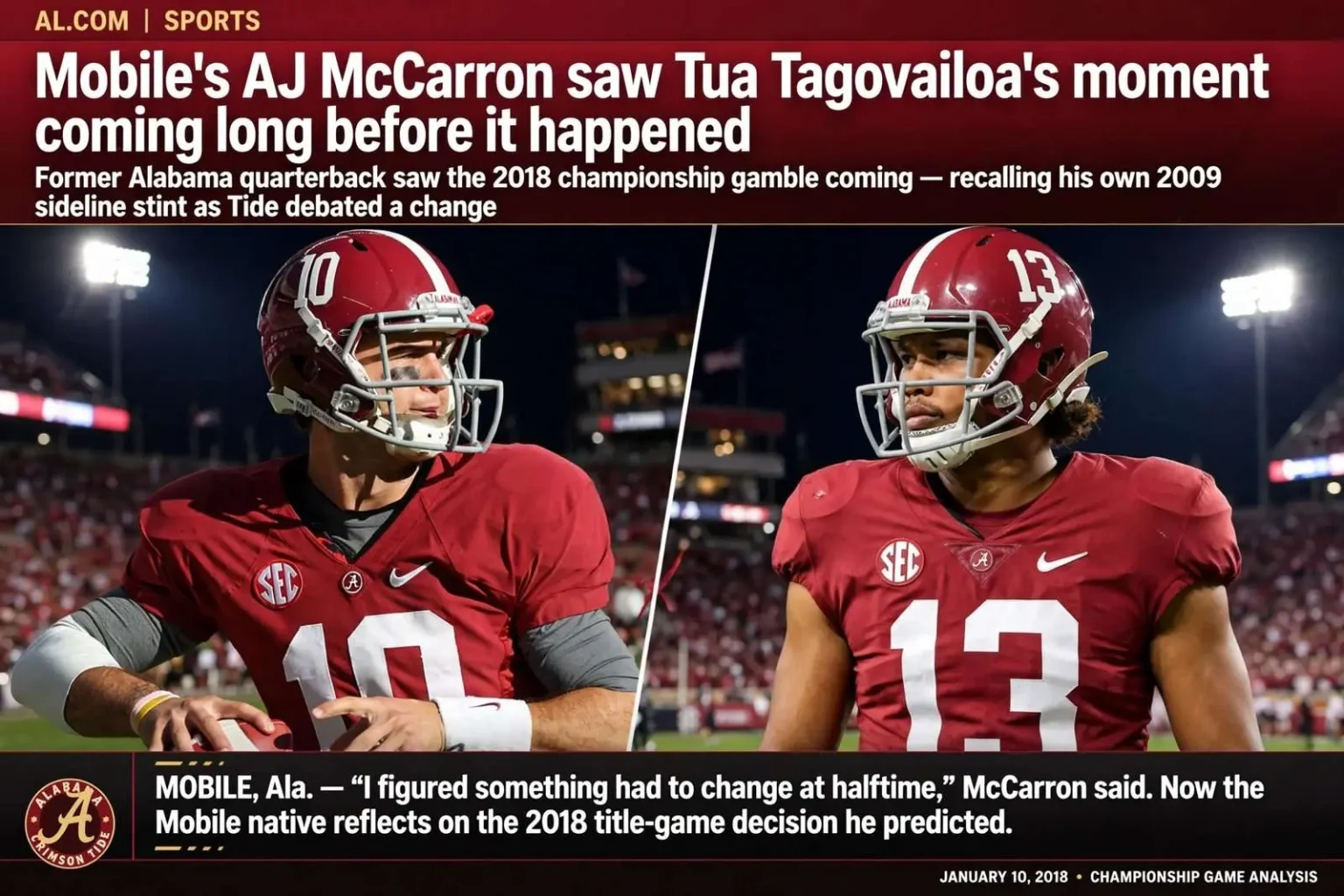
MOBILE, Ala. — When Nick Saban sent freshman Tua Tagovailoa into the national championship game against Georgia, it looked to much of the country like a bold gamble. To Mobile native AJ McCarron, it looked familiar. McCarron had lived a version of the same moment nearly a decade earlier, as a talented young quarterback waiting on the Alabama sideline while coaches debated whether his number should be called.
The setting for Tagovailoa’s introduction was the sport’s biggest stage — Alabama’s national championship collision with Georgia, an all-Southeastern Conference final that pitted the Crimson Tide’s grueling defense-first identity against a rival it knew down to the last tendency. With Alabama’s offense stuck, Saban made the kind of decision for which his career is equally famous and criticized: he benched a returning starter at halftime and handed the game to a true freshman from Hawaii who had never started a college game.
What followed is already part of Alabama lore. Tagovailoa steadied the Tide, dragged the offense back into the game, and ultimately delivered the decisive throw down the left sideline in overtime to win the title. The poise he showed — reading the defense, moving a safety with his eyes and body language, then making the throw — became the single image of the night.
For McCarron, watching from afar, none of it came as a surprise. McCarron grew up in Mobile and starred at St. Paul’s Episcopal School, where he established himself as one of the most productive quarterbacks the Mobile area has produced, before signing with Alabama and winning two national championships as the Crimson Tide’s starting quarterback. He knows how Saban’s staff thinks, and he knows what it feels like to sit behind a veteran starter while the coaches weigh a change.
McCarron lived a similar moment in 2009
Back in 2009, as Alabama marched toward its first national title of the Saban era, the coaching staff repeatedly debated whether to insert the talented young McCarron in relief of veteran starter Greg McElroy. McCarron was a redshirting freshman that season — a detail that shaped how the decision played out — but that did not stop the conversations on the coaching staff from happening again and again as the Tide’s offense sputtered at times during championship runs.
“I was told three weeks in a row that if we didn’t score coming out of halftime they were going to put me in,” McCarron recalled. “All three weeks we got the ball first in the second half and all three times we scored.”
Each time, the veteran offense answered the challenge, and the young quarterback stayed on the sideline. McCarron eventually redshirted that season, preserving his eligibility, and the season ended with Alabama hoisting the national championship trophy — the program’s first under Saban and the first of what became a dynasty-era run.
From that vantage point, McCarron understands both sides of the championship-game calculus better than most. He knows the staff will change quarterbacks if the offense stalls, because he was nearly the beneficiary of that willingness in 2009. And he knows what it costs a locker room — and a starter — when the move is made, because he later became the veteran starter whose job was suddenly in play.
Speaking on Mobile radio
McCarron shared the story on WNSP’s “Sports Drive,” the Mobile sports talk station that covers Alabama football with the intensity of a market that lives and dies with the Tide. Mobile has long been one of the sport’s most fertile recruiting territories — the city has produced a long line of college and professional stars — and McCarron remains one of its most celebrated football exports.
He said he was not surprised that Saban turned to Tagovailoa against the Bulldogs. Halftime of a stalled championship game is precisely when the Alabama staff has historically shown it will act rather than hope.
“I figured something had to change at halftime,” McCarron said. “Sometimes if you’re struggling on offense you just have to show you’ll take a shot down the field.”
That willingness to stretch the field vertically, McCarron suggested, is part of what changed the game. Georgia’s defense had spent two quarters choking off Alabama’s short passing game and bottled-up run game; a quarterback genuinely willing to attack downfield forces even the best secondary to back off and defend the whole field.
Praise for the freshman’s poise
McCarron praised Tagovailoa’s composure on the game-winning drive, and in particular the freshman’s ability to manipulate the safety before delivering the decisive throw down the left sideline. Quarterbacks who reach the highest level tend to share that trait: the physical throw is only half the play, and the other half is moving a defender out of position before the ball ever leaves the hand. For a freshman playing in the sport’s biggest game, against an elite Georgia defense, that level of command stood out even to a former Alabama starter.
But McCarron also issued the caution that comes with experience. Opponents will now have film to study. A quarterback who surprises the league once enjoys an advantage that disappears the moment every defensive coordinator has a full offseason of cut-ups to dissect. Tagovailoa’s highlights made the rounds instantly after the championship; so did the coaching points for how to attack him — disguised coverages, pressure packages and the rest of the standard SEC counterpunching that greets every new starter in the league.
First things first: winning the job
Before Tagovailoa can live up to the soaring expectations that followed his championship heroics, McCarron noted, he must first win the job outright over Jalen Hurts. That point matters more than it might seem from a distance. Hurts had started for Alabama for two seasons, led the Tide to a national championship game the previous year, and had done nothing to forfeit the role other than play for a staff that decided the position needed a change.
Alabama’s quarterback competition entering the next season became one of the most closely watched in college football, and McCarron’s own career is a reminder of how these situations resolve. When he finally took over as the starter, he held the job through two national championship seasons and left Tuscaloosa as the winningest quarterback in Alabama history — a legacy built not just on talent but on navigating exactly the kind of depth-chart pressure now facing both Tagovailoa and Hurts.
“When you have more than one good quarterback you never know when your number is going to be called,” McCarron said. It is a lesson he learned from the sideline in 2009, and one he carried into a career in which readiness — not just ability — separated the players who played from the players who watched.
For Alabama fans, the situation is the enviable kind of problem. Two capable quarterbacks, one championship infrastructure, and a head coach who has proven he will make the uncomfortable call. For the two young quarterbacks, it is the daily reality of competing at a program where the backup is often a star and the starter’s seat is never warm for long.
What it means going forward
The championship game did more than hand Alabama another trophy. It reset expectations for the program’s offense and created the quarterback debate that dominated the offseason across the state. Talk radio in Mobile and Birmingham, bars in Tuscaloosa and family dinner tables from Huntsville to Foley all weighed the same question McCarron addressed on WNSP: who starts, and what happens to the one who doesn’t?
McCarron’s answer was characteristically grounded. He knows Saban’s staff will play whoever gives Alabama the best chance, he knows the film will even the field, and he knows competition at Alabama is permanent. The freshman’s moment came because the situation demanded it. Whether the next moments belong to Tagovailoa or Hurts will be decided the way everything is decided at Alabama — in practice, in the fall, under the same unforgiving standard.
Mobile’s quarterback lineage
McCarron’s connection to the story runs deeper than shared experience. Mobile has produced an outsized share of championship quarterbacks and stars, and St. Paul’s Episcopal School — the private school where McCarron starred before Tuscaloosa — remains a frequent stop for college recruiters from across the country. The Gulf Coast’s football culture, from youth leagues through high school powerhouses, feeds talent into SEC rosters every signing class, and Alabama’s in-state recruiting pipeline runs straight through the Port City.
McCarron himself became a measuring stick for Mobile quarterbacks. After redshirting in 2009, he waited behind McElroy, took over the starting job, and guided Alabama through two national title seasons while piling up wins at a rate no quarterback in program history had matched. His path — patience, preparation, then sustained excellence — is the roadmap he implicitly offered both Tagovailoa and Hurts.
His radio appearance also reflects the role former players play in the state’s football conversation. Stations like WNSP put former Tide stars on the air regularly, and their first-hand knowledge of the program — how staff meetings work, how competitions are run, how Saban operates in a crisis — gives their commentary a weight that outside analysts cannot match.
The bigger picture in Tuscaloosa
The Tagovailoa decision also fit the pattern of Saban’s tenure. Alabama’s dynasty has been built partly on an unusual willingness to treat every position, quarterback included, as open. Starters are benched mid-game when performance dips, true freshmen play immediately when they earn it, and no individual — however decorated — outranks the standard. The 2009 deliberations over McCarron, and the 2018 decision to turn to Tagovailoa, come from the same playbook.
For Alabama’s opponents, the deeper problem is what the championship game revealed: the Tide can lose its rhythm, lose its starting quarterback, insert an untested freshman, and still win the title. The depth that made the Tagovailoa-for-Hurts switch possible is a structural advantage no SEC rival fully matched during that stretch of the Saban era.
McCarron’s final word on the matter was the practical one he learned a decade earlier in Tuscaloosa. Moments like Tagovailoa’s are created by preparation meeting opportunity — a freshman ready when the staff finally turned to him, just as a young McCarron stayed ready through three consecutive weeks of halftime ultimatums that never came to pass. At Alabama, the number gets called eventually. What happens next depends entirely on whether the quarterback holding the clipboard was ready when it did.
For now, Mobile can claim a stake in the story twice over: in the hometown star who saw the moment coming, and in the freshman whose championship legend began with the kind of decision McCarron once sat three weeks away from himself.