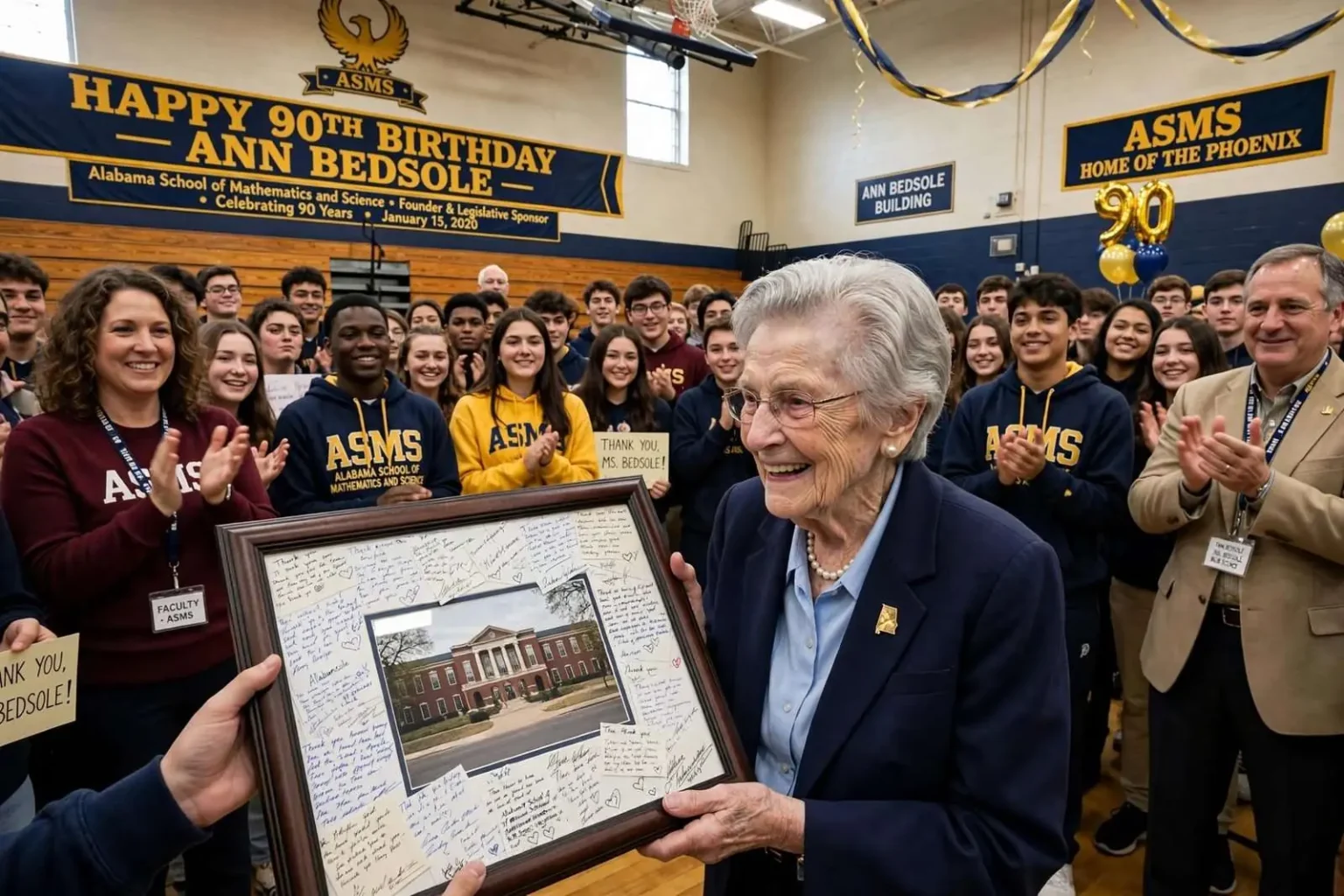
Ann Bedsole, the Mobile civic leader who wrote the legislation that created the Alabama School of Mathematics and Science, marked her 90th birthday with a surprise celebration inside the school’s gymnasium, where students, faculty and staff gathered to honor the woman who made the Mobile institution possible.
Bedsole, who turned 90 on Jan. 15, was greeted by the full student body during the gathering. As a gift, students presented her with a framed photograph of the school surrounded by a matte covered in handwritten notes of thanks from every student enrolled, a gesture meant to capture more than three decades of impact in a single keepsake.
The scene — several hundred teenagers rising to honor a nonagenarian in a school gymnasium — was an unusual one for any institution, and more so for a school whose students were born long after the legislation that created it. Faculty members said the assembly had been organized quietly enough that Bedsole, a regular presence on campus, had no warning of what waited inside the gym when she arrived.
The Legislation That Started It
The school, known widely by its acronym ASMS, exists because of legislation Bedsole introduced in the Alabama State Senate in 1989. At the time, she envisioned a public boarding school that could gather Alabama’s most driven students in one place and prepare them to lead the state’s future.
The idea drew on a national model. Specialized residential science and math schools had taken root in a number of states during the 1980s, built on the argument that a state’s brightest teenagers — many of them in small towns without advanced coursework — deserved a public institution that could challenge them the way private academies did. Bedsole’s bill brought that model to Alabama, anchoring it in Mobile, a city with the historic institutional fabric to host a statewide school.
Since its founding, Bedsole has remained closely tied to the school, serving on its board and later on its foundation board, and she funded construction of the Ann Bedsole Building, the newest addition to the campus. The building carries her name onto the campus quad daily, a detail students pass on the way to class and one that school leaders describe as a standing reminder of the institution’s origin story.
“Just as we predicted way back when, we have evolved from a ‘field of dreams’ into a school that is 100 percent committed to producing Alabama’s best leaders and most outstanding innovators,” Bedsole said of the school’s growth since it opened. “These young men and women are literally creating opportunities out of what others might see as challenges and obstacles.”
The “field of dreams” line, a nod to the era’s famous movie admonition that if you build it they will come, summed up the gamble the legislation represented. Alabama in 1989 was pouring resources into industrial recruitment and education reform, and a tuition-free residential school for high achievers was an untested proposition in a state more accustomed to debating education funding than creating new kinds of schools. Three decades later, the school’s graduates scattered across the nation’s top universities and technical fields are the argument’s answer.
A Life of Firsts
Born on Jan. 7, 1930, in Selma, Bedsole has spent nine decades building a record of public service and civic leadership across south Alabama. She was named First Lady of Mobile in 1972, Mobilian of the Year in 1993 and Philanthropist of the Year in 1998 — a series of honors that traces an arc from civic hostess to policy-maker to philanthropist, each title marking a different decade of involvement in the city’s public life.
In 1979, she became the first Republican woman elected to the Alabama House of Representatives, a milestone that preceded her later State Senate service and her push to establish ASMS. Breaking into the Legislature as a Republican woman in a body dominated by Democrats — and by Democratic men — required her to build coalitions across the aisle in an era when the GOP held only a handful of the State House’s seats, an experience her colleagues later credited for the persistence that carried the ASMS bill through the Senate a decade later.
Bedsole studied at the University of Alabama and the University of Denver before returning to south Alabama, where she has continued to run Bedsole Farms and serve as president and chairman of the board of White Smith Land Company, one of Mobile’s longstanding real estate and land firms. Her decades of business and civic leadership have earned her numerous public service honors across the state.
The combination was unusual for its time: a working land-company executive and farm operator who was simultaneously raising a family, chairing civic causes and serving in elected office. Her career in the Senate coincided with the years when Alabama was remaking its education and economic development policies, and she became one of the chamber’s recognizable voices on education matters before leaving elected office to concentrate on philanthropy and the boards she continues to serve.
Those who have worked with her across those decades describe a through-line: the same recruiting instinct that filled civic committees in the 1970s was applied to ASMS, where she personally pressed the case for the school with legislative colleagues, business leaders and prospective students’ families long after the law creating it had passed.
What the School Offers Today
ASMS President Dr. John Hoyle said Bedsole’s staying power comes from an ability to balance ambition with realism. “She is exactly the type of leader we hope our students will become one day,” Hoyle said. “What makes Ann Bedsole so special is that she has been a visionary for not just one but multiple organizations, populations and philanthropies. She sees the future with not just hope, but also through a realistic lens. I think that is why she has not stopped going to work even at the age of 90.”
Located at the corner of Dauphin Street and Ann Street in Mobile’s midtown area, ASMS is Alabama’s only fully public, tuition-free residential high school. The school focuses on advanced coursework in math, science and the humanities, offering free tuition, room and board to motivated students from across the state. Enrolled students have access to more than 100 courses along with research opportunities and leadership training designed to prepare them for competitive colleges and careers.
The residential model is the school’s distinguishing feature. Students leave home — often small towns across the Wiregrass, the Black Belt, north Alabama and the Gulf Coast — to live on the midtown campus for the last two or three years of high school, taking on course loads closer to a college sophomore’s than a traditional senior’s. School officials have long argued that the residential environment matters as much as the curriculum: it gathers students who in their home districts might be the only ones of their kind into a community where ambition is the norm.
Admission is competitive, and the school recruits deliberately in communities that historically send few students to selective programs, an outreach mission that supporters say fulfills Bedsole’s original vision of serving the whole state rather than its largest cities. Graduates go on to engineering programs, medical schools, research labs and technology companies, and the foundation that supports the school raises scholarship and program funds to keep the offer of free tuition, room and board intact.
For students like senior Jalexis Edwards, the doors Bedsole’s legislation opened have reshaped what they believed was possible for their own futures. “Ms. Bedsole has given ASMS students opportunities that we could have never imagined,” Edwards said. “If you told me three years ago that I would have numerous opportunities to grow as a leader, I would not have believed you. Thanks to Ms. Bedsole and ASMS, the unimaginable is my everyday reality.”
Edwards’ remarks, delivered at the birthday assembly, drew the loudest response of the afternoon, students and faculty said — the founder hearing directly from the generation her bill was written for. The student gift, with its handwritten notes from every enrolled student, was presented afterward, and photographs of the moment circulated among alumni within days.
Bedsole’s family and business associates were among those present at the assembly, and school administrators used the occasion to note that her connection to the campus has been continuous — board service, foundation work, gifts and a near-constant attendance at milestone events since the first students arrived in the school’s earliest years.
More than three decades after she introduced the bill that created ASMS, Bedsole remains a visible presence at the school she founded, one whose influence, students and administrators say, continues to shape the next generation of Alabama’s leaders. The gymnasium celebration was, in effect, a rare public accounting of what a single piece of legislation can produce: a campus on Dauphin Street filled with students from every county, a building with her name on it, and a room full of teenagers thanking the woman who built their school before they were born.