Mobile’s Arts Groups Press On With Discounted Symphony Tickets, University Theater and Livestreamed Concerts
As COVID-19 continues to disrupt live audiences, Mobile's arts community is adapting with a discounted Mobile Symphony Orchestra membership, a University of Mobile production of "Little Women" and livestreamed University of South Alabama concerts.
Mobile’s performing arts organizations are working to keep audiences engaged even as a slow-moving COVID-19 vaccine rollout keeps many venues operating at reduced capacity. Local arts leaders say the pandemic has created a two-front challenge: containing the virus itself and overcoming public wariness about returning to shared indoor spaces, a combination that has made it difficult for groups that depend on ticket sales and live audiences to fully rebound.
The strain has been felt personally throughout Mobile’s arts community over the past year, with several prominent local performers and supporters among those sickened by the virus. Organizers say that until infections subside and residents feel confident attending events again, groups such as the Mobile Symphony Orchestra and area theater and music programs will continue to face financial pressure.
The arithmetic behind that pressure is unforgiving. Performing arts organizations earn most of their revenue from live audiences — tickets, subscriptions and the ancillary spending that surrounds a performance — and a hall restricted to a fraction of its seats cannot approach its break-even point. Grants and donations have cushioned the blow, but arts groups across the Gulf Coast have spent the pandemic burning reserves, cutting programming and improvising new formats simply to keep their musicians, actors and staffs attached to the institutions that employ them.
Civic boosters often point to the symphony and other performing arts institutions as markers of the city’s quality of life, arguing they help attract business investment while also simply making everyday life in Mobile more vibrant. That argument has acquired new weight during the pandemic: a city whose cultural institutions go dark loses a recruiting argument as well as a season. The organizations still producing work — even at reduced capacity, even for online audiences — are keeping a civic signal alive that Mobile’s cultural life continued through the crisis.
University of Mobile stages ‘Little Women’ to a sold-out house
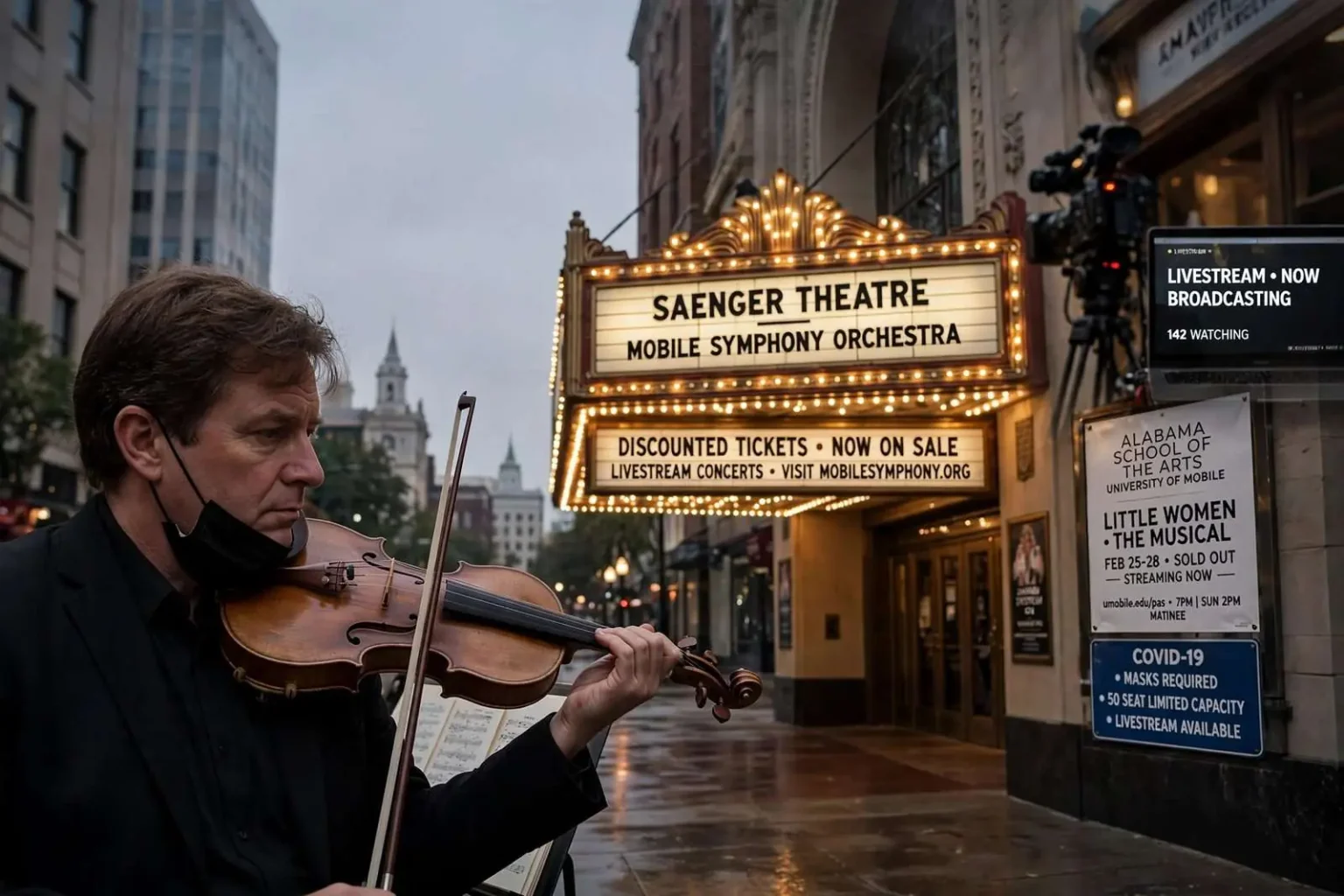
Despite the obstacles, several organizations are moving ahead with productions and offers meant to keep the arts alive through the final stretch of winter. The Alabama School of the Arts at the University of Mobile, located at 5735 College Parkway, is staging the musical “Little Women” Feb. 25-28. Based on Louisa May Alcott’s semi-autobiographical novel, the production follows sisters Meg, Jo, Beth and Amy March through the mid-19th century as they grow from childhood into adulthood.
Pandemic precautions limited the in-person run to just 50 seats, which have already sold out, but the show can still be viewed online for a fee through umobile.edu/pas. Performances are scheduled for 7 p.m. each night except for a 2 p.m. matinee on Sunday. Those with questions can call 251-442-2383 for more information.
The production’s doubling as a streamed event has become the template for the era. Fifty seats in a university theater cannot sustain a musical, but a digital audience is not capped by fire code — and the fee-based stream gives alumni, extended family and housebound patrons a way to attend from anywhere. What the university learned staging it mirrors what every producing organization in the region has learned: the show itself changes less than the business model around it.
The symphony’s answer: discounted tickets
The Mobile Symphony Orchestra is offering its own incentive to keep patrons coming back: discounted tickets, aimed at rebuilding an audience that has spent nearly a year out of the habit of attending. An orchestra’s relationship with its subscribers is built on season-long rituals — the same seats, the same pre-concert dinners, the same weekends — and a year of disruption breaks that habit in ways that outlast the restrictions themselves. Discounting is the classical remedy: lower the barrier, get patrons back into the hall, and let the music do the rest.
The orchestra has also joined the region’s shift toward streamed and recorded programming, presenting concerts online during periods when full houses were impossible. For an ensemble whose economics depend on filling the Saenger Theatre, digital offerings are a stopgap rather than a substitute — production costs money and streaming revenue rarely matches a ticketed house — but they serve the deeper purpose of keeping the orchestra audible in the life of the city between live dates.
The institution behind those efforts is one of Mobile’s oldest cultural anchors. The symphony’s roots in the city reach back to the 1930s, and its professional musicians have anchored music education and chamber playing across the Gulf Coast for generations. Organizations of that depth are resilient — they have survived recessions, hurricanes and a century of changing taste — but resilience is not immunity, and arts leaders have been candid that a second year of constrained audiences would force harder decisions about season length and ensemble size.
A wider season of adaptation
Around the symphony and the university production, the region’s smaller organizations have been adapting in their own ways. Community theaters have pushed openings later into the spring, rehearsed in pods, and experimented with outdoor and cabaret-format performances that allow distancing. Music programs that depend on school partnerships have contended with the same disruptions facing the schools themselves, and church and choral groups — a major part of Mobile’s musical life — have navigated singing restrictions that hit their art form with particular force.
For performers, the year has meant improvised incomes: teaching online, playing streamed services, recording parts at home. Mobile’s arts community is compact enough that nearly every working musician wears several hats — symphony player, teacher, church music director, wedding band member — and the loss of live work in any one lane ripples through all of them. The illness of several prominent local performers and supporters made the stakes concrete in a way no balance sheet could.
Public health dynamics will decide the timeline more than any marketing plan. The slow rollout meant that capacity limits and public caution would persist through the winter and into spring, and organizers have planned accordingly — shorter runs, smaller casts, flexible formats that can pivot from stage to stream if conditions worsen. The lesson of the season so far, arts leaders say, is that adaptability is the difference between a dark season and a diminished one.
What the season means for downtown
The health of the performing arts is tied to more than the arts. A symphony night fills downtown restaurants before curtain and bars afterward; a theater run books hotel rooms for visiting family and casts. The pandemic’s interruption of that circulation has been felt across Mobile’s hospitality economy, which is one reason city boosters watch the arts community’s recovery as a proxy for downtown’s overall rebound.
It is also why the organizations pressing ahead this winter matter beyond their audiences. Every streamed performance, every discounted ticket, every sold-out fifty-seat musical is a signal that Mobile’s stages have not gone dark — that the institutions which anchor the city’s cultural identity planned to outlast the pandemic and were already rehearsing for the season after. For a city that markets its quality of life to employers and families, that signal may prove to be worth as much as the ticket revenue.
Why ‘Little Women’ fit the moment
The choice of “Little Women” for a pandemic-era university production was fitting beyond its familiarity. Alcott’s novel is about a household holding itself together through hardship — shortages, separation, illness — with creativity and mutual care doing the work of money. The musical adaptation keeps that spine: the March sisters’ ambitions and quarrels, Jo’s stubborn work as a writer, and the family’s re-making of celebration out of almost nothing. For a cast and crew performing to fifty masked seats and a camera, the story of a family making do was not a stretch.
The Alabama School of the Arts production also served its students at a moment when their training had been disrupted like everyone else’s. Musical theater students lost performance seasons they will never get back, and a staged, streamed, fully produced show — however constrained — returned something essential to their education: an audience, even a small one, and the discipline of a run that must go on nightly. The Feb. 25-28 schedule, with 7 p.m. curtains and the Sunday 2 p.m. matinee, gave the students the ordinary pressure of a real opening week under extraordinary conditions.
For patrons, the university’s production doubled as a working demonstration of how live performance survives a pandemic: reduced house, mandated precautions, a paid stream carrying the show to everyone the fifty seats could not hold. The model costs more to produce and earns less per viewer than a full house — but as the school’s sold-out run showed, demand for live performance did not disappear during the pandemic; it accumulated.
The road to a full house
What arts leaders across Mobile describe as the finish line is not the lifting of restrictions but the restoration of confidence — the moment patrons decide, household by household, that sitting in a theater again is simply a night out rather than a calculated risk. Vaccine distribution moves that date forward; infection rates set it back. In the meantime, the organizations that kept operating — with discounted symphony tickets, streamed concerts and small-cast productions — are positioned to lead the rebound, because their audiences never fully lapsed.
The financial recovery will take longer than the public health one. A season sold at reduced capacity is a season of losses even when attendance is strong relative to the limit, and reserves spent in 2020 and early 2021 will take years to rebuild. Arts administrators have been planning for that arithmetic: conservative budgets, shorter seasons, and a deliberate sequence of offerings designed to rebuild subscription bases before returning to full-scale productions.
Still, the winter’s news from Mobile’s stages was, by the standard of the past year, encouraging. A university musical sold out its fifty seats and opened a second, digital front. The symphony gave patrons a reason to come back now rather than later. Smaller groups kept rehearsing, streaming and planning. The two-front challenge — the virus and the wariness it left behind — remained, but Mobile’s performing arts community had answered it the only way it could: by performing, in whatever rooms and formats the moment allowed, until the houses filled again.