Mobile’s Arts Scene Gears Up: Joe Jefferson Players Close Season With ‘Ragtime,’ Mobile Opera Announces 2018-19 Lineup
Joe Jefferson Players close their 70th season with 'Ragtime,' the Mobile Arts Council spotlights Alabama architecture for the state's bicentennial, and Mobile Opera unveils a jealousy-themed 2018-19 season.
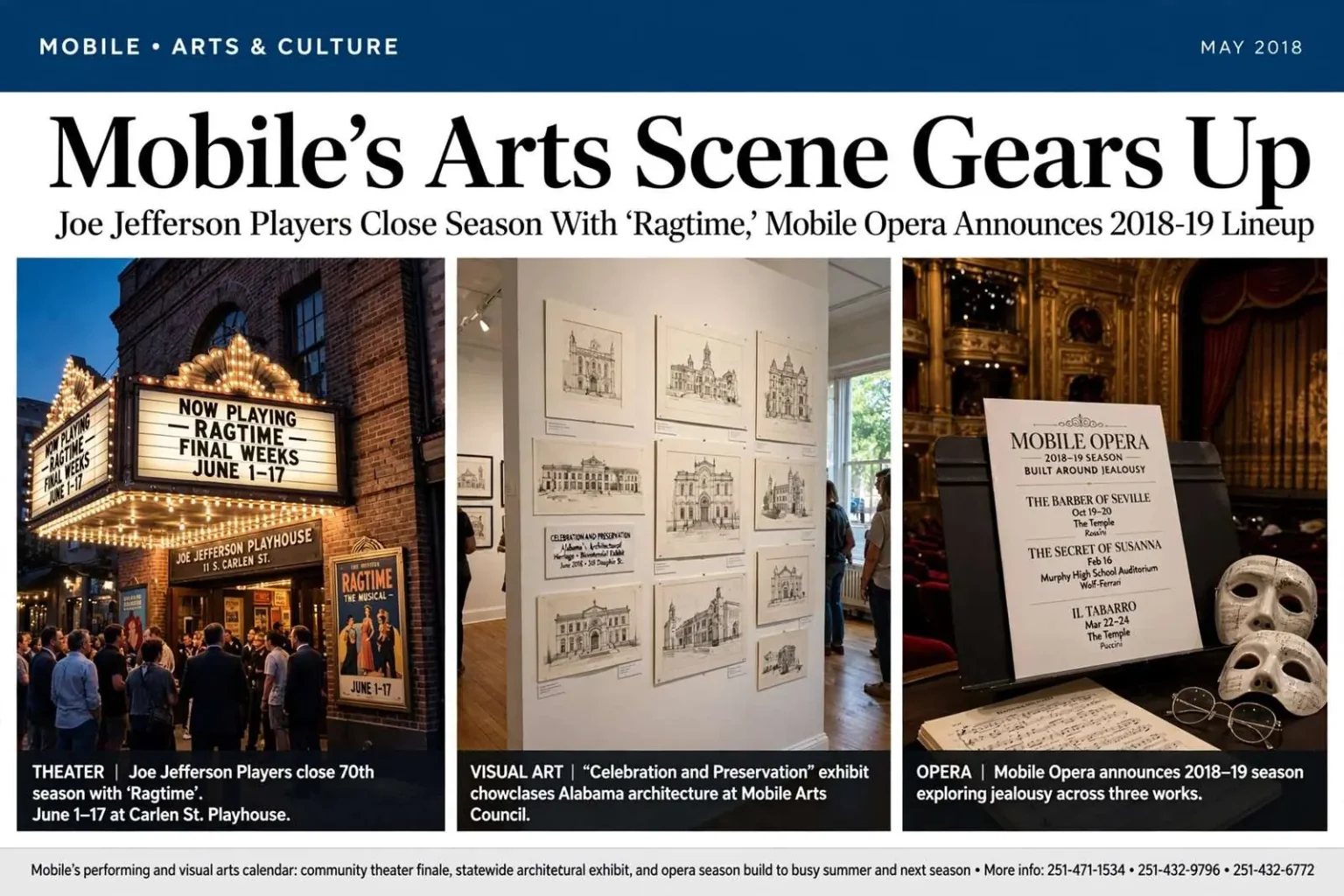
Mobile audiences have a full slate of theater, visual art and opera to look forward to this summer and into next season, with three local arts organizations all announcing new work in the same stretch. From a closing musical at one of the city’s oldest playhouses to an architectural exhibition tied to the state’s bicentennial and a season of opera built on a single destructive emotion, the announcements together traced the breadth of Mobile’s cultural calendar.
Joe Jefferson Players close out 70th season with ‘Ragtime’
Joe Jefferson Players is wrapping up its 70th season with a production of “Ragtime,” the Tony Award-winning musical based on E.L. Doctorow’s 1975 novel of the same name. Reaching a 70th season is a milestone few American community theaters can claim, and the organization — named for the celebrated 19th-century actor Joe Jefferson, who made his home in the Mobile area and was famous nationwide for his Rip Van Winkle — has occupied its Carlen Street playhouse since the mid-20th century as the city’s anchor for community theater.
Set in New York City at the turn of the 20th century, the story follows a wealthy white family, a family of Jewish immigrants and a Black musician as their lives intersect against a backdrop of class tension, prejudice and shifting assumptions about what America could become. Doctorow’s novel wove real historical figures through its fictional families, and the musical — with music by Stephen Flaherty and lyrics by Lynn Ahrens — distilled that sweep into a show that has become a modern staple of American musical theater since its Broadway premiere in 1998.
The musical draws on period forms like marches, cakewalks and gospel, along with the ragtime syncopations that give the show its name, to pull audiences into the social currents that shaped a defining era of U.S. history. For a community theater company, it is a demanding choice: a large cast, an orchestral score and subject matter that requires more than stagecraft to carry.
Local theatergoers can catch the show June 1-17 at the Joe Jefferson Playhouse, 11 S. Carlen St. Friday and Saturday performances begin at 7:30 p.m., with a 2 p.m. matinee on Sundays. Tickets and additional information are available by calling 251-471-1534.
Mobile Arts Council spotlights the state’s architectural history
Alabama’s built environment is getting its own showcase this June at the Mobile Arts Council, 318 Dauphin St., where an exhibit called “Celebration and Preservation” will feature 25 drawings highlighting distinct architectural periods and tastes from across the state’s history. The Arts Council’s downtown gallery on Dauphin Street has long served as the hub for visual art in the city, rotating exhibitions alongside its programs for local artists and schools.
The exhibit, which is traveling the state as part of Alabama’s bicentennial celebration, spans styles including Federal, Greek Revival, Gothic Revival, Italianate, Romanesque and Mission Revival architecture. The bicentennial — marking Alabama’s admission to the Union in December 1819 — has been observed across three years of programming, and architectural heritage has been one of its most visible themes, with the state’s antebellum courthouses, churches and mansions standing as the most photographed remnants of its early decades.
Alabama’s architectural record is unusually deep for its size. The Greek Revival plantation houses of the Black Belt, the Victorian commercial blocks of small-town Main Streets and the 20th-century civic buildings of its industrial cities all fall within the styles on display, and the drawings approach them not as museum pieces but as working buildings that communities still use, maintain and argue about.
A 32-page catalog produced in partnership with the Alabama Architectural Foundation accompanies the show, giving visitors a reference to take home and schools a teaching aid for the preservation lessons the exhibition is meant to carry. More information is available by calling 251-432-9796.
Preservation has a particular resonance in Mobile, where the city’s historic districts — from the Oakleigh Garden neighborhood to the antebellum and Victorian streetscapes downtown — have shaped the city’s identity and its tourism economy. An exhibition that frames preservation as celebration, rather than restriction, fits the civic mood that has surrounded the city’s tricentennial and bicentennial-era investments in its historic core.
Mobile Opera announces a season built around jealousy
Mobile Opera has unveiled its upcoming season, built around three works that share a common thread: jealousy, explored through two comedies and one drama. Programming a season around a single emotion is a curator’s device — it gives audiences a throughline across very different scores and lets a company market a season as one story told three ways.
The season opens with Rossini’s “The Barber of Seville” on Oct. 19 and 20 at The Temple, at the corner of Claiborne and St. Francis streets. The comic opera follows Figaro and Count Almaviva as they scheme to win Rosina away from her jealous, overprotective guardian, with the plot’s mishaps ultimately giving way to a happy ending. First performed in 1816, “The Barber of Seville” remains the most performed of all comic operas, and its overture and arias — “Largo al factotum” foremost among them — are among the most recognizable music in the repertoire.
On Feb. 16, Wolf-Ferrari’s “The Secret of Susanna” will headline the company’s Winter Gala at Murphy High School Auditorium. The choice carries some historical weight for Mobile Opera: the same work, staged in the same venue, was the company’s very first production 72 years ago, making the gala both a season event and an anniversary observance. Like the season opener, it’s a lighthearted comedy centered on jealousy and mistaken suspicion, with an upbeat resolution — a husband’s comic interrogation of his new wife’s afternoon habits resolving into warmth rather than recrimination.
The season closes on a heavier note with Puccini’s “The Cloak,” also known as “Il Tabarro,” the final piece in a dark trilogy that begins with “Gianni Schicchi” and “Suor Angelica.” Unlike the season’s comic offerings, jealousy in this Puccini one-act leads not to laughs but to old-fashioned tragedy. Set on a barge on the Seine, “Il Tabarro” is the most compact work of Puccini’s “Trittico,” and its murder-driven final scene is among the starkest in the operatic canon. Performances are set for March 22 and 24 at The Temple.
Tickets and season subscription information for Mobile Opera’s lineup are available by calling 251-432-6772. Subscriptions have long been the financial backbone of a company of Mobile Opera’s size, and a season deliberately weighted toward beloved comedy was built to fill them.
A full calendar
Between the Joe Jefferson Players’ season finale, the Mobile Arts Council’s architectural retrospective and Mobile Opera’s newly announced season, Mobile’s performing and visual arts calendar is shaping up to be a busy one heading into the back half of the year. The three announcements landed within the same stretch of spring, and together they illustrated the division of labor in the city’s cultural life: a community theater closing a 70th season, a gallery carrying the state’s bicentennial story, and an opera company marking its own history with a season that begins in farce and ends in tragedy.
The playhouse and its namesake
The Joe Jefferson Players carry one of the most storied names in American theater history. Joe Jefferson, born in Philadelphia in 1829 into a family of touring actors, spent the final decades of his life at his estate in the Mobile area and became internationally famous for the title role in “Rip Van Winkle,” a part he performed thousands of times before audiences on both sides of the Atlantic. The community theater that took his name traces its own institutional history through the Great Depression and wartime Mobile, and its 70th-season finale underscored a continuity of volunteer theater that has survived longer than most professional companies manage.
Staging “Ragtime” as that finale was a statement in itself. Community theaters typically close their seasons with reliable crowd-pleasers; the Players instead chose one of the most ambitiously themed musicals of the past quarter-century, with an ensemble that spans three communities and a score that moves from parlor ballads to full gospel chorus. The production gives local performers roles that rarely appear on community stages, and it gives audiences a musical they are unlikely to have seen done locally.
Opera’s home venues
The season’s split between The Temple and Murphy High School Auditorium reflects the practical geography of opera in Mobile. The downtown performance venue at Claiborne and St. Francis streets offers the intimacy that suits one-act works like “The Secret of Susanna” and “Il Tabarro,” while the Murphy auditorium — one of the city’s largest and most historic school stages — accommodates the galas and larger productions that draw subscribers from across the bay.
Mobile Opera, founded in the years just after World War II, ranks among the oldest continuously operating opera companies in the region, and its longevity has rested on the same formula the new season follows: one beloved staple to fill the house, one rarity to reward the faithful, and one powerful short work to close with force. A 72-year arc from a company’s first production back to the same Wolf-Ferrari comedy, in the same hall, is the kind of institutional memory few American companies can claim.
For audiences, the season’s design lowers the barrier to entry. Comic opera — and “The Barber of Seville” above all — has survived two centuries precisely because it works on newcomers: recognizable tunes, broad comedy and a plot that needs no program notes. A season that opens there and builds toward Puccini is, implicitly, an invitation to subscribers who have never set foot in an opera house.