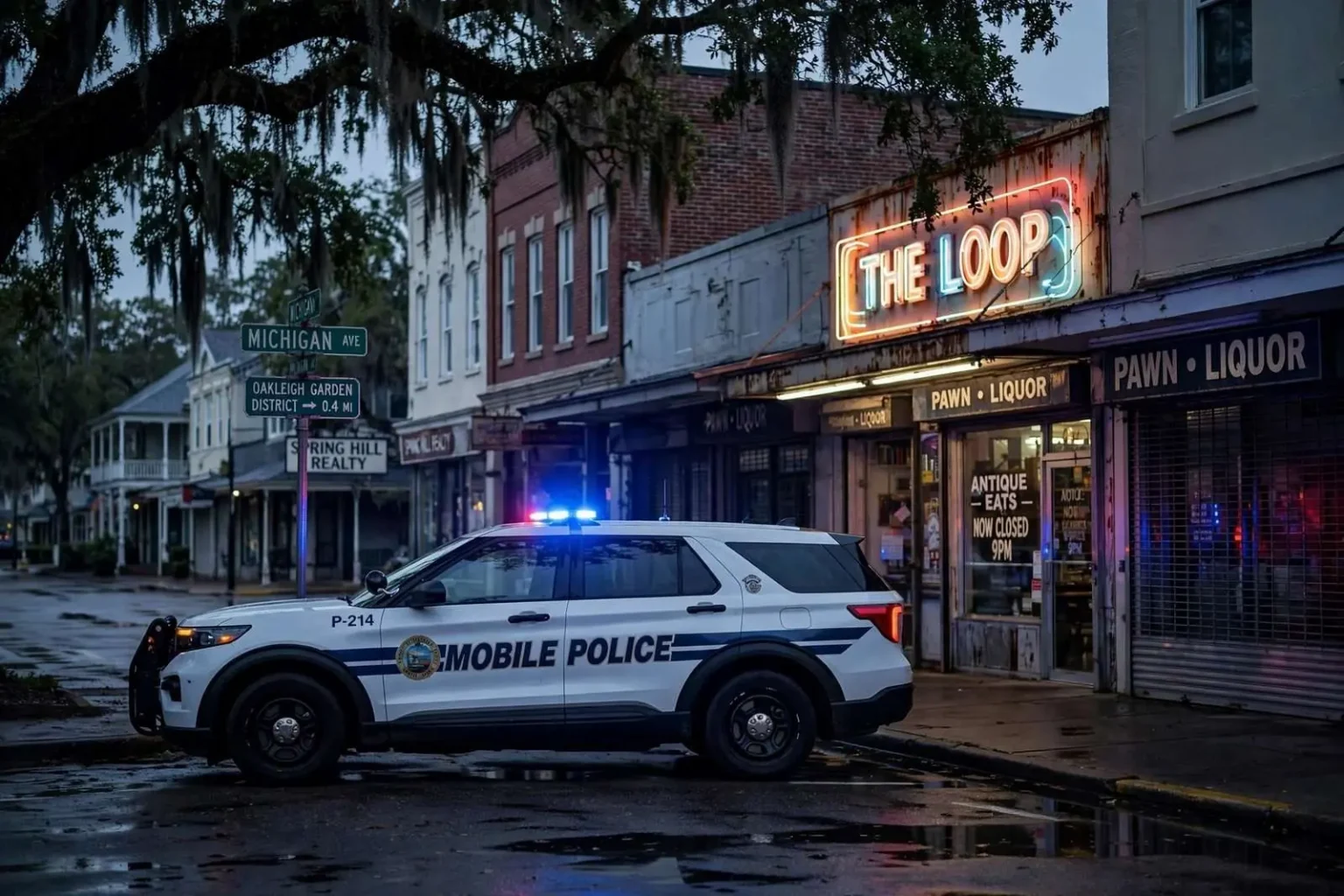
A recent spike in crime around Mobile has drawn heavy attention to downtown and its surrounding neighborhoods, with much of the media coverage focused squarely on that part of the city. But residents and observers say the problem is not confined to downtown at all — it is showing up in neighborhoods across Mobile, from the historic Oakleigh Garden District to The Loop and even into more affluent areas like Spring Hill. Oakleigh has seen its share of incidents, as has downtown itself, but The Loop, one of Mobile’s busier commercial and entertainment corridors, has reportedly been hit especially hard.
Even Spring Hill, a neighborhood not typically associated with high crime rates, has seen holdups that residents there have been reluctant to publicize. The reluctance is itself part of the story: neighborhoods that trade on their reputations — for property values, for school enrollment, for the simple comfort of feeling safe — often prefer quiet dealing with the police over headlines that spread the word further. The result is a public record of crime that undercounts what people in those neighborhoods are actually experiencing.
City Hall’s official position has been that overall crime numbers have not actually increased. That claim is met with skepticism by residents who argue it depends heavily on which crimes get counted and which get noticed. The argument is that the raw number of armed robberies citywide may indeed be flat, but that statistic obscures a shift in where those crimes are drawing public attention.
The Geography of a Statistic
A robbery at a juke joint on Michigan Avenue at midnight tends to draw little notice outside the immediate neighborhood. A holdup at a well-known retail location in The Loop, by contrast, becomes a citywide talking point. The result, critics say, is a distorted public sense of where crime is actually concentrated, even if the city’s aggregate figures are technically accurate. Two identical crimes, committed the same night, produce two entirely different levels of public alarm depending on where they land.
That dynamic puts residents and city officials in a genuine disagreement over facts rather than over honesty. The numbers City Hall cites are real, and so is the perception on the street that things have gotten worse. Both can be true at once when crime migrates between neighborhoods, shifts between victims who report and victims who don’t, and moves from places where cameras and social media record everything to places where nothing is recorded at all.
The Loop’s particular vulnerability as a commercial corridor makes its experience a useful barometer. Strippers of inventory, holdups of late-night businesses and parking lot robberies all cluster where commerce concentrates, and businesses that feel unprotected respond by closing earlier, which empties corridors that depend on evening traffic. A crime wave in a commercial district does quiet economic damage long before it shows up in statistics.
What Rank-and-File Officers Say They Need
Rank-and-file police officers interviewed about the situation describe a consistent need: more people patrolling the streets. Their preferred fix is straightforward — shift resources away from lower-priority enforcement, such as roadblocks aimed at catching drivers with lapsed insurance, and toward visible patrol presence in neighborhoods experiencing break-ins and robberies. More officers on the street, equipped and ready to respond, is described as the difference between preventing a robbery and investigating one after the fact.
The argument carries professional weight because patrol visibility does several things at once. A marked unit rolling through a commercial corridor deters the opportunistic offender, reassures the business owner closing up alone, and shortens response time when a call does come in. Insurance roadblocks, by contrast, generate citations and revenue but, in officers’ telling, do little to interrupt the crimes residents are actually afraid of.
The tension between enforcement priorities is ultimately a budget question. A police department of fixed size allocates hours to traffic details, administrative duties and specialized units before a single beat is walked, and every hour reassigned to patrol comes from somewhere else. That is the trade-off residents are asking their elected officials to make, explicitly and on the record.
The Neighborhoods Where It’s Happening
The Oakleigh Garden District, with its historic homes and walkable streets near downtown, has long been a neighborhood where residents feel comfortable walking at night, and the incidents there have been noticed precisely because they depart from that expectation. The district sits close enough to the downtown entertainment district that its boundaries absorb some of the same late-night traffic, and its residents have been among the most organized in pressing the city for answers.
The Loop’s situation is different in kind. The corridor is a working commercial district — restaurants, shops, service businesses — that serves customers across midtown all day and into the evening. Robberies there strike at the livelihood of business owners who cannot simply relocate, and at employees who close registers and take out trash at the hours when holdups are most likely. Word travels fast among the corridor’s merchants, and so does the sense that reports to the city produce meetings rather than patrols.
Spring Hill’s experience completes the picture. Holdups in a neighborhood where residents can afford alarms, gates and private response show that crime follows opportunity rather than respecting income lines, and the neighborhood’s preference for discretion means its incidents surface in public only when a victim chooses to speak. Police who work the area know the pattern even when the public does not.
The Perception Problem and Its Politics
For city officials, the gap between the statistics and the street-level mood is a political hazard. A mayor or council member who answers “crime is down” to a constituent whose neighbor was robbed risks sounding dismissive, even when the numbers are accurate on their own terms. The durable response to that gap is transparency about geography: publishing where crimes are happening, by neighborhood and by type, so residents can see the pattern rather than argue about the total.
The media’s role in shaping perception cuts both ways. Downtown crime gets covered because downtown is where the cameras, the bars and the city’s public life are concentrated, and a single well-publicized incident can outweigh a month of quieter incidents elsewhere. Residents of The Loop and Oakleigh have noticed that asymmetry and pressed for their neighborhoods to be counted in the public conversation, not just in the annual report.
Business groups in the affected corridors have their own stake. Commercial districts live and die on customer comfort, and repeated robberies — even ones that never make the news — eventually show up in foot traffic. Merchants along The Loop have historically responded to crime spikes by organizing, sharing information with police and demanding visible presence, which is precisely what the rank-and-file officers say they want to provide.
What a Reallocation Would Look Like
Shifting enforcement away from insurance roadblocks toward neighborhood patrol would change the daily texture of policing in visible ways. Residents would see marked units on residential streets during the evening hours when break-ins cluster, more presence around closing time in commercial corridors, and faster response when a holdup is reported. The department’s specialized investigation capacity would still handle the cases that occur, but the goal of the patrol shift is to reduce the number of cases that need investigating at all.
The counterargument usually raised by city finance offices is that traffic enforcement is not merely a nuisance function — it generates revenue and removes dangerous drivers. But few dispute the officers’ core premise that a burglary interrupted is worth more, in both safety and public confidence, than another lapsed-insurance citation.
The debate comes down to what residents believe the police department is for, and the neighborhoods now living with break-ins and robberies have given their answer: boots on the block, every night, in the places where the crimes are actually happening.
How Mobile Counts Crime — and Why It Matters
The disagreement over whether crime is “up” in Mobile ultimately turns on methodology. Cities report crime through standardized categories — the Part I offenses that include robbery, burglary and aggravated assault — and totals can be compared across months and years. But totals conceal distribution, and the citywide number can hold steady while a handful of neighborhoods absorb a doubling of incidents that other areas no longer experience. Averages do not describe the block where three houses on one street were entered in a single month.
Underreporting compounds the problem. Property crimes in particular go unreported at high rates nationally, and victims in neighborhoods with complicated relationships to police — or in affluent areas that prefer discretion — contribute to the gap in different ways. When residents say the numbers feel wrong, they are often describing the difference between the crimes committed around them and the crimes that entered the record.
Departments that manage this well publish neighborhood-level data and hold regular community meetings where commanders answer for the trends on specific beats. The transparency does not lower crime by itself, but it replaces the argument over whether there is a problem with a shared picture of where and when it is happening, which is the necessary first step toward deploying resources against it.
The Cost of a Robbery Wave Beyond the Headlines
Every robbery and burglary in the current wave carries costs that never appear in a police report. The shop owner in The Loop who installs bars on a window after a holdup is spending money that would have gone to inventory or wages. The Spring Hill family that stops evening walks is trading away part of the quality that made the neighborhood desirable. The Oakleigh resident who buys a security system is making a private payment on a public problem.
There are also the human costs of the crimes themselves. Robbery victims describe the aftermath in terms that outlast the stolen wallet — the wariness, the changed routines, the startle at a knock on the door. A city that takes the wave seriously is protecting not just property but the daily freedom of movement that residents of a city like Mobile have always taken for granted.
Where the Pressure Lands Next
The pressure now on City Hall is to bridge the gap between its statistics and its residents’ experience before the gap hardens into distrust. The rank-and-file officers have supplied a concrete demand — more patrols, drawn from lower-priority enforcement — that the administration can act on without waiting for new revenue. Council members from the affected districts, whose constituents in Oakleigh, The Loop and Spring Hill are all reporting the same experiences from different corners of the city, have both the mandate and the information to force the conversation.
What residents are watching for is not another round of reassurance but a visible change in the rhythm of their evenings: a patrol car on the corridor at closing time, a familiar unit circling the blocks where the break-ins happened, a department treating their neighborhoods as places to protect rather than places to explain. If the officers who work these streets are right, that change alone will bend the trend the statistics will eventually record.
Until then, the wave continues to spread its costs across neighborhoods that never expected to be part of the story — and the residents, merchants and officers who live inside the numbers keep making the case that Mobile’s crime problem is everyone’s, everywhere in the city at once.