Mobile’s Cynthia Gonzales reflects on Army career, faith and family ahead of doctorate
Mobile native Lt. Col. Cynthia Gonzales, an Army nurse, reflects on 35 years of service and the doctorate of nursing practice she is about to earn.
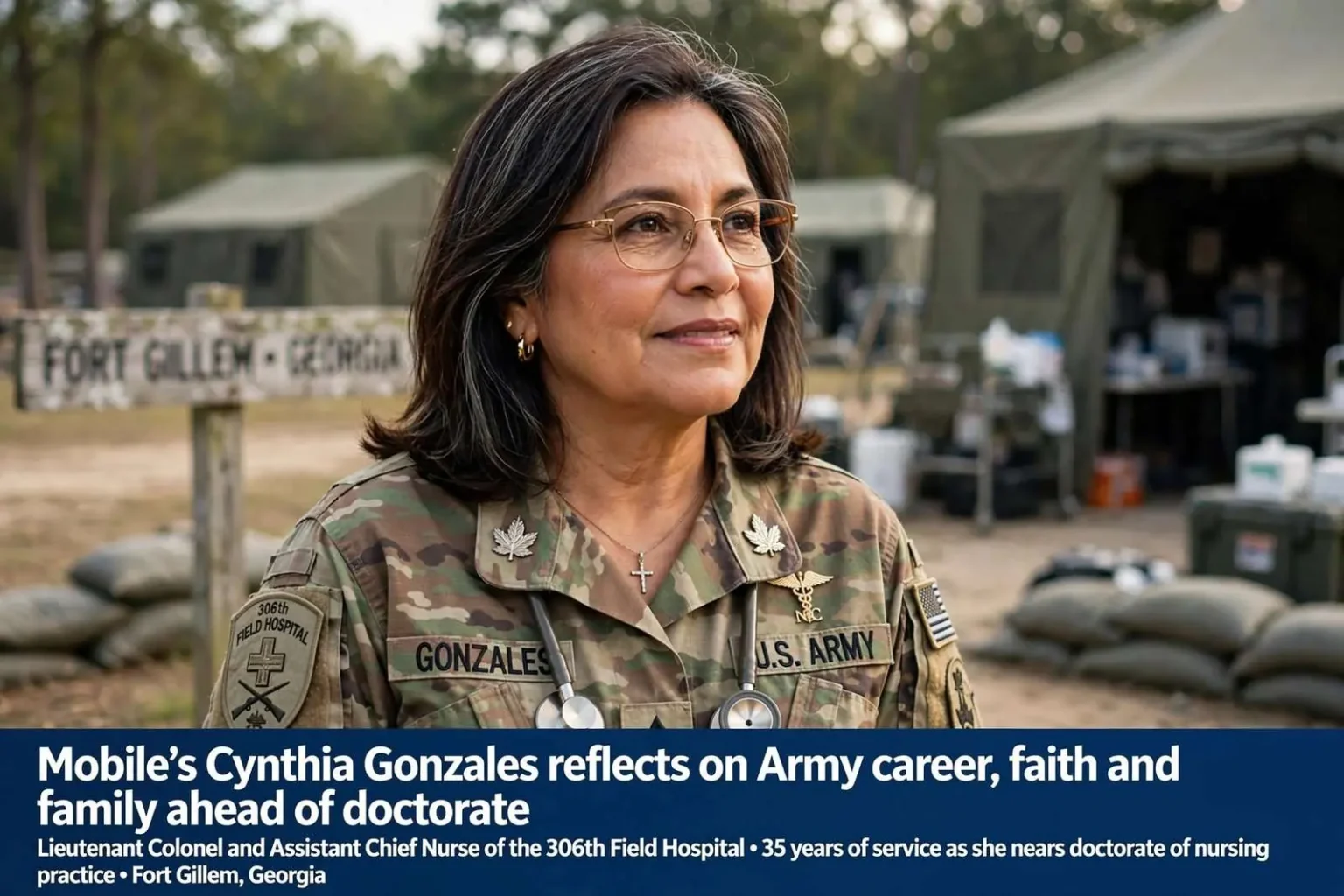
Cynthia Gonzales never planned to join the military, but 35 years ago she enlisted in the U.S. Army to help pay for college. Today the Mobile woman is a lieutenant colonel and assistant chief nurse of the 306th Field Hospital at Fort Gillem, Georgia. What began as a practical decision about tuition became a career that has spanned more than three decades, taken her through the ranks of the Army Nurse Corps and placed her in a senior nursing role at one of the Army’s field hospital units. Her story is the kind that military families in Mobile know well: a short-term plan that turned into a life’s work.
In December 2020, Gonzales earned a promotion to the rank of lieutenant colonel. Within months, she expects to reach another milestone: a doctorate of nursing practice. The two achievements together mark the top of both tracks she has climbed — the military hierarchy and the clinical-education ladder. A promotion to lieutenant colonel places an officer in the field-grade ranks, where responsibilities shift from leading small teams to shaping how entire units operate, and an assistant chief nurse in a field hospital carries direct responsibility for the nursing staff that keeps the hospital functioning.
The 306th Field Hospital, where Gonzales serves, represents the Army’s deployable medical capability. Field hospitals are designed to move with combat forces, establishing surgical and inpatient care where fixed facilities do not exist, and their personnel train continually for conditions far removed from a civilian hospital’s controlled environment. Fort Gillem, located just outside Atlanta in Forest Park, Georgia, has long housed Army units serving that mission. For a nurse based in Mobile, the posting means regular travel to Georgia for drills, training cycles and unit leadership — a commitment woven into a civilian life and career.
Service as Second Nature
Gonzales describes the pull of service in the simplest terms. “It’s just like breathing… to me it’s just like breathing. I cannot not serve,” Gonzales said. “I cannot not help somebody that’s in need.” Thirty-five years after an enlistment she never planned, that instinct remains the through-line of the story — the reason the tuition fix became a career, and the reason she still leads nurses in a field hospital unit while working toward a doctorate.
Family members describe her as quiet and studious as a child, always reading and studying. Her mother, Lucy Pickett, said she “went above and beyond” and kept pushing toward her goals. The portrait that emerges is of someone whose discipline was visible long before the ranks and degrees accumulated — a Mobile girl with her nose in a book whose persistence carried her through nursing school, military service and now doctoral study, each stage building on the last. Mothers’ assessments of their children’s persistence carry their own authority, and Pickett’s account of a daughter who kept pushing frames the career as character rather than circumstance.
The doctorate of nursing practice she expects to complete within months represents the highest clinical degree in nursing, focused on advanced practice and systems of care rather than research alone. Pursuing it while serving as a senior officer in a field hospital unit means running two demanding programs at once — military leadership duties and graduate-level clinical education — and finishing both is the kind of record that speaks for itself in both worlds.
An Army Nursing Career in Context
The path Gonzales took reflects the long tradition of Army nursing, which traces its formal history to the creation of the Army Nurse Corps in 1901 and its modern practice to the integration of nurses as commissioned officers with their own career progression. Army nurses serve across the full range of military medicine — stateside facilities, field and combat support hospitals, and aeromedical evacuation — and senior nurses in field hospital units must combine clinical expertise with the leadership of personnel who may be called on to deliver care under austere conditions. Rising to lieutenant colonel in that structure means three and a half decades of accumulating both, from bedside fundamentals to the administrative command of a nursing operation.
The promise that drew her in — help paying for college — has been the doorway for generations of service members. Military education benefits have shaped the American middle class for decades, offering tuition support in exchange for service, and for many students from families without means the arrangement has been transformative. Gonzales’s case shows the longer arc of that bargain: an enlistment justified by tuition becoming a career of service, and the education it funded extending from college all the way to a doctorate.
Her plans after the military continue the same thread. After retiring from the military in about five years, Gonzales hopes to work with the Centers for Disease Control and Prevention to help military veterans who are struggling. The CDC, headquartered in Atlanta, sits within driving distance of Fort Gillem, and the agency’s public health mission touches veterans’ health through programs addressing the mental, physical and social challenges that follow military service. A nurse with field hospital leadership experience and a doctorate of nursing practice would bring to that work both clinical depth and an insider’s understanding of the military population she wants to serve.
Faith, Family and What Comes Next
She says her faith anchors everything she does. “Most important to me is my relationship with God,” Gonzales said, adding that her strength comes from her family and her conviction that she was put on earth to help others. For a career spent in service — first to patients, then to soldiers and their care — the framing ties the professional record to the personal one. The same conviction that made an unplanned enlistment feel inevitable, in her telling, now points toward a second career serving veterans.
The recognition coming her way in a single stretch — a promotion to lieutenant colonel in December 2020 and a doctorate within months — caps a chapter that began 35 years ago in a recruiter’s office over a tuition problem. The chapter that follows, whether at the CDC or in whatever form her service takes next, will build on the same foundation her mother watched form in a studious child: quiet persistence, faith and a stubborn belief that helping someone in need is not a job description but a calling.
For Mobile, her story adds to the city’s long ledger of military families whose service runs deep and quiet — carried out in units far from home, marked by promotions and deployments that neighbors rarely hear about. Lieutenant Colonel Cynthia Gonzales’s 35 years in uniform, and the nursing career built alongside them, are the latest entry in that ledger, with more still to come.
The dual achievement of officer promotion and doctoral completion also highlights how military nursing careers interlock with civilian credentials. Army nurses are required to hold nursing licensure and many pursue advanced degrees during their service, with the military supporting education that also strengthens the force. A nurse who completes a doctorate of nursing practice while serving in a field hospital unit brings that education directly back to her unit — evidence-based practice, updated clinical systems and advanced assessment skills flow into how the hospital trains and operates. The promotion board that confirmed her as lieutenant colonel in December 2020 evaluated a record that included exactly that kind of professional development.
The 306th Field Hospital’s assistant chief nurse role places Gonzales in the management layer of a deployable medical unit, where the work involves overseeing nursing personnel, maintaining clinical readiness standards and preparing the hospital’s staff for mobilization requirements. Field hospital medicine demands versatility from its nurses — intensive care, emergency care, perioperative support and general ward nursing can all be required of the same team when a hospital deploys — and the leadership above them must keep training and credentials current across all of it. A nurse who reaches that role after 35 years carries institutional memory of how military medicine has evolved across three and a half decades.
Her hopes for work with the CDC after retirement would extend a career already spent at the intersection of health care and service populations. Public health work with veterans addresses needs that clinical practice alone does not reach — the epidemiology of conditions that disproportionately affect service members, the programs that connect veterans to care, and the policy questions about how a nation supports those who served. Nurses with doctorates are increasingly central to that field, and a veteran herself would arrive with credibility no credential can confer.
As the milestones arrive — the rank already pinned, the doctorate within months, the retirement in roughly five years — Gonzales’s account of it all returns to the same place: faith, family and the conviction that she cannot not serve. Whatever form the next chapter takes, those three anchors, by her own description, will be doing the steering.