Mobile’s I-10 Bridge Missing From Trump Team’s Infrastructure Priority List
A draft infrastructure priority list circulated by the incoming Trump administration left out every project from Alabama, including Mobile's long-sought I-10 Mobile River bridge, prompting state and federal officials to scramble for a fix.
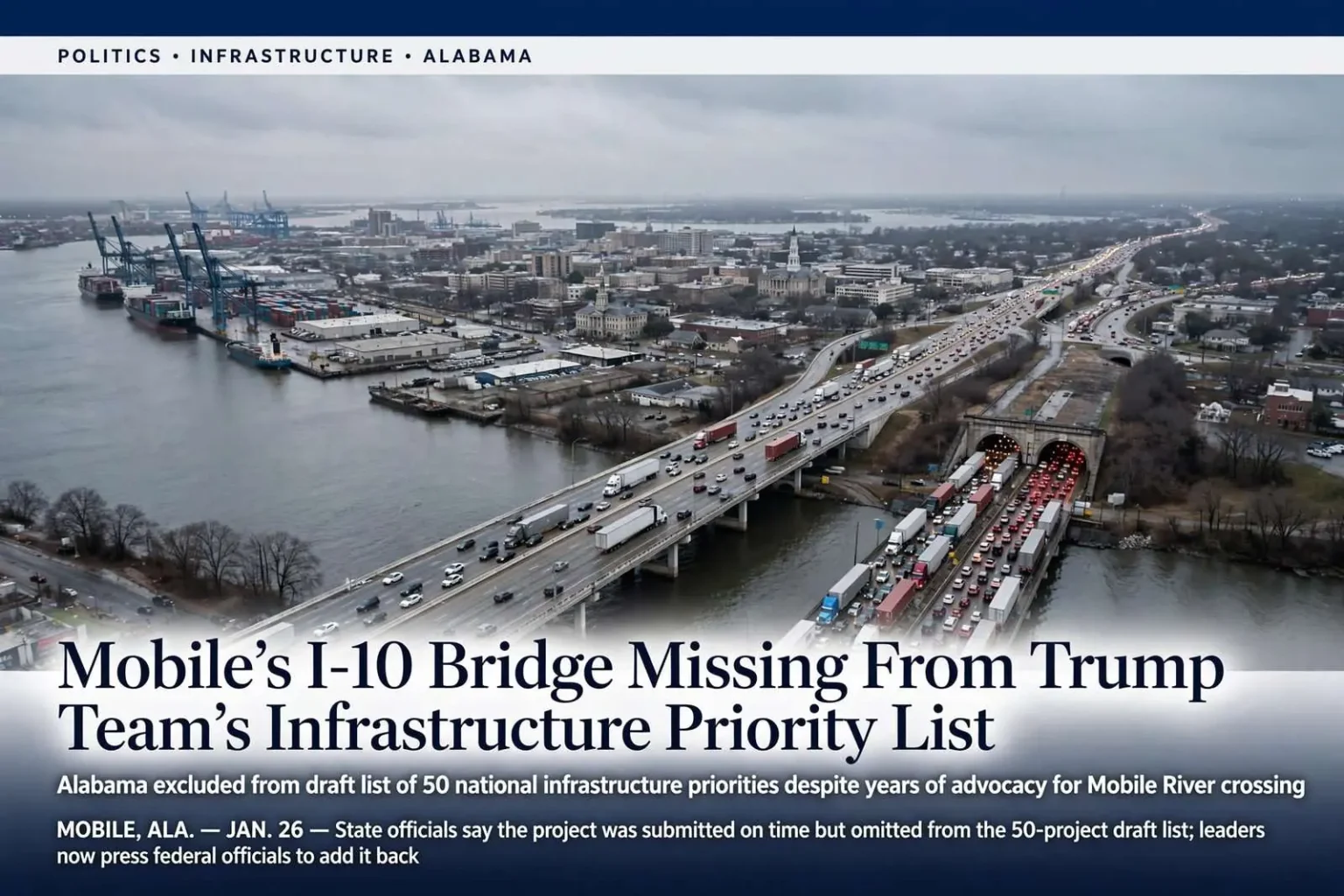
A draft list of the nation’s top infrastructure priorities being reviewed by the incoming Trump administration left Alabama off entirely, omitting Mobile’s long-sought Interstate 10 bridge over the Mobile River — a project local and state officials have pushed for years as vital to easing one of the worst bottlenecks on the Gulf Coast.
The omission landed with particular sting in Mobile, where the bridge has been the community’s defining transportation priority for more than a decade and where leaders had spent years building the case that the project deserved a place in any serious federal infrastructure program. A draft list of the country’s fifty most important projects — one that skips Alabama altogether — threatened, at a stroke, to erase that work from Washington’s attention.
The draft, which surfaced in the press in late January, lists roughly 50 infrastructure projects from across the country but does not include a single one from Alabama. The list originated from a request the National Governors Association sent to every state’s governor in mid-December, asking each to submit three to five priority infrastructure projects that the incoming administration would consider vetting for a new federal infrastructure investment program.
The process was meant to be straightforward: governors know their states’ most urgent needs, and the new administration wanted a menu of ready projects for a promised program of federal investment. That promise — recycled repeatedly on the campaign trail — had raised hopes in states like Alabama, where big-ticket projects have waited years for funding commitments. The governor’s office had precisely the kind of project the process was designed to surface.
Alabama Says It Submitted on Time
Yasamie August, spokesperson for Alabama Gov. Robert Bentley, said the governor’s office met that deadline and submitted a list that included the Mobile River bridge along with several smaller projects. She said the omission was not the result of any error on Alabama’s part.
“It is important to note, the governor’s office did not make a mistake,” August said in a statement. “The National Governors Association asked all the states to submit a list of priorities in December, as we did. That information was then submitted to what was then the Trump transition team. The list of projects released this week was not reflective of all the projects submitted by the states. The list Alabama submitted included the Mobile River Bridge and other smaller projects.”
August pointed out that Bentley has been pressing the issue for some time, noting that the governor testified before Congress in 2015 about the need to fund large-scale projects like the Mobile River bridge. Questions remain, however, about exactly when the state’s list reached the association responsible for compiling it. The document provided by the governor’s office as the submitted list is undated, but the underlying file was created on Jan. 24 — the same day the draft list without any Alabama projects became public. When asked to confirm that the same list had in fact been received earlier by the National Governors Association, August did not respond.
The metadata discrepancy mattered because it left the timeline unresolved. Either the list sat unseen somewhere between Montgomery and Washington, or it arrived too late to make the draft. The National Governors Association and the governor’s office each described a process that should have included Alabama; only the draft list itself suggested otherwise, and neither party could produce a timestamp that settled the question.
Byrne Moves to Fix the Omission
U.S. Rep. Bradley Byrne, who represents Mobile and has long championed a new bridge across the Mobile River, said his office moved quickly once the draft list became public.
“As soon as we heard about the situation, my office reached out to the new staff at the federal Department of Transportation to emphasize the need for the I-10 bridge,” Byrne said in a statement. “We have been reassured they are aware of the project and that the project list is not final or comprehensive. I believe our efforts have succeeded in assuring the I-10 bridge will be on the list.”
Byrne’s intervention reflected the political geography of the moment. With a new administration still assembling its staff and its priorities, early impressions carry outsized weight — and a project absent from the first draft risks being absent from every later one. By going directly to Department of Transportation staff in the transition’s opening days, the Mobile congressman sought to reinsert the bridge into the conversation before the list hardened.
Byrne had spent years making the bridge a fixture of his Washington agenda, walking federal officials through the project’s case at every opportunity. The omission tested whether that groundwork had registered — and his statement, issued within days, was an attempt to make sure the record reflected the project’s importance before any final document went out.
A Bottleneck Between Los Angeles and Jacksonville
Mike Lee, chairman of the Mobile Area Chamber of Commerce’s Build the Bridge Coalition, said the omission was troubling but that he was encouraged the matter was being sorted out quickly.
“It’s important to get back on there and get it corrected,” Lee said. “We’ve been told from the federal level that it’s a major bottleneck on I-10 between Los Angeles and Jacksonville, so it should be high profile.”
Lee’s coalition — a chamber-led alliance of business, civic and government groups formed specifically to push the bridge — has framed the project in exactly those national terms: not as a Mobile wish, but as a repair to a defect in the nation’s principal southern artery. Interstate 10 runs more than 2,400 miles from the Pacific to the Atlantic, carrying freight traffic between the country’s largest ports, and Mobile is one of the few places along that entire route where the interstate funnels into a narrow downtown corridor with no alternative crossing.
The stretch of I-10 through downtown Mobile, including the aging Wallace Tunnels beneath the Mobile River, has for years been identified by transportation planners as one of the most congested and structurally constrained sections of the interstate system along the Gulf Coast, making a new bridge and bypass a priority for business and civic leaders on both sides of Mobile Bay.
The tunnels, bored beneath the river in the early 1970s, carry the interstate under the Mobile River and the city’s riverfront. Their limitations are structural and permanent: they cannot be widened, they close periodically for maintenance, they are vulnerable to hurricane evacuation demands, and they force the interstate’s east-west traffic — including heavy truck traffic generated by the port, one of the fastest growing in the nation — into a pair of bottlenecks that back up through downtown on a daily basis. Every eastbound and westbound vehicle on I-10 passing Mobile must use them; there is no alternate interstate crossing for hundreds of miles in either direction.
The proposed bridge would bypass the tunnels entirely, crossing the river north of downtown and reconnecting to the interstate on either side, while taking through traffic — particularly freight — off the local interchanges that gridlock the city’s street grid. Planners have studied versions of the project for years, and the funding question — how to finance a crossing of that scale — has been the constant obstacle, with proposals that have included tolls and combinations of federal, state and local money.
The Association Confirms Receipt
National Governors Association spokesperson Elena Waskey confirmed in a phone interview that the organization did receive a list of priority projects from Bentley’s office, though she would not specify when it arrived. Asked whether she could guarantee the Mobile River bridge would appear on any final list vetted by Trump administration officials, Waskey said she was confident it would.
“Yes, absolutely,” she said. “The bridge will be on the list.”
For Mobile’s leaders, the assurance was welcome but partial. A promise that the bridge “will be on the list” restores the project to the conversation; it does not fund it, schedule it or commit any administration to building it. The episode nonetheless demonstrated the leverage local officials believe they have: within days of the omission surfacing, a congressman, a governor’s office and a national association had all lined up to say the bridge belonged in Washington’s plans.
For now, state and local officials say they are continuing to press federal transportation officials to ensure the Mobile River bridge project is formally recognized as the review of state infrastructure priorities continues in Washington. As the review proceeds, officials in both parties say the episode has underscored how much of the project’s fate now depends on Washington’s early planning documents rather than on any single grant application or congressional earmark.
The stakes extend beyond one list. Federal infrastructure programs of the kind the new administration promised would be assembled once — and the projects named early would be the ones positioned for funding when the money moved. For a project that has waited through years of studies and funding debates, inclusion on that list was never a formality. It was, in the view of the officials pressing the case, the difference between a bridge that gets built and a bridge that keeps getting studied.