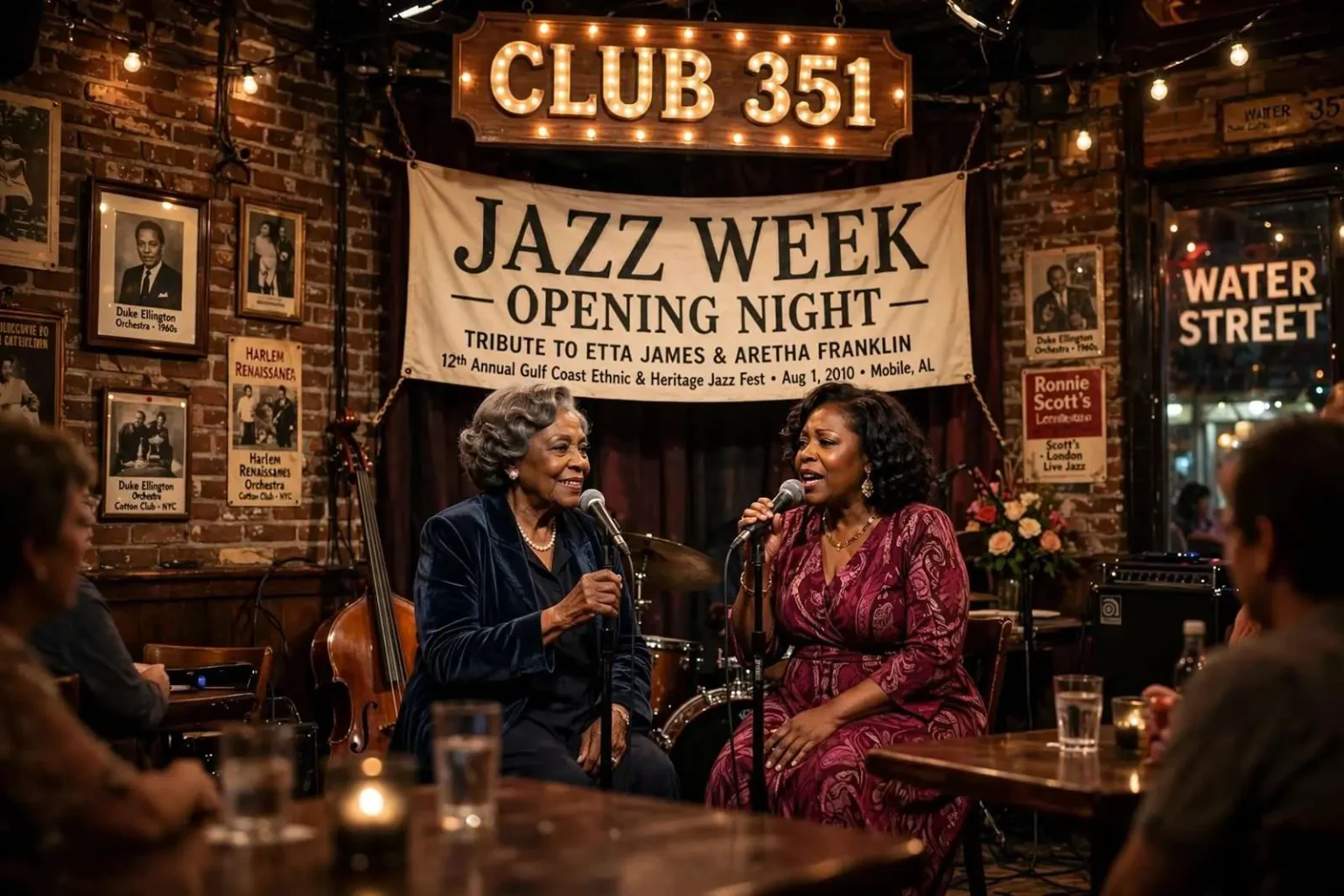
MOBILE, Ala. — The stretch of days Mobile music writers had taken to calling the city’s own “Jazz Week” opened on Sunday night, August 1, 2010, with a tribute to two giants of American song — Etta James and Aretha Franklin. The tribute belonged to Karmilla Ali and Lil Greenwood, two hometown voices with national resumes, staged at Club 351 on Water Street just south of the GM&O building, with a 6 p.m. start that set the tone for a week of music across the city.
For twelve summers running, the opening night celebration had anchored the Gulf Coast Ethnic & Heritage Jazz Fest, the festival many locals simply called Mobile’s Jazz Fest. The event had grown into one of the Port City’s signature summer traditions, pairing big-name tributes with regional acts and drawing music lovers to downtown venues that most nights sat dark. Opening the week at a Water Street club gave the festival an appropriately intimate start — a listening room rather than a fairground, close enough to the stage that every lyric landed.
The choice of honorees said as much as the lineup. Etta James, whose career ran from 1950s Chicago rhythm and blues through the 1960s Chess Records classics that made her a household name, and Aretha Franklin, the Queen of Soul whose gospel-rooted singing reshaped American popular music from the late 1960s onward, both built their art on the same blend of blues, gospel and jazz that the Gulf Coast festival celebrated. Rendering them in tribute required singers who could move between those worlds, and the festival had paired exactly that in Ali and Greenwood.
Two Generations of Mobile Voices
Lil Greenwood was one of Mobile’s genuine legends — a singer who had performed with Duke Ellington’s orchestra, an honor that placed her among the elite voices of the big-band era. Ellington’s orchestra was the most storied institution in American jazz, and the singers who toured and recorded with it carried a particular weight wherever they went. Greenwood brought that pedigree back home to Mobile, where generations of local listeners knew her name long before they knew her discography.
Karmilla Ali carried her blend of jazz, gospel and rhythm and blues from Mobile to New York stages, including performances at the famed Cotton Club with the 18-piece Harlem Renaissance Orchestra, and to rooms like London’s Ronnie Scott’s. The Cotton Club, revived in its later Manhattan incarnation, remained one of the most recognizable addresses in American music, and Ronnie Scott’s in Soho has been London’s premier jazz room since the late 1950s. For a Mobile singer to hold both stages was a statement about the depth of talent the city’s music community had produced.
Pairing the two hometown voices in tribute to James and Franklin gave the festival’s opening night a through-line from big-band history straight into modern soul. Greenwood’s Ellington-era credentials reached back to the swing tradition that jazz festivals exist to honor; Ali’s Cotton Club and Ronnie Scott’s work connected that tradition to the contemporary circuit where jazz, gospel and soul still trade players and phrases. Between them, the two singers covered most of the last half-century of American song.
A Water Street Room With Its Own History
The venue mattered as much as the voices. Club 351 on Water Street sat in the shadow of the GM&O building, the grand railroad terminus that anchors the southern end of downtown Mobile’s historic district. The building, a landmark of the Gulf, Mobile & Ohio Railroad’s passenger era, gives the surrounding blocks a distinct sense of place — brick and iron and memory — and the clubs that line Water Street have long served the late-night crowd that moves between downtown’s bars and performance rooms.
For many festival-goers, the tribute night was also a rare invitation inside. It gave Mobilians a reason to finally see a Water Street room they may have only passed by, and the pairing of an unfamiliar venue with two beloved hometown singers was the kind of programming that turns first-time visitors into regulars. Jazz Week, as the city’s writers had come to call the festival’s run of shows, depended on exactly that discovery — a week when downtown’s smaller rooms filled with listeners who came for one name and stayed for the set.
Why a Jazz Fest Matters to Mobile
The Gulf Coast Ethnic & Heritage Jazz Festival grew from a simple idea: that Mobile’s deep musical heritage — from the blues and jazz traditions of the Deep South to the gospel and soul sounds that shaped the region — deserved a summer stage of its own. By its twelfth summer, the festival had become part of the city’s cultural calendar alongside Mardi Gras, Mardi Gras-related celebrations and the other institutions that give Mobile its identity, and its tributes to national figures gave younger Mobile musicians a chance to share a bill with the history they grew up hearing about.
Opening with James and Franklin made sense for that mission. Both women shaped the way American singers approach a song — James with the raw, behind-the-beat phrasing that influenced decades of blues and soul vocalists, Franklin with the gospel virtuosity that turned pop radio into a pulpit. A tribute to either demands range; a tribute to both demands singers who understand where soul and jazz meet, which is precisely the territory Ali and Greenwood had staked out in their own careers.
The 6 p.m. Sunday start also reflected the festival’s family-friendly roots. Early evening shows allowed listeners of every age to attend, and the downtown location let audiences wander between the festival’s venues as the week unfolded. For locals, Jazz Week offered the rare experience of hearing world-class singing within walking distance of home — no ticket lines, no highway drives, just two Mobile voices honoring two American legends in a Water Street room as the festival’s twelfth summer got underway.
The Music the Tribute Honored
Etta James and Aretha Franklin occupy adjacent but distinct thrones in American music. James, discovered while still a teenager, turned songs like “At Last” and “I’d Rather Go Blind” into standards that every working singer eventually faces, and her ability to slide between blues shout and balladry made her a favorite of audiences who rarely agreed on anything else. Franklin’s catalog — from “Respect” and “Chain of Fools” to her gospel recordings — rewrote the role of the soul singer entirely, and her 1960s Atlantic run remains one of the most influential bodies of work in popular music.
For Ali and Greenwood, the tribute was less an imitation than an inheritance. Both had built their careers on the same repertoire of jazz standards, blues numbers and gospel-rooted soul that James and Franklin defined, and the festival’s stage gave them room to present those songs as Mobile music — sounds that traveled north from the Gulf Coast in the middle of the last century and came home again through singers who never left the region’s tradition behind.
That homecoming quality is what separates the Gulf Coast Ethnic & Heritage Jazz Fest from the many summer festivals that pass through the Gulf South. The event’s tributes have consistently reached for artists with local ties, treating the festival as a reunion as much as a concert. In Ali and Greenwood, the opening night of the festival’s twelfth summer had two performers who could claim Mobile not just as a hometown but as a musical lineage — proof that the city’s contribution to American song did not end with the big bands of the 1940s.
A Week With a Name of Its Own
By 2010, the festival’s run of shows had earned the informal title of Mobile’s Jazz Week, a stretch when the city’s clubs, churches and outdoor stages fill with the music the Gulf Coast does best. The name reflected how much the event had grown from its beginnings: what started as a celebration had become a week-long fixture that downtown businesses, music fans and visiting musicians planned their summers around.
Club 351’s role in the opening night also highlighted the small venues that make such a week possible. Downtown Mobile’s performance rooms — clustered along Dauphin Street, Water Street and the blocks around the GM&O building — give touring and hometown acts places to play at every scale, and festivals like this one feed those rooms audiences they might not otherwise see. The tribute’s early Sunday crowd helped set the tone: attentive listeners, close tables, and two singers whose careers stretched from Ellington’s orchestra to the Cotton Club and Ronnie Scott’s.
As the sun went down over Water Street, the festival’s twelfth summer had its opening statement. Two Mobile voices had honored two American originals, in a room the city could finally call its own jazz address, at the start of a week the whole city had learned to expect. The rest of Jazz Week had its work cut out to match the standard set that Sunday evening — and Mobile’s music scene, with its deep bench of singers and players, was more than used to the assignment.