
Mobile’s Mardi Gras Balls May Need a New Home as Civic Center’s Future Grows Uncertain
Mayor Sandy Stimpson says Mardi Gras societies need a new ball venue by 2016 as the aging Mobile Civic Center faces up to $15 million in ADA costs.
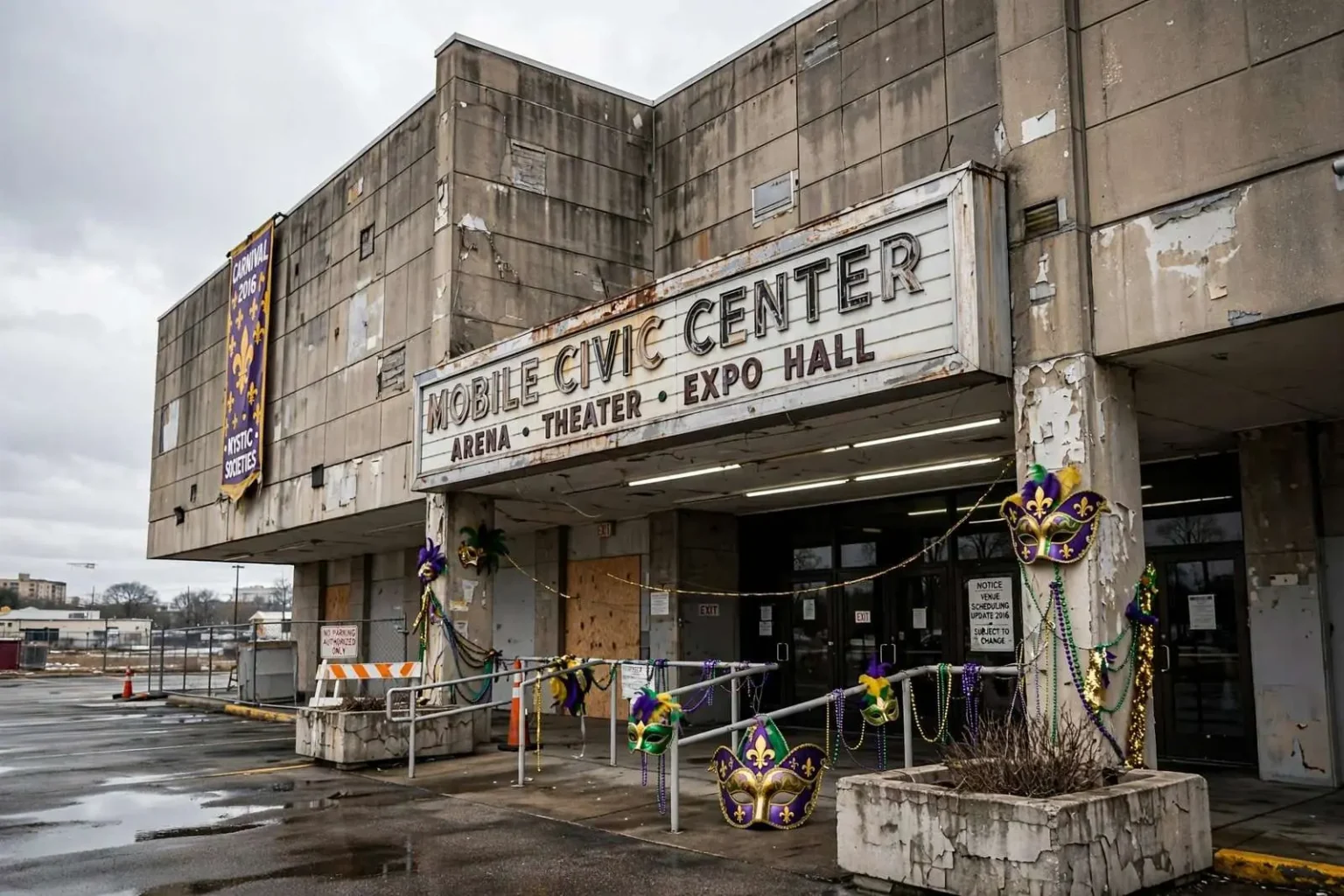
Mobile’s largest Carnival societies may be dancing somewhere else by 2016. Mayor Sandy Stimpson has told the city’s Mardi Gras organizations they will need to find another ball venue as questions mount over the future of the 50-year-old Mobile Civic Center. The warning puts the city’s most storied private celebrations at the center of a public debate over an aging landmark that has hosted them for generations.
No wrecking ball is scheduled, but all options are on the table for a facility widely acknowledged to be in poor shape. The Civic Center opened in the mid-1960s as Mobile’s premier event complex — arena, theater and expo hall under one roof — and for decades it was the unquestioned capital of Carnival season, hosting the biggest balls on the social calendar. Fifty years of Gulf Coast humidity, hurricanes and deferred maintenance have taken their toll, however, and successive administrations have kicked the question of the building’s future down the road. Stimpson’s message to the Mystic societies amounts to an acknowledgment that the road has run out.
Mobile’s Carnival ball tradition is among the oldest in the country, stretching back to the early 18th century and predating the more famous New Orleans celebration. The city’s Mystic societies — private organizations that stage masked balls and parades — form a social infrastructure unto themselves, with memberships passed through families and traditions guarded across generations. Because the balls are invitation-only affairs, the societies’ fortunes rise and fall with their venues: the room is the ball, in a way that parade routes can never be. That is why the Civic Center’s fate matters so much to organizations whose season is defined by a single night in a single hall.
Stimpson told local media that bringing the building into compliance with the Americans with Disabilities Act alone could cost up to $15 million, before any modernization begins. That figure covers only the legal baseline — accessible seating, restrooms, entrances and circulation — for a complex of its size and vintage. Modernization on top of that: mechanical systems, electrical capacity, roofing, concessions, the upgrades any competitive venue needs. The arithmetic behind the mayor’s caution becomes clear quickly: a full renovation of a 50-year-old complex could dwarf the cost of building new.
The Civic Center also loses money every year — estimates reported locally run from roughly $700,000 to $800,000 annually. For a city weighing streets, drainage and public safety against an events venue, that recurring deficit is the real pressure point. Every year the city keeps the building open, it absorbs a seven-figure subsidy to host a calendar that no longer fills the arena.
Where the balls would go
Balls are only part of Mobile’s Carnival economy, and not every society calls the Civic Center home. Many organizations have already shifted to Fort Whiting, the Convention Center and even the Cruise Terminal. The migration has been underway for years, driven by scheduling pressure, cost and the simple fact that Mobile’s inventory of large event spaces has grown while the Civic Center has aged. Each venue change reshapes a society’s ball in small ways — the sight lines, the stage, the parking, the traditions built around a particular room — and each move has taught the Carnival community that relocation is possible, if never painless.
But the dozen or so biggest societies still using the Civic Center — including the Crewe of Columbus, Conde Cavaliers and Mystics of Time — have spent decades growing to fill its space, and scaling back would be difficult and potentially costly. The largest balls in Mobile are elaborate productions: tableau presentations, elaborate ball gowns designed months in advance, full bands, courts with pages and maids, and guest lists that can run to the thousands. A society that builds its ball around a 10,000-seat arena cannot simply shrink the celebration to fit a hotel ballroom without cutting guests, downsizing the court or compromising production values that took generations to build.
That scale is exactly why the Civic Center question lands so hard in Carnival circles. The arena’s floor, its backstage capacity and its storage are calibrated for the biggest societies, and no current alternative in the city offers the same combination of size and history. Fort Whiting has its devoted partisans, and the Convention Center offers modern amenities on the river, but the grandest balls have always belonged to the arena — the building Carnival generations simply call the Civic Center.
Outside Carnival season, the arena remains a reliable stop for World Wrestling Entertainment, but few other events regularly fill it. That pattern tells the story of mid-sized arenas across the country: built in an era when a city’s arena was its only large venue, then outcompeted by newer facilities, casinos and amphitheaters for concerts and touring shows. The WWE dates deliver reliable crowds, but a calendar anchored by a handful of wrestling nights cannot sustain an operating budget on its own.
The theater and expo hall portions of the complex continue to serve a rotating cast of community events — graduations, trade shows, recitals and civic gatherings — but those uses, while valued, typically fill the smaller spaces rather than the arena itself. The result is a building with three identities: a beloved Carnival palace used a few weeks a year, a modest community hall used steadily, and a big-league arena used rarely. Managing a facility with that split personality is what the city has effectively been doing for two decades, and it is why every administration has inherited the same unresolved question about what the complex should be.
The economics of arena operations sharpen the dilemma. A modern mid-sized arena books a full calendar of concerts, family shows, graduations and sporting events to spread its fixed costs across hundreds of event nights. A venue whose calendar concentrates into a few weeks of Carnival balls plus occasional wrestling dates cannot generate the revenue to cover even routine maintenance, much less the capital repairs a 50-year-old building demands. Each year of operation therefore adds to the backlog, making the eventual decision more expensive — the classic dynamic that eventually forces every aging civic arena’s reckoning.
That raises the question now facing City Hall: how much longer can the city afford to maintain a money-losing facility whose anchor tenants are private Carnival clubs, even accounting for the millions Mardi Gras brings to Mobile each year? Carnival’s economic footprint is enormous — the season fills hotels and restaurants and defines the city’s identity — but the Civic Center’s share of that activity is concentrated into a few weeks of balls, while the subsidy is paid twelve months a year. Distinguishing between supporting Mardi Gras and subsidizing a building is the distinction at the heart of the debate.
The stakes extend beyond the ball season. Whatever replaces or renews the Civic Center will shape downtown Mobile’s ability to book conventions, concerts and sporting events for the next generation. Cities across the country have faced the same reckoning with their 1960s-era arenas, and the outcomes vary: some communities have renovated, some have demolished and rebuilt, and some have let their aging venues linger as shadows of themselves. Mobile’s decision will signal which path the city intends to take — whether it aims to compete for regional events with a modern facility or to concentrate its investment elsewhere and accept a smaller events footprint.
What the societies are weighing
For the Mystic societies, the uncertainty is itself disruptive. Planning a ball is a year-round undertaking: costumes are designed and sewn across the summer, themes are chosen in the spring, and contracts with bands and caterers are settled months in advance. A venue question left unresolved into the planning cycle forces societies to make commitments without knowing where — or whether — their productions will fit. Some have begun evaluating their options in detail, walking the alternate venues with tape measures and seating charts, in case the decision comes down to the calendar.
There is also an emotional dimension that balance sheets cannot capture. The Civic Center’s arena is where generations of Mobilians made their debuts, where queens were presented and where family traditions passed from parents to children. The building carries nicknames and memories the way an old stadium does, and for the Carnival community, the possibility that the balls could move is a conversation about identity as much as real estate.
For now, the societies that fill the Grand Linoleum Palace each season are waiting to learn where — or whether — their balls fit into the building’s future. The city’s deliberations will be watched closely not just by Carnival organizations but by everyone with a stake in downtown’s vitality. Whatever Mobile decides about its Civic Center, the season will go on: the floats will roll, the bands will play and the balls will be held somewhere. The question that remains is which door the masks and gowns will walk through when the 2016 season arrives.