
Mobile’s Mardi Gras Tree Gets Its Branches as Carnival Season Nears
City crews in Mobile have finished installing branches on the official Mardi Gras Tree downtown, with ornaments coming soon ahead of carnival season.
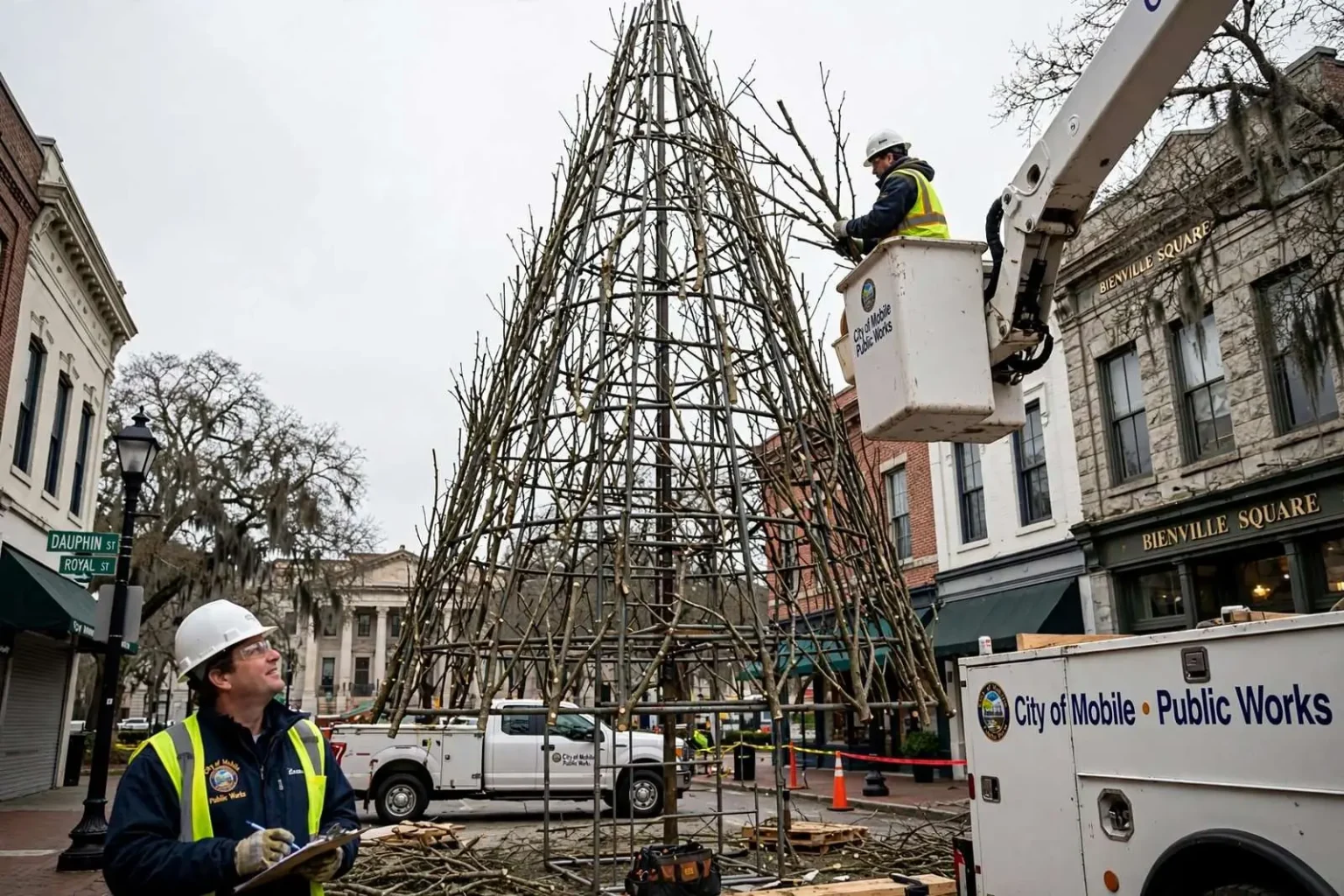
One of downtown Mobile’s most recognizable carnival season landmarks is taking shape again. City crews have finished installing the branches on the city’s official Mardi Gras Tree, according to an announcement from the City of Mobile in mid-January 2020. The municipal crew behind the project confirmed the milestone on social media, telling followers that ornaments would be coming next as the display is built out toward full decoration.
The tree has become a fixture of the weeks leading up to Fat Tuesday in the city that America’s original Mardi Gras calls home, joining the parade schedule and downtown festivities as a visual countdown to carnival. Once the ornament phase is complete, the display typically stands as a centerpiece for visitors and locals alike through the height of the season. City officials encouraged residents to keep an eye out for the finished product as decorations continue to go up.
A Season That Starts Long Before Fat Tuesday
In Mobile, carnival is not a single night but a season that unfolds over weeks, and the tree’s gradual dressing mirrors that rhythm. The season officially opens on Twelfth Night, January 6, when carnival societies hold suppers and symbolically begin the countdown to Mardi Gras Day. From that point forward, downtown grows steadily more colorful, with organizations staging bal masques at convention venues while parade nights fill the calendar in the weeks before Ash Wednesday.
The branch installation in mid-January falls squarely inside that build-up. By the time Fat Tuesday arrived on February 25, 2020, the display stood fully dressed, giving the downtown corridor one of its most photographed seasonal landmarks. For residents who measure the year by carnival rather than by the calendar, the sight of crews working on the tree is as reliable a signal of the season as the first floats rolling down Government Street.
How the Mardi Gras Tree Became a Mobile Tradition
Mobile’s decorated carnival tree traces its roots to a homemade tradition that took hold in the mid-twentieth century, when a group of neighbors began fashioning an oversized tree from chicken wire, paper, and other everyday materials to celebrate the season. What started as a creative neighborhood project grew into a civic institution, and the city eventually adopted the display as an official part of its carnival decorations, rebuilding it over the years in sturdier form while keeping the playful, handcrafted spirit of the original.
The modern version stands tall enough to dominate its surroundings, and crews decorate it in the purple, green, and gold that define carnival across the Gulf Coast. Rather than going up in a single day, the display is assembled in stages — first the structural branches, then the ornaments and lights — which turns the tree itself into a countdown clock for the season. Each phase of construction tells passersby that another milestone on the road to Fat Tuesday has been reached.
That staged approach also makes practical sense for a municipal crew. A display of this size involves rigging, electrical work, and careful placement of heavy decorative elements, and breaking the job into phases lets workers handle each piece safely and spread the effort across the early weeks of the year. The mid-January announcement that the branches were finished marked the completion of the structural phase, with the ornament work — the step that transforms the frame into a carnival landmark — still to come.
Mobile, the Birthplace of American Mardi Gras
The tree carries extra weight because of where it stands. Mobile’s carnival celebration predates the more famous edition in New Orleans by nearly two decades, reaching back to 1703, when the French colonists of the original Mobile settlement marked the pre-Lenten season while the city was still the capital of French Louisiana. That colonial-era beginning is why Mobile residents and civic leaders have long embraced the claim that the Port City is home to America’s original Mardi Gras.
The modern parade tradition took formal shape in the decades before the Civil War and solidified in 1867, when the Order of Myths, the city’s oldest continuously parading mystic society, rolled with its signature emblem, the skeletal jester Folly chasing Death around a broken circus ring. That organization still closes the season with its parade on Mardi Gras night, a distinction no other Mobile society can claim. Generations of other societies followed, from the Crewe of Columbus to the Mystics of Time, each adding its own floats, themes, and throws to the downtown schedule.
Carnival in Mobile has also long been a story of parallel traditions. The Mobile Carnival Association and the Mobile Area Mardi Gras Association each stage their own court, balls, and parades, reflecting the city’s history and giving the season a breadth that goes well beyond a single procession route. Together these organizations put dozens of parade and ball events on the calendar each year, drawing hundreds of thousands of visitors to the downtown district between Twelfth Night and Ash Wednesday.
Where the Tree Fits in the Downtown Celebration
The tree’s prominence comes from its place in the heart of the parade district. Downtown Mobile’s carnival footprint is compact and walkable, anchored by streets like Dauphin, Royal, St. Francis, and Government, and framed by public spaces including Bienville Square, Mardi Gras Park, and the old City Hall precinct along Royal Street. Parade routes thread through this grid, and on parade nights the area fills with families, ladder chairs rigged with kids’ seats, and crowds waiting for moon pies, beads, and doubloons.
Against that backdrop, a fully decorated Mardi Gras Tree serves as a gathering point and an orientation landmark. Visitors use it as a meeting spot before parades, a photo backdrop during them, and a reminder of the season when the streets are quiet between processions. Local media and the city’s own communications regularly feature the display as part of the visual identity of Mobile’s carnival, alongside the colorful balcony decorations that businesses and residents hang along the parade routes each year.
The 2020 season the tree was built to celebrate was shaping up as a busy one for the city. Mobile’s parade calendar runs across roughly two and a half weeks of nightly processions in the final stretch, with multiple societies parading on peak nights and the largest crowds turning out on the final weekend before Fat Tuesday. Businesses along Dauphin and Royal streets staff up for the surge, hotels in the downtown core fill with weekend visitors from across the Gulf Coast, and the city’s police, fire, and public works departments shift into their annual carnival posture — closing streets, managing traffic, and cleaning the routes before the next evening’s rolls.
What the Season Means for Residents
For Mobile residents, a civic project like the tree’s decoration is more than ornamentation. Carnival season drives measurable business for restaurants, bars, hotels, and costume and supply shops, and the city treats the infrastructure of the season — signage, lighting, route preparation, and decorations — as part of hosting one of the region’s signature events. The tree stands as the most visible piece of that public investment, and its phased construction gives residents a running progress report on the city’s readiness for the crowds.
The display also plays a role in how the city markets itself. Visit Mobile and civic boosters have long leaned on the birthplace claim, pointing visitors to the Mobile Carnival Museum on Government Street, which preserves the history of the city’s mystic societies, their gowns, scepters, and float designs. A visitor who stops at the museum and then walks the downtown blocks will pass the tree on the way to the same streets where that history has unfolded for more than three centuries, tying the modern celebration directly to its origins.
Local schools and families build their own rhythms around the season as well. Parade nights are community events in the fullest sense — grandparents stake out the same curb corners year after year, marching bands from area high schools practice for their turns in the processions, and the throws that rain from the floats, from beads to moon pies, become a small economy of their own among neighborhood kids. The weeks between Twelfth Night and Mardi Gras Day are, for many Mobilians, the social high point of the year.
The Crew Behind the Display
The branch installation was the work of municipal workers rather than outside contractors, and the crew’s own social media announcement of the milestone reflected the pride the project generates. City crews handle the tree’s assembly, decoration, and eventual takedown each year, and the phased process — structure first, ornaments next — is a familiar routine to anyone who follows the city’s accounts. In 2020 the crew told followers to watch for ornaments as the next step, and city officials urged residents to keep an eye out as the remaining decorations went up in the run toward the season’s peak.
That kind of public communication has become part of the modern carnival experience. Where residents once simply noticed the tree one day fully dressed, the city now documents each stage of the build-out, and followers respond with the enthusiasm of a community that counts the season’s milestones personally. The tree’s progress posts reliably draw comments from locals declaring the official start of carnival and from former residents checking in on the city’s traditions from afar.
From Branches to Full Bloom
With the branches in place, the remaining work was largely additive: hanging the ornaments, stringing the lights, and dressing the structure in the season’s colors until the display reached full decoration. By tradition the finished tree glows through the height of the season, standing watch over the final parade nights and the crowded Mardi Gras Day itself before crews quietly dismantle it after Ash Wednesday, when the city pivots from celebration to the quieter rhythms of Lent.
The cycle then resets. Each winter the same questions return — when will the branches go up, when will the ornaments follow — and each year the answer arrives on schedule, right as the parade calendar fills in. In a city where carnival is the organizing event of the first quarter of the year, the Mardi Gras Tree’s slow transformation from bare frame to fully decorated landmark has become one of the season’s most dependable opening acts.
A Landmark Worth Watching
For visitors planning a trip to Mobile during carnival, the tree offers a simple wayfinding point amid the crowds and barricades. It stands within easy reach of the main parade routes and downtown attractions, making it a natural rendezvous before an evening of processions. And for locals, the city’s advice in mid-January 2020 held for the season as a whole: keep an eye out. Between the branch installation, the ornament phase, and the parades that follow, downtown Mobile was once again dressing itself for the celebration that the Port City has staged longer than any other in America.
As the ornaments went up and the display moved toward full decoration, the countdown to Fat Tuesday ran on toward February 25, 2020, when the Order of Myths would close the season as it has since 1867 and the tree would stand, fully dressed, over the final night of another Mobile carnival.


