Mobile’s Maritime Community Mobilizes Hurricane Relief Shipments to the Bahamas
Mobile's port community coordinates relief supply shipments to the Bahamas after Hurricane Dorian, moving donations through damaged port infrastructure.
MOBILE, Alabama — Members of Mobile’s maritime community are working to move as many relief supplies as possible to the Bahamas in the wake of Hurricane Dorian, coordinating a logistics chain that stretches from the Port of Mobile to the storm-ravaged islands. The effort has drawn together port officials, shipping companies and volunteers across the Gulf Coast in the weeks since the Category 5 storm devastated the northern Bahamas.
“It’s in coordination with the officials on the ground working relief efforts and they’ve assured us the goods will get to where they need to go,” said Judy Adams with the Alabama State Port Authority.
Supplies are being gathered at Mobile and other Gulf Coast ports, then shipped to an American port in the Everglades before continuing to the Bahamas. The two-step routing is a product of necessity rather than choice: with Bahamian port facilities badly damaged, cargo that would normally move directly to the islands must first be consolidated in Florida and transferred to smaller vessels capable of working the battered harbors.
The effort is being spearheaded by Mediterranean Shipping Company, the world’s second-largest container line, which operates a major hub at Port Freeport in the Bahamas. MSC’s regular Gulf-to-Bahamas services made the company a natural coordinator, giving relief organizers access to vessels, warehouse space and local knowledge that ad hoc operations rarely have.
A Port Strained by the Storm
Adams noted that the hurricane so damaged Bahamian port infrastructure that the country can only accept one vessel in and one vessel out at a time, often requiring smaller ships rather than the large container vessels that typically call at the Port of Mobile. The bottleneck means every sailing must be planned around what the receiving port can handle, stretching delivery timelines even as demand for aid grows.
“The government and port officials in the Bahamas are coordinating one vessel in, one vessel out — they have to use small ships, not the typical ships that call the port of Mobile,” Adams said. The constraint has forced relief planners to think in terms of consolidated, high-priority cargo rather than the rapid, high-volume deliveries that major ports normally make possible.
Dorian struck the Abaco Islands and Grand Bahama in early September with sustained winds near 185 mph, among the strongest landfalls ever recorded in the Atlantic. Entire neighborhoods were flattened on Abaco, and flooding covered large portions of Grand Bahama for days. Tens of thousands of residents were left homeless, and the storm damaged airports, seaports, utilities and the supply networks those islands depend on for nearly everything they consume.
The scale of the destruction is what turned a routine shipping corridor into a relief pipeline. The Bahamas imports the overwhelming majority of its food and goods, and with its own ports crippled, outside help has to arrive by sea — which is precisely where Mobile’s maritime community comes in.
Where Mobile Is Collecting Supplies
Collection points were established at the Port Authority’s locations on Water Street and Ezra Trice Boulevard, as well as a drop-off site in the atrium of Government Plaza operated by the Mobile County Commission. The sites were chosen to make giving easy for both port workers and downtown office workers, and county officials publicized the locations as donations poured in during the first days after the storm.
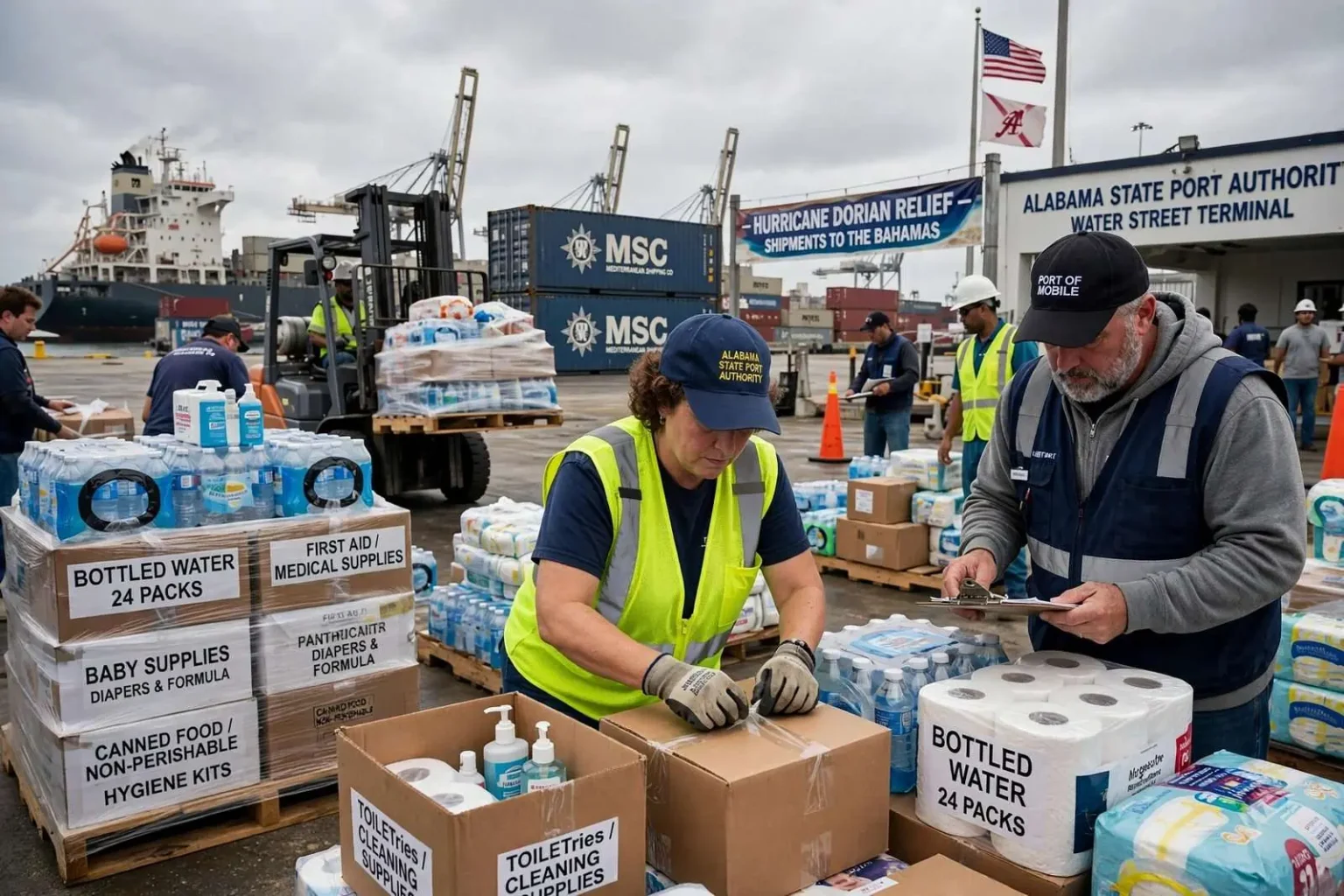
Needed items included bottled water, canned and dry foods, batteries, basic medicines and first-aid kits, toilet paper and paper towels, mosquito repellent, cleaning supplies, hygiene products, and baby supplies. Organizers emphasized basics over clothing donations, because the goods being shipped are destined for distribution networks on the islands that need items that can be sorted, stored and handed out quickly.
Port workers, shipping company employees and ordinary residents all contributed, filling pallets at the collection sites. Volunteers have helped sort and box donations so that shipments can be loaded efficiently once vessels are assigned, and the Port Authority has coordinated with relief officials in the Bahamas to match what is being sent with what is actually needed on the ground.
A Gulf Coast Lifeline for a Devastated Neighbor
The Bahamas has longstanding ties to the Gulf Coast shipping community, and Mobile’s port operators moved quickly to leverage those connections. Cargo regularly moves between Gulf ports and the islands, Bahamian vessels call at regional harbors throughout the year, and many families and businesses along the Gulf Coast have personal or commercial links to the island nation. When Dorian hit, those relationships gave Mobile a head start on organizing aid.
The logistical challenges — damaged ports, limited vessel capacity, and the need to transship through Florida — underscore the difficulty of delivering aid to the islands. Relief cargo that once moved in a single voyage now requires multiple legs, extra handling and careful coordination with Bahamian officials who are rationing the use of their own damaged facilities.
The Alabama State Port Authority, which operates the public terminals at the Port of Mobile, has played a central role in the effort. The port handles tens of millions of tons of cargo each year and is one of the largest tonnage ports in the nation, giving it the space, equipment and shipping relationships to assemble and move relief cargo at a scale few other organizations on the Gulf Coast could match.
Officials say the operation will continue as long as the need does, with the Bahamas facing a recovery measured in years rather than weeks. Rebuilding homes, schools, utilities and port facilities on Abaco and Grand Bahama will require sustained deliveries of construction materials and supplies alongside the immediate humanitarian aid, and Gulf Coast ports are expected to remain part of that pipeline for the foreseeable future.
What the Effort Means for Mobile
The Bahamas relief operation has highlighted the part Mobile plays in the Gulf’s humanitarian infrastructure, a role the city has filled repeatedly after hurricanes strike the region. Port communities are often the first places capable of mounting large-scale sea shipments, and Mobile’s combination of deepwater terminals, warehousing and experienced stevedores makes it a practical staging ground when disasters hit the Caribbean and the Bahamas.
It has also shown how quickly the pieces of a relief chain can come together when a shipping line with regional reach takes the lead. Mediterranean Shipping Company’s involvement meant the effort did not have to charter vessels or negotiate space on short notice; instead, relief cargo could ride MSC’s established services as far as the Everglades hub and continue from there on ships suited to the damaged Bahamian harbors.
For Mobile County government, the Government Plaza drop-off site turned city hall into a visible symbol of the response, and commissioners reported steady traffic from residents bringing cases of water, food and supplies. Local businesses have joined in as well, with some organizing their own collection drives and delivering the results to the port sites.
Aid organizations caution that the most useful donations in the weeks after a storm are the ones that fit the distribution system on the ground. Sealed food, hygiene items and cleaning supplies can be handed out directly, while clothing requires sorting and storage the islands can ill afford right now. That guidance has shaped the lists Mobile organizers have published, and they continue to update them as conditions on Abaco and Grand Bahama evolve.
Recovery Will Take Years
The immediate relief phase will eventually give way to reconstruction, and the shipping community expects to be involved in both. Lumber, roofing materials, generators and building supplies will be needed in volumes that dwarf the first weeks of donations, and the same one-vessel-in, one-vessel-out constraints will apply until Bahamian ports are repaired. That makes the relationships and routines being built now — between Mobile shippers, MSC and officials in the Bahamas — likely to matter for a long time.
In the meantime, organizers in Mobile say the message to residents is simple: the need has not passed. Supplies can still be dropped at the Port Authority locations on Water Street and Ezra Trice Boulevard, and officials are coordinating with relief partners in the Bahamas to ensure the goods keep moving to the communities that need them most.
For a port city whose fortunes have always been tied to the water, the operation is a reminder that the maritime economy is about more than cargo tonnage. The same docks, cranes and container lines that move the region’s commerce have become a lifeline for a neighbor in the worst days of its history — and Mobile’s maritime community has shown it is ready for the job.
Storm veterans along the Gulf Coast understand the timelines better than most. Coastal Alabama communities have weathered their share of hurricanes, from Frederic in 1979 to Ivan and Katrina, and residents here know how long it takes to rebuild after the cameras leave. That shared experience is part of why donation drives across the region have drawn such steady participation, and why volunteers keep showing up at the collection sites weeks after the storm.