Mobile’s Push for a New Animal Shelter Runs Into Resistance Over Consultant-Driven Overhaul
Mobile is redesigning its Animal Services Department and planning a new shelter around a Huntsville-style, community-based model, but a citizens advisory committee says its own recommendations were sidelined in the process.
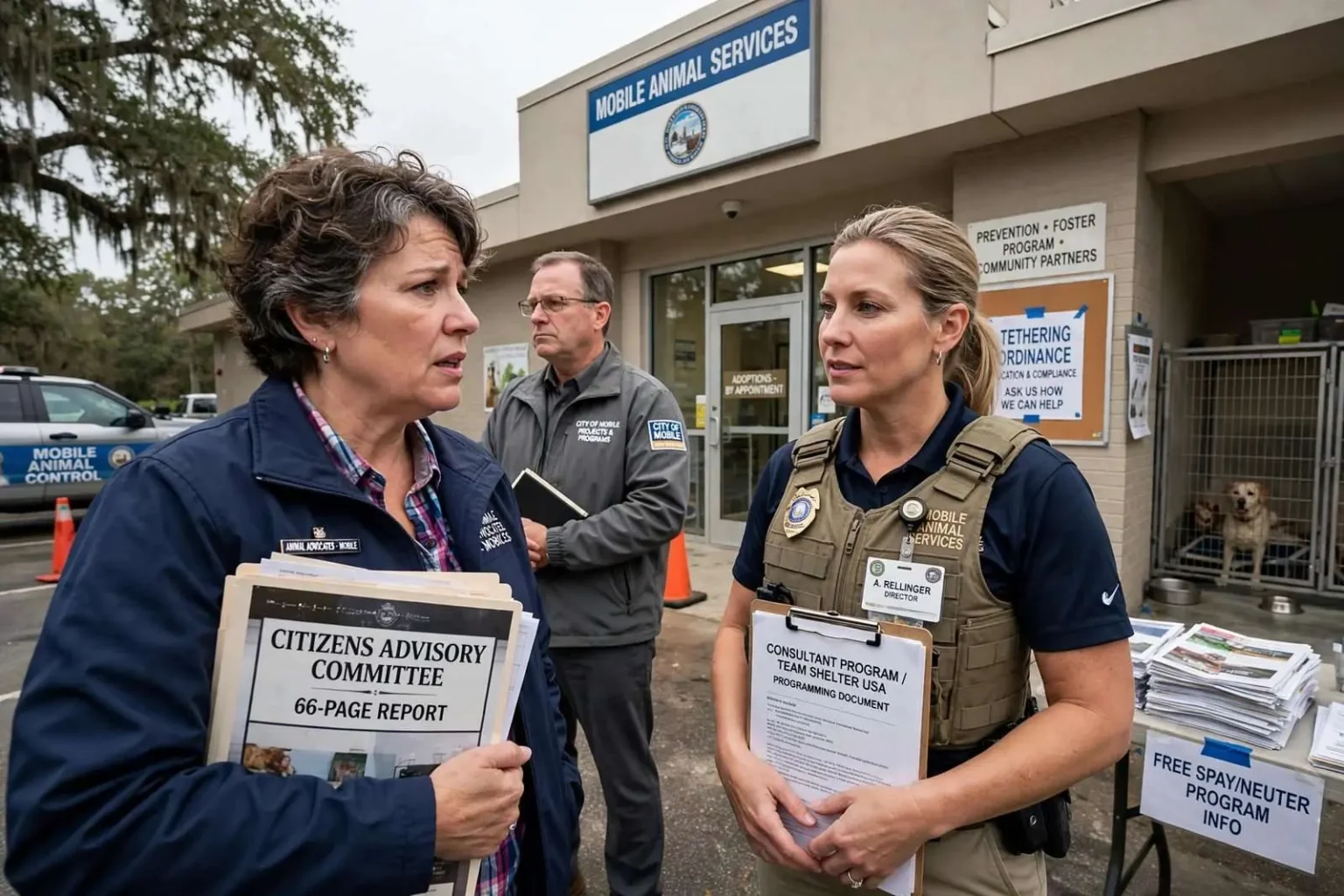
Mobile officials are moving forward with plans for a new animal shelter, but the process has exposed a rift between the city's Animal Services Department and a group of local animal welfare advocates who say their own months of work on the project has been sidelined.
At the center of the debate is a shift in philosophy for how the city handles stray, surrendered and at-risk pets. Rather than simply building a bigger facility to house more animals, the city has hired a national shelter consultant to help redesign how Animal Services operates altogether, with an eye toward reducing the number of animals that end up in a kennel in the first place.
The city paid $30,000 to bring in Dr. Sara Pizano of Team Shelter USA, the same consultant credited with helping Huntsville's municipal shelter dramatically improve its live release rate over the past decade. Pizano's firm was hired to produce a programming document that will guide the design of Mobile's new shelter, an approach city leaders argue will make sure the building itself is designed around modern, effective practices rather than outdated ones.
Huntsville's experience is being held up as the model. That city's shelter had long aimed for a 90 percent live release rate, the widely used benchmark for a shelter with no unnecessary euthanasia, but struggled to consistently hit it. After bringing in a Target Zero consulting team in 2014, the shelter's director, Dr. Karen Hill Sheppard, said her staff got there within about a year.
Eight years later, Huntsville has not only sustained that success but improved on it, now saving 96 percent of the animals that come through its doors. Sheppard said the investment in outside expertise was worth it, even though some of the community-based strategies that came with it were not universally popular at first. "A lot of people don't like it," she said of the shift away from a traditional intake-and-shelter model. "Some of the progressive programs are perplexing for them."
In Mobile, that same tension has surfaced. Terri Mitchell, who chaired an ad-hoc citizens advisory committee on Animal Services, said the committee spent months producing a 66-page report for the Mobile City Council that included recommendations on a pet licensing program, targeted spay and neuter campaigns, and shelter staffing needs.
Mitchell and other members contend that work was effectively set aside once Mayor Sandy Stimpson's administration brought in Pizano. In a letter to city leaders, Mitchell and other concerned residents argued the consultant's hiring amounted to an unnecessary expense. They said veterinary best practices, including standard kennel space requirements, are well documented and were already built into the committee's own report, and that any architect hired to design the shelter would be expected to incorporate those same standards.
Pizano, for her part, said the citizens committee's report was useful but was never going to be sufficient on its own to serve as a programming document capable of guiding architectural design for a new shelter.
She said much of the sheltering industry still operates on what she called an "antiquated" intake-driven model, and that her goal in Mobile is to help the department pivot toward prevention. Rather than focusing on how many animals a shelter can house, Pizano said the more effective approach starts with asking pet owners what support might keep them from surrendering an animal in the first place. She pointed to research from the ASPCA suggesting that as many as 80 percent of families who give up a pet do not actually want to, and said Mobile's own numbers back that up. "We can just use the data we have, at any given time there may be 30 percent to 50 percent owner surrenders," she said, adding that nonprofit partners in the community are already interested in building out a broader safety net for struggling pet owners rather than leaving the shelter as the only option. That safety net, Pizano said, would let the shelter or partner nonprofits help owners keep and care for a pet instead of surrendering it, freeing up Animal Services staff to focus more directly on public and animal safety. She said the same philosophy extends to how officers work in the field, favoring assistance over immediate punishment. "Because I can sit here and give citations to someone living below the poverty level and I didn't solve anything," she said. "Maybe I take their pet and they're intact and now they want a pet, they go get another intact pet. What if I help sterilize the pet?"
Inside the shelter, new Animal Services Director Ali Rellinger has already begun making operational changes alongside the broader policy debate. Staff have started letting some dogs out of their kennels to socialize with one another, and the department launched a foster program that Rellinger said the city had never offered before. "I had always heard before I started the job that we couldn't have those programs for some reason or another, legal or liability," Rellinger said. "So, we worked really hard on getting agreements to open up these programs, so now we're actually able to do those kinds of things where if the community wants to take home a pet and help get it ready for adoption, they can foster it, they can walk a dog, they can actually have access to the shelter to participate in the process."
Rellinger said her staff is also working to expand public access to the shelter. It is not currently open for weekend adoptions, something Mitchell has criticized as a basic expectation for any modern shelter operation. Rellinger said Saturday adoption hours are a goal for the near future, and in the meantime the shelter is open to prospective adopters by appointment.
Mitchell also raised concerns in her letter about Rellinger allowing some dogs to be adopted out before being spayed or neutered. Rellinger said that does not happen often, but when it does, the adoptive family leaves with a scheduled spay or neuter appointment already included in the adoption fee, and staff follow up to confirm the procedure is completed. Mitchell has suggested requiring a $100 deposit to guarantee those appointments are kept, but Rellinger said she prefers not to hold an adoptable animal back over paperwork. "Every animal is being altered, but I'm not going to make the animal sit there for four days when this great family is going to take it home," she said. "All these people are trying to help a shelter pet; they don't want me to tell them the pet has to sit here a week while we wait on a spay and neuter program."
Huntsville's shelter follows a similar practice, according to Sheppard, releasing some unaltered animals to families and following up rather than requiring a deposit. She said her shelter has also fully committed the $100,000 it budgets annually for a low-income spay and neuter program in each of the past two years, a sign of how much demand exists for accessible sterilization services.
Enforcement of Mobile's dog tethering ban, passed by the City Council last year, has become another flashpoint. Mitchell has questioned whether the ordinance is being enforced consistently.
Jenn Greene, the city's director of programs and project management who works closely with animal rescue organizations, said animal control officers are enforcing the law but are currently emphasizing warnings and education over citations and confiscation. A tethering violation alone, she said, is not grounds for an officer to remove a dog from its home. "We are working to educate citizens who may not be aware and working with them to comply with the ordinance," Greene said. "We're not seizing a dog. Animal control officers are trained to look for other signs of cruelty. Like no access to food or shelter or if the dog is harmed in some way then, of course, they do something."
Rellinger said she is looking at ways to help residents comply rather than simply cite them, including a proposal to purchase legal tethering equipment and stock animal control vehicles with it so officers can hand it out to low-income residents on the spot.
City officials say the broader goal behind the consultant-driven approach is to build a shelter designed for the department Mobile wants going forward, rather than one that simply replicates existing operations at a larger scale.
Key Terms in the Debate
A shelter’s live release rate is the share of animals that leave alive, whether adopted, returned to their owners or transferred to rescue groups, out of all the animals that leave the shelter. The 90 percent figure Huntsville aimed for is the benchmark most often used to call a shelter “no-kill.”
The programming document Pizano’s firm is preparing is a standard early step in designing a public building. It lists the spaces the facility needs, their sizes and how they relate to one another, based on how the department plans to operate. Architects then use it as the basis for the design.