Mobile Arts Council names lineup for first MobTown Mural Fest, retiring 13 years of The Throwdown
The Mobile Arts Council has named the lineup for the inaugural MobTown Mural Festival, a free two-day event on Sept. 12-13 that will transform three downtown walls and five marine-grade cubes. The artists were chosen from more than 65 applications, and the festival marks a shift from competition to collaboration after 13 years of The Throwdown.
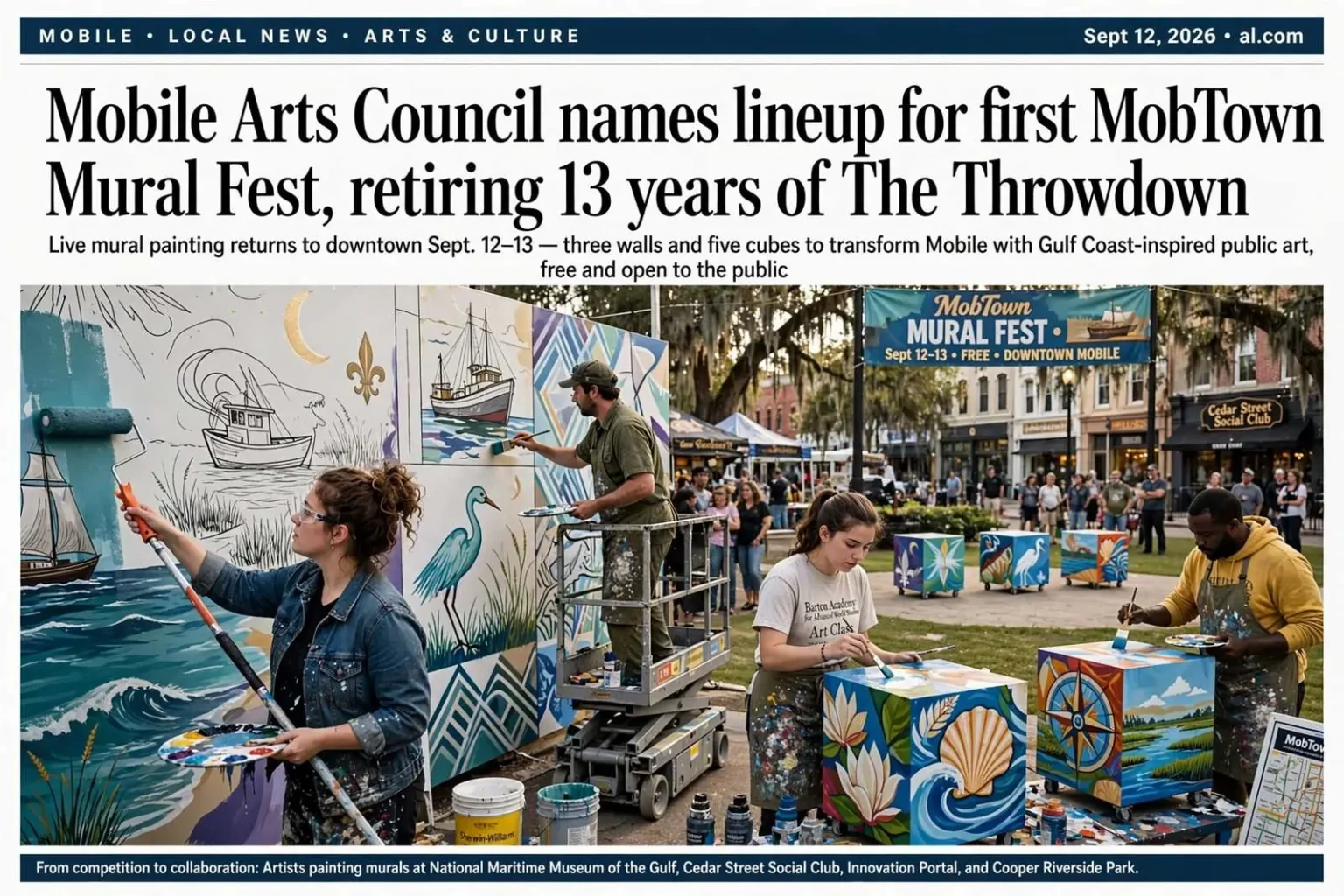
MOBILE, Ala. — Downtown Mobile is about to get several stories taller in color. The Mobile Arts Council has announced the artists selected for the inaugural MobTown Mural Festival, a two-day celebration of public art that will put painters on three full-scale downtown walls and five sculptural cubes over the weekend of Sept. 12 and 13.
The festival, presented by the Downtown Mobile Alliance, runs both days from 10 a.m. to 5 p.m. It is free and open to the public, and the whole point is that the work happens in the open — visitors are encouraged to walk the mural sites, watch the artists at work, and see a piece of public art come into existence rather than simply encounter it finished.
The selected artists were chosen from more than 65 applications submitted for the first edition of the festival.
The artists
The artists selected for MobTown Mural Fest are:
- Hannah Legg
- Gary Brady
- JD Swiger
- Apollo
- Jenyes
- Rachel Schwemin
- Brian Tan
- David Rojas Pacheco
- Greg Crimmins
- Christy LeGros’ Barton Art Class students
The inclusion of a class of students alongside working artists is a notable choice for a festival’s debut lineup. It puts young people into the same public program as established painters, on work that will remain on view in the city after the weekend ends.
Three walls downtown
Three full-scale mural sites will be transformed across downtown Mobile during the festival.
The first is the Jimmy Buffett mural wall at the National Maritime Museum of the Gulf. The second is the Mobile Mysticks mural wall at Cedar Street Social Club. The third is the west-facing wall of Innovation Portal.
The geography of those three sites is part of the design. Spreading the murals across separate downtown locations turns the festival into something visitors move through rather than stand still for. A person who spends the day at MobTown Mural Fest will necessarily walk downtown Mobile — past storefronts, restaurants and blocks they might not otherwise have reason to cross — which is a familiar and deliberate feature of urban arts programming.
Each of the three host sites is also a working institution in its own right. The National Maritime Museum of the Gulf, Cedar Street Social Club and Innovation Portal all appear among the festival’s listed sponsors, meaning the walls are being provided by organizations that have signed on to the effort rather than simply been selected as surfaces.
Five cubes and a park
The murals are not the only surfaces in play. At Cooper Riverside Park, artists will paint five cubes measuring four feet on a side, built of marine-grade material, with the work done live in front of visitors.
The cubes are a clever piece of programming for a first-year festival, and they solve several problems at once.
Scale is the first. A full building wall is a commitment — in time, in equipment and in permanence. A four-foot cube can be completed within a festival weekend by a single artist working at ground level, which means more artists can participate and visitors can see a piece move from blank to finished in the time they are there.
Access is the second. Watching someone paint a mural on a large wall often means watching from a distance, or watching a lift move. A cube in a park is at eye level and within conversation range. That changes the experience from spectating to something closer to visiting a studio.
Durability is the third, and it explains the marine-grade specification. Once finished, the cubes join the city’s inventory of public art, available for display in parks and public spaces across Mobile. Anything installed outdoors on the Gulf Coast has to contend with humidity, salt air, intense sun and driving rain, and marine-grade materials are built to survive exactly those conditions. The specification tells you these objects are meant to last.
The mobility is the point that distinguishes the cubes from the murals. A mural belongs to its wall permanently. A cube can be moved — placed in one park this year and another next year — which means the art created over this weekend can eventually reach neighborhoods well beyond the downtown blocks where it was made.
The brief: paint the Gulf Coast
Submissions were open for either the full-scale murals or the four-by-four cubes. Applicants were asked for designs drawing on the Gulf Coast, shaped by what is distinctive about Mobile — its culture, its landscape, its history and the way people live here.
That is a broad prompt by design. It does not prescribe subject matter, and with more than 65 submissions to draw from, it left the selection process room to assemble a range rather than a theme.
Mobile is a city with an unusually deep well to draw from in each of those four categories — culture, landscape, history and lifestyle. It is a port city on a bay, at the edge of a delta, with a civic identity shaped by centuries of maritime commerce and a Carnival tradition older than any other in the country. A brief pointing artists toward that material is a brief with a great deal of room in it.
From a title belt to a collaboration
The MobTown Mural Festival represents a new direction for the Mobile Arts Council’s annual public art programming, and the shift is a real one.
For 13 consecutive years, the council’s signature public art event was The Throwdown, a competition that challenged artists to vie for the coveted Throwdown title belt. With MobTown Mural Fest, the council is moving its focus from competition to collaboration and creation.
That is a meaningful change in what the event is for. A competition produces a winner and, by structure, a field of people who did not win. It generates energy and stakes, and for 13 years it clearly worked. But it also frames artists as rivals for a single prize.
A mural festival inverts that. Everyone selected is making something, all of it goes up, and the measure of success is what exists downtown when the weekend is over rather than who takes home a belt. It also produces something a competition does not: permanent work that stays in the city.
‘Beautiful things are possible’
Jessica Jones, Community Engagement Coordinator for the Mobile Arts Council, framed the festival as an investment in the city’s own creative community.
“When we place value on our creatives and give them ownership in the city they call home, beautiful things are possible,” Jones said. “Public art strengthens our creative currency and helps shape the culture and identity of our community. We are thrilled to exercise our creative community muscles and put Mobile’s incredible artists on full display as they paint the town red, blue, yellow, or whatever colors they choose.”
She returned to the same theme in describing what the council hopes the work accomplishes over the long term.
“Mobile Arts Council believes that when a community embraces its artists, it has the opportunity to create the cityscape it wants to live in,” Jessica said. “Public art creates a sense of place, draws visitors, inspires residents, and helps build a community where creatives can thrive.”
The phrase “creative currency” is doing real work in that first quote. It describes something cities increasingly treat as an economic asset rather than a decorative one — the accumulated presence of artists, venues and visible creative activity that makes a place distinctive.
What a live mural weekend looks like
For readers who have never attended a mural festival, the format is worth explaining, because it is different from most arts events.
There is no performance to arrive on time for and no exhibition to walk through. Instead, artists work on their assigned surfaces during posted hours — in this case 10 a.m. to 5 p.m. on both Saturday and Sunday — and the public comes and goes.
Large-scale mural work moves through recognizable stages. A wall is prepared and primed. A composition is laid out, often through a grid, a projection or a freehand sketch. Then large color fields go down before detail and line work follow. The consequence is that a wall visited Saturday morning and revisited Sunday afternoon can look like two entirely different paintings, which is a genuine argument for coming both days.
It is also, by the standards of public events, unhurried. Painters work for hours at a stretch, and the pace leaves room for the conversations between artists and passersby that these festivals are partly designed to create.
Who is paying for it
The festival’s sponsor list runs long, spanning government, philanthropy, business and the venues hosting the walls.
The Downtown Mobile Alliance is the presenting sponsor. Other listed sponsors include the City of Mobile, The Ben May Charitable Trust, the Sybil Smith Foundation, the Mobile County Commission, Karen Carr and Michael Smith, UA Local 119 Plumbers and Pipefitters, Hieronymus CPA’s, 22nd State Bank, Bright Haven Therapy, Dr. Kristin Rager, Colin-Al Green Attorney at Law, Heroes Bar and Grille, Sherwin-Williams, the National Maritime Museum of the Gulf, Cedar Street Social Club and Innovation Portal.
The breadth of that list is what makes the festival free. Public art programming carries real costs — materials, equipment, insurance, site preparation, artist compensation — and an event with no admission charge covers them somewhere other than the gate. The mix here is notable: a downtown business organization, city and county government, charitable trusts and foundations, individual donors, a trade union local, small professional firms, a paint retailer and the three institutions supplying the walls.
If you go
- What: MobTown Mural Festival, presented by the Downtown Mobile Alliance
- When: Saturday and Sunday, Sept. 12–13, 2026, from 10 a.m. to 5 p.m. each day
- Where: Downtown Mobile — the Jimmy Buffett mural wall at the National Maritime Museum of the Gulf, the Mobile Mysticks mural wall at Cedar Street Social Club, the west-facing wall of Innovation Portal, and Cooper Riverside Park for the cube painting
- Cost: Free and open to the public
Organizers are inviting residents to stop by the sites at any point across the two days, spend time watching the painters work, and get a firsthand look at what Mobile’s creative community can do.
What to watch next
Two things are worth following after the weekend closes.
The first is where the five cubes end up. Because they are meant for display in parks and public spaces around the city, placement decisions follow rather than precede the painting. Those decisions will determine how far beyond downtown the festival’s output actually travels.
The second is whether the shift from competition to collaboration holds. The Throwdown ran for 13 consecutive years, which is a long run for any local arts event. Whether MobTown Mural Fest builds a comparable stretch will depend on what this first weekend produces — and on whether more than 65 artists apply again next time.
Either way, three downtown walls will look different on Monday morning than they did on Friday afternoon, and that is the kind of change a city notices.
Update: Painted Cubes, 65 Applicants and a High School Art Class
Additional details have emerged about the scale of the selection process and one element of the festival that will outlast the weekend.
Five marine-grade art cubes will be painted live at Cooper Riverside Park over the course of the festival. Once finished, the cubes will be placed permanently as public art pieces in parks across Mobile.
That detail changes what the festival is. Murals are fixed to the walls they are painted on; the cubes are portable public art, which means a weekend event in the urban core will end up distributing finished work to neighborhood parks that were never part of the festival footprint.
Selected From More Than 65 Applicants
The featured artists were chosen from a field of more than 65 applicants — a figure that suggests considerably more regional interest in public art commissions than the number of available walls.
The lineup includes Hannah Legg, Gary Brady, JD Swiger, Apollo YaKongo Art, Jenyes, Rachel Schwemin, Brian Tan, David Rojas Pacheco and Greg Crimmins, along with students from Christy LeGros’ art class at Barton Academy for Advanced World Studies.
Including a high school class alongside working professionals is not a token gesture at an event where the work is done in public. The students will be painting in front of the same crowds, on the same days, as everyone else on the roster.
‘Bring People Together, Create a Sense of Place’
Mobile Arts Council Executive Director Angela Montgomery called the festival an “exciting milestone for Mobile’s arts community,” and described public art as having the power to “bring people together, create a sense of place, and inspire civic pride.”
She said the festival will not only “beautify our city but also create the opportunity for visitors and residents to experience live art in action.”
Live installations will unfold at the National Maritime Museum of the Gulf, the Cedar Street Social Club and Innovation Portal, alongside the cube painting at Cooper Riverside Park. Festival maps and schedules are available through the Mobile Arts Council.