
MOJO Salutes Charlie Parker With All-Star Lineup at Gulf City Lodge
MOJO's Charlie Parker salute at Gulf City Lodge paired Rebecca Barry, Jonathan Martin and a Gulf Coast rhythm section with jambalaya and ice cream.
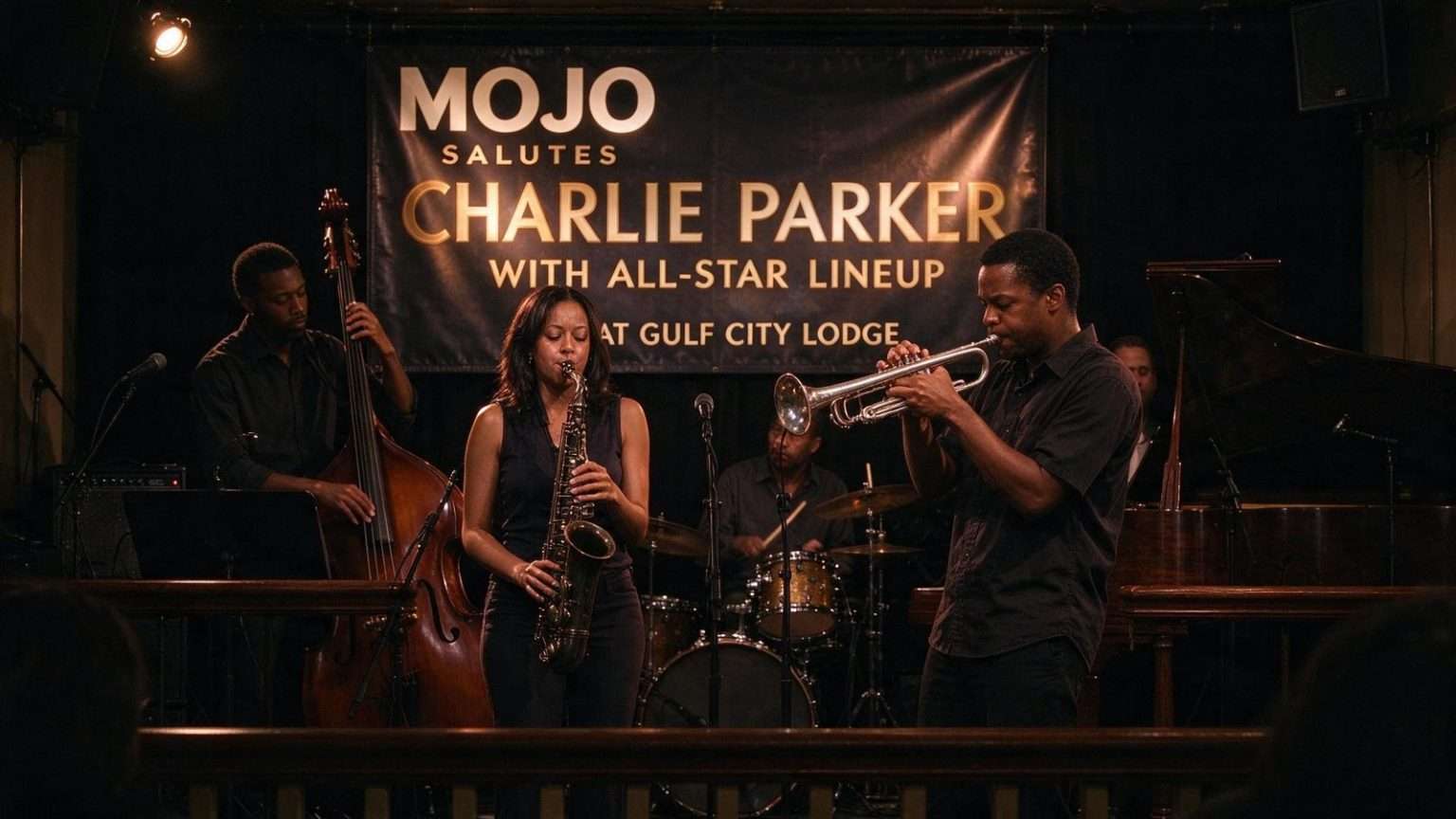
Mobile’s jazz organization MOJO saluted one of the towering figures in American music — alto saxophonist Charlie “Yardbird” Parker — with a tribute evening at the Gulf City Lodge, 601 State St., starting at 6:30 p.m. on February 27, 2012. The show gave Mobile audiences a chance to hear the music that upended jazz in the 1940s, performed live by some of the most accomplished players on the Gulf Coast in one of the city’s most storied neighborhood halls.
MOJO president Kevin Lee built the program around the saxophonist whose virtuosity and revolutionary ideas changed jazz just as the Atomic Age began. Parker’s music, with its breakneck tempos, chromatic harmonies and improvisations that seemed to leap several steps ahead of the rhythm section, remains one of the most demanding bodies of work in all of American music. Building an entire evening around it was no small undertaking for a local organization, but Lee and the musicians he assembled approached it as a challenge worth meeting head on.
Tackling the daunting Parker book — much of it written in musical partnership with trumpeter Dizzy Gillespie — fell to saxophonist Rebecca Barry and trumpeter Jonathan Martin, backed by some of the finest players on the Gulf Coast: pianist Cynthia Domulot, bassist Tommy Sciple and drummer Fred Domulot. The pairing of saxophone and trumpet at the front of the ensemble mirrored the classic bebop front line that Parker and Gillespie made famous, letting the two hornmen trade melody and improvisation the way the music was originally conceived.
The choice of venue added its own flavor to the night. The Gulf City Lodge on State Street has long been a gathering place for community events in Mobile, and its room gives listeners the kind of close, unamplified contact with a jazz combo that clubs of the bebop era offered. For a program devoted to a music built on conversation between musicians, that intimacy mattered.
Parker’s shadow still falls across the music
More than half a century after his death, Parker’s influence remained woven through virtually every style of jazz a listener might encounter. Nearly every saxophonist who picks up the instrument works through his solos at some point, and his recordings are studied in conservatories and high school band rooms alike. The idea that a Mobile jazz organization would devote a full evening to his catalog was less a novelty than a rite of passage for the players involved.
For the audience, the tribute offered a tour through the repertory that defined modern jazz: the blistering uptempo numbers, the luminous ballads, and the blues-inflected pieces that kept Parker tethered to the Kansas City roots he carried east. Hearing those works performed in sequence, by musicians who had done the woodshedding to play them at tempo, was the kind of experience MOJO had built its reputation on providing since its founding.
Parker was born in Kansas City, Kansas, in 1920 and came of age in a city whose nightclubs pulsed with the blues and the big bands of the Southwest territory circuit. By his late teens he was working professionally, and after a humiliating early jam-session experience in which drummer Jo Jones famously tossed a cymbal at his feet to signal he was not ready, Parker withdrew and practiced with a discipline that transformed him almost overnight. When he resurfaced, first in the territory bands and then in New York, he arrived with a technique that left even veteran musicians shaking their heads.
His partnership with Gillespie produced the recordings that gave bebop its vocabulary. Numbers like “Ko-Ko,” “Shaw ’Nuff,” “Groovin’ High” and “Salt Peanuts” took the harmonic discoveries of the swing era and accelerated them past anything the ballrooms had heard. The melodies moved in long, sudden arcs; the tempos pressed the limits of the day’s musicians; and the improvisations seemed to outline chords that existed only in the moment they were played. Critics of the time found it chaotic. Practically every serious jazz musician of the generation that followed found it irresistible.
The nickname “Yardbird,” later shortened to “Bird,” followed Parker from his earliest touring days, and his compositions kept the nickname alive long after his death at age 34 in 1955. Tunes such as “Ornithology,” “Bird Gets the Worm” and “Yardbird Suite” remain staples of the jazz repertory, and the phrase “Bird lives” — chalked on New York club doors after his death — has proved prophetic. Each generation of players rediscovers the records, and each finds something new in them.
That living repertory was exactly what the Mobile program set out to honor. Rather than presenting Parker’s music behind glass, as museum pieces, the tribute put it in the hands of working Gulf Coast musicians who play it the way bebop demands: live, at speed, and with room for the improvisation that made the original records feel so dangerous in their day.
A program with teeth for the front line
Rebecca Barry, one of the region’s most respected saxophonists, drew the largest share of the melodic burden. Playing the alto parts meant not only executing Parker’s famously convoluted heads but improvising in his shadow night after night of rehearsal, a task jazz musicians describe with a mixture of excitement and dread. Jonathan Martin’s trumpet carried the Gillespie side of the ledger, with its dramatic upper-register leaps and ebullient phrasing.
Behind the horns, the rhythm section carried responsibilities of its own. The pianist in a bebop combo has to voice fast-moving chords beneath improvisers who change direction on every downbeat, and Cynthia Domulot’s role in the ensemble required exactly that kind of sustained alertness. Bassist Tommy Sciple anchored the walking lines that give bebop its momentum, while drummer Fred Domulot held together the ride-cymbal pulse that drives the music forward without ever stepping on the soloists.
Ensembles of this quality are one of MOJO’s signature contributions to Mobile’s cultural life. The organization has spent years building an audience for straight-ahead jazz along the upper Gulf Coast, presenting national artists alongside the region’s own players and giving local audiences a steady calendar of performances that would otherwise require a trip to New Orleans or beyond. Tribute evenings such as this one sit at the heart of that mission, pairing the music’s history with the people who keep it alive in local clubs and band rooms.
For Lee, the Parker tribute carried a personal weight as well. The homage was a long time coming for the MOJO president, who credited Parker with his own initiation into jazz in the newspaper article that introduced MOJO to the world more than a decade earlier. The organization’s founding story and Parker’s music were entwined from the beginning, which made the 2012 evening something closer to a homecoming than an ordinary concert booking.
The project only came together when Rebecca Barry offered to take on the work. Learning the Parker book is an investment measured in months, not weeks, and Lee jumped at the chance once a musician of Barry’s caliber agreed to lead it. Her willingness to shoulder the repertory gave the organization the confidence to put the date on the calendar and build the evening’s programming around it.
The pairing of Barry and Martin also reflected the way MOJO tends to assemble its programs: drawing on trusted local veterans rather than importing headliners, and trusting the region’s own talent to carry music of real technical difficulty. For younger players and students in the audience, watching Gulf Coast musicians negotiate Parker’s tunes at tempo sent its own message about what was possible close to home.
Practical details and a sweet extra
Admission to the tribute was $12, or $8 for MOJO members, with a light jambalaya dinner included in the price. The organization has long structured its events as full evenings rather than bare concerts, and the dinner service gave attendees a reason to arrive early, settle in and greet fellow members before the music began.
The evening was BYOB, though mixers, set-ups and non-alcoholic beverages were available at the bar. The arrangement is a familiar one for Gulf Coast civic halls, letting organizations like MOJO keep ticket prices modest while still offering a proper night out. Staff kept the bar stocked with soft drinks and the tools patrons needed to mix their own, and the room filled steadily as the 6:30 p.m. down time approached.
There was also a special treat honoring the birthday of MOJO muse Carmen Brown: Cammie’s Old Dutch Ice Cream set up a serving station to dish out icy treats all night. The beloved Mobile creamery, known across the city for rich, old-fashioned flavors, has been a fixture of the local dessert scene for decades, and its presence gave the tribute a festival air beyond the music itself.
Brown, whose birthday fell near the date of the show, has been a visible presence in Mobile’s arts community and a longtime supporter of the organization, and members greeted the ice cream announcement with the enthusiasm the gesture deserved. Between the jambalaya, the frozen treats and a repertory of bebop classics, the evening stretched well past the boundaries of a typical Monday concert.
The tribute also landed at a moment of renewed attention to Parker’s legacy. His recordings had been reissued in ever more complete editions, scholarly biographies continued to appear, and saxophonists across genres — from mainstream players to experimentalists — kept citing him as the wellspring of modern improvisation. In jazz education, his solos functioned the way etudes once did for classical students: the first serious mountain every aspiring player climbs.
Mobile’s own connection to the broader jazz tradition runs deep. The Gulf Coast sits within the orbit of New Orleans, the music’s birthplace, and generations of Alabama musicians have carried the idiom up the bay and along the coast. Organizations like MOJO keep that lineage visible, giving the city a place where the music’s history is treated as a living resource rather than a nostalgia act.
For the players, a night like this also served as a public demonstration of the local scene’s depth. Rhythm sections capable of holding together the Parker book do not assemble themselves; they come from years of club dates, festival stages and rehearsal rooms across the region. The tribute put that accumulated craft on display under the brightest possible spotlight, on repertory that leaves no room to hide.
And for the audience, the night delivered something increasingly rare: a chance to hear the foundations of modern jazz performed live, at full strength, within walking distance of downtown. Parker’s music was born in small rooms filled with listeners standing close to the bandstand, and the Gulf City Lodge returned it to something like its native habitat.
A lasting marker for the organization
MOJO’s leadership framed the evening as part of an ongoing commitment rather than a one-time event. The organization has consistently paired tributes to canonical figures with programs spotlighting regional composers and rising players, and the Parker date fit squarely within that pattern. Members who attended left with the sense that the organization’s second decade had begun exactly as its first had: with ambitious programming and reasonable ticket prices.
The combination of elements — a demanding repertory, a hand-picked ensemble, an affordable dinner, a beloved local creamery on hand — made the February 27 gathering a representative snapshot of what the organization does best. It honored a giant of the music without museum solemnity, and it gave Mobile’s jazz community one more evening worth remembering.
Those who wanted to attend future events could count on MOJO’s usual channels for announcements, with membership discounts continuing as the organization’s chief incentive for joining. Given the response to the Parker tribute, the question among local listeners was less whether to attend the next program than how soon the calendar would fill in.
In the end, the night belonged to the music. More than fifty years after his death, Charlie Parker’s ideas still demanded everything from the musicians who approached them — and, on a late-winter evening on State Street, Mobile’s finest gave them everything they had, with ice cream to follow.