MOJO’s Jazz Jambalaya brings touring keyboardist and saxophonist to Mobile’s Elks Lodge
MOJO's monthly Jazz Jambalaya returns to Club 601 at the Elks Lodge on March 28 with local drummer Jimmy Roebuck joined by touring keyboardist Red Young and woodwind player Bob Maksymkow.
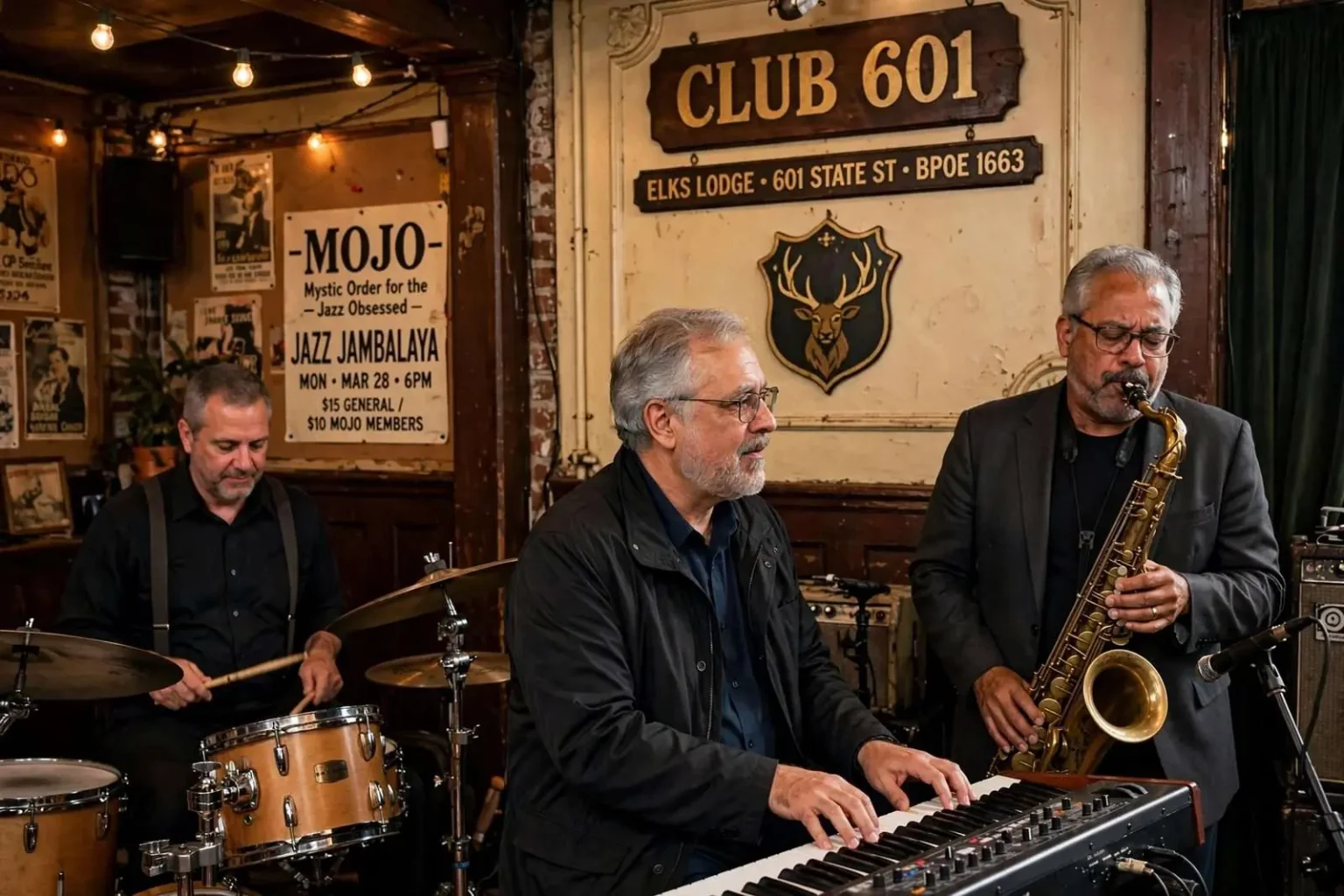
Mobile jazz fans will have the chance to hear two well-traveled musicians share a stage with a local favorite when the Mystic Order for the Jazz Obsessed, better known as MOJO, hosts its monthly Jazz Jambalaya on Monday, March 28, at 6 p.m. The installment brings together a rhythm section leader from Mobile’s own club circuit and two guests whose resumes run from arenas and network television to military bands and conservatory training, all packed into one evening at one of downtown Mobile’s most reliably musical rooms.
The show takes place at Club 601 inside the Elks Lodge at 601 State St. in downtown Mobile, with tickets priced at $15 for the general public and $10 for MOJO members. The Elks Lodge building has become a fixture of the local jazz scene precisely because of nights like this one, offering the kind of unadorned listening room where the distance between the bandstand and the audience is measured in feet rather than rows.
Club 601’s home inside the Elks Lodge gives the series a venue whose character matches the music. The room’s unpolished intimacy is part of the draw for regulars who have spent years hearing the Jazz Jambalaya there, and it keeps the focus where MOJO has always wanted it, on the players and the tunes rather than the surroundings.
MOJO has been a fixture of the Azalea City’s live music scene for two decades, organizing a Jazz Jambalaya on the fourth Monday of nearly every month, pausing only during the Mardi Gras season. The Mardi Gras break is a Mobile tradition in itself, ceding the city’s entertainment calendar to the parades and balls that consume February, but once the season passes the Jazz Jambalaya returns with the regularity that has built its audience over the years.
The timing of the show, a Monday evening with a 6 p.m. start, reflects the deliberately accessible way MOJO has always operated. Weeknight jazz at an early hour lets working listeners attend without a late night, gives visiting musicians a stop on off-nights between weekend engagements, and keeps the series rooted in the rhythm of the city’s ordinary week rather than competing for Friday and Saturday crowds.
The recurring series is built around an intimate club setting that lets audiences hear both established local players and visiting musicians in close quarters, a format organizers say has helped sustain a steady jazz following in Mobile even as larger touring acts have come and gone. In an era when jazz presentations increasingly depend on festivals and concert halls, MOJO’s insistence on the club format has kept the music at its most conversational, where musicians react to the room and audiences can hear every nuance.
The Local Anchor
The March installment will be led by local drummer Jimmy Roebuck, a familiar presence on the Mobile jazz circuit, who will be joined by two guest performers making the trip in for the occasion. Drummers occupy a particular place in a house-band format, setting the feel of every number and adjusting in real time to the soloists who sit in beside them, and Roebuck’s familiarity with the room and its audience gives the night its foundation.
Keyboardist Red Young, who grew up in Texas immersed in influences ranging from classical pianist Van Cliburn to blues and country artist Delbert McClinton, has built a career working alongside a long list of major recording artists, including Dolly Parton, Cher, Eric Burdon and Linda Ronstadt. That list of employers tells its own story about Young’s versatility. It spans country, rock and roll and blues at the highest professional level, where the keyboardist’s job demands fluency in every one of those idioms and the ability to switch among them on a moment’s notice.
Young’s Texas upbringing sits at an interesting musical crossroads that audiences will hear in his playing. The state that produced Van Cliburn’s classical tradition also produced the roadhouse blues and honky-tonk country that shaped players like Delbert McClinton, and a keyboardist who absorbed both carries a vocabulary that can move from a lush jazz ballad voicing to a barrelhouse roll without changing chairs.
During the swing and big-band revival of the late 1990s, Young toured and recorded with Big Bad Voodoo Daddy, one of the acts most closely associated with that resurgence. The band’s role in the revival, which put jump blues and swing in front of mainstream American audiences and packed dance floors from coast to coast, gave its sidemen a touring experience few jazz players ever encounter: theaters, television appearances and crowds who came to dance.
His return to Mobile gives local audiences a rare opportunity to see a musician with that breadth of experience in a small-venue setting. Players of Young’s profile typically appear in Mobile, when they appear at all, as featured guests in theater settings or at ticketed concerts; hearing them work a club room, trading solos with local players and adjusting to the night’s spontaneous turns, is a different and rarer experience altogether.
A Woodwind Specialist with a Worldly Resume
Also joining the lineup is woodwind specialist Bob Maksymkow, traveling from Florida for the performance. Maksymkow holds a bachelor’s degree from Juilliard and spent years performing on saxophone and clarinet as a band leader and clinician with the U.S. Air Force, work that took him around the world. The Air Force’s premier bands function as full professional ensembles, touring internationally and performing for audiences ranging from service members to heads of state, and a seat in one is among the most competitive jobs in American music.
He has since remained active as a performer for hire while teaching at Pensacola State College and the University of West Florida. His dual life as a working saxophonist and a college instructor places him in a tradition of musician-educators whose students learn the craft as it is actually practiced, and his base just across the state line in Pensacola has made him a natural recurring guest on the Mobile scene.
Maksymkow’s teaching posts across Pensacola Bay add a regional dimension to the night as well. The Gulf Coast’s college music programs have become a quiet pipeline for area jazz talent, and instructors like Maksymkow link Mobile’s club scene to that pipeline, giving students a working example of the performing career the classroom points toward.
His improvisational style has made him a regular guest at MOJO’s Jazz Jambalaya over the years. Regular guests are the connective tissue of a series like this one, returning often enough that the audience knows them and the house band knows exactly what to expect, while each visit still brings something unrepeatable. Jazz at this scale lives on those accumulated relationships between players who have shared enough bandstands to anticipate one another.
What the Series Means for Mobile
Organizers say the combination of a seasoned local rhythm section with visiting soloists is typical of what keeps the monthly series drawing repeat crowds, offering something different each installment while maintaining the same relaxed, listening-room atmosphere. The model resembles the jazz club traditions of larger cities, distilled to a scale Mobile can sustain, and it has given the city’s working players a dependable monthly stage and its audiences a dependable monthly appointment.
The series also serves as a bridge between generations of musicians and listeners. Student players from the Gulf Coast’s university programs sit in alongside veterans, audiences range from longtime jazz devotees to curious first-timers drawn by the modest ticket price, and the fourth-Monday rhythm of the series has made it one of the steadiest fixtures on the local calendar outside of Mardi Gras.
For a city that claims a rich musical heritage reaching from Tuskegee to Muscle Shoals to its own Mardi Gras traditions, MOJO’s two decades of monthly programming represent a quiet form of cultural stewardship. The organization’s name, the Mystic Order for the Jazz Obsessed, borrows Mobile’s own mystical society vocabulary, an acknowledgment that the series belongs to the same civic tradition as the parades it takes a month off for each year.
For visitors passing through Mobile on the last Monday of the month, the series doubles as an introduction to the city’s musical life. The ticket price asks little, the room asks less, and the quality of the players on the bandstand regularly surprises travelers who expected to find a quiet night in a smaller city.
The March 28 gathering brings that tradition another installment: a hometown drummer holding the groove, a Texas keyboardist with a discography most players could only envy, and a Pensacola-based woodwind specialist whose Juilliard training and Air Force career have carried him around the world and back to a club room on State Street. Tickets at the door put the whole evening within reach of anyone curious enough to come hear what Mobile’s jazz audience has known for twenty years.
More information on the series, including ticket details and future dates, is available at mojojazz.org.