Molino Man Convicted of Molesting Two Young Girls
An Escambia County jury convicted Dennis Lester Odom, 60, of Molino on two counts of child molestation; he faces at least 25 years at January sentencing.
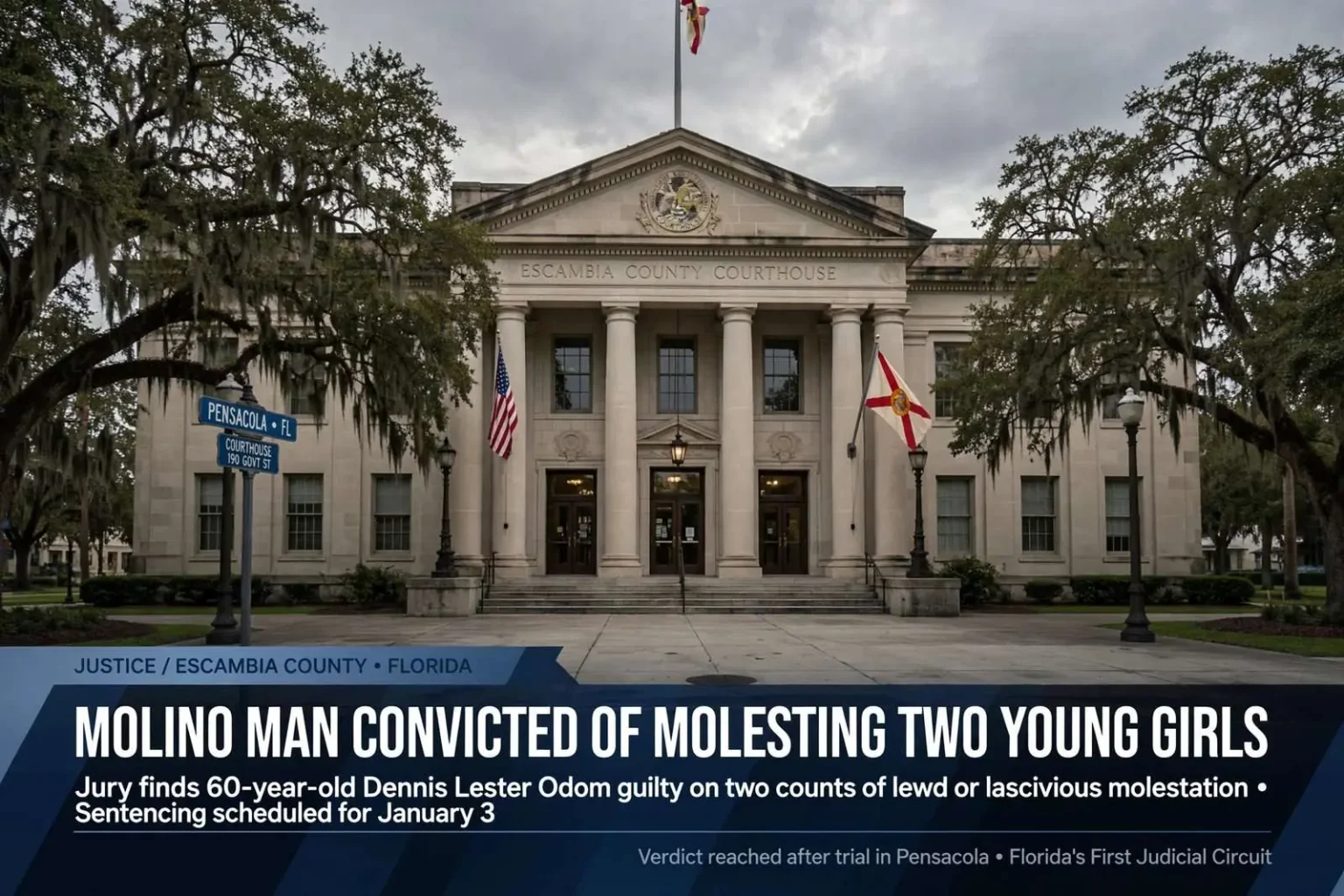
An Escambia County, Florida jury has convicted a Molino man of two counts of lewd or lascivious molestation involving two young girls, closing the trial phase of a case that prosecutors built on testimony stretching back more than a year of abuse.
Prosecutors said Dennis Lester Odom, 60, molested an 11- and 12-year-old girl left in his care between June 2017 and September 2018. The abuse occurred at his home on Branch Crossing Road, in the rural Molino community north of Pensacola in western Escambia County. The girl disclosed the abuse to a family member, leading to Odom’s arrest, and investigators built the case from there — a pattern that child-protection professionals see repeatedly, in which a child’s disclosure to a trusted relative is the first break in a secret that may otherwise never reach authorities.
After news of the case became public, a second girl came forward to report that Odom had molested her over the course of several years. Prosecutors added that account to the case, and the jury’s verdict covered both victims.
The convictions followed a trial in Escambia County’s court system, where prosecutors presented evidence and testimony from the victims and the investigators who handled the disclosures. Jurors returned guilty verdicts on two counts of lewd or lascivious molestation, the Florida felony charge that covers sexual contact with a child under circumstances like those described in the case.
The charges and the law
Lewd or lascivious molestation is one of Florida’s most serious felony charges involving child victims. Under Florida law, the offense carries heavy penalties that escalate with the age gap between the offender and the child, and convictions expose a defendant to decades in prison. The charge is distinct from lesser offenses in Florida’s sentencing structure precisely because it involves intentional sexual contact with a child, and prosecutors in the First Judicial Circuit — which covers Escambia, Okaloosa, Santa Rosa and Walton counties — treat the prosecution of crimes against children as a specialized part of their caseload.
Sentencing is scheduled for January 3. Odom faces a minimum mandatory sentence of 25 years in state prison, with a maximum of up to life, and he will be designated a sexual predator under Florida law. The minimum mandatory provision means the sentencing judge has no discretion to go below 25 years, a reflection of the Legislature’s decision that crimes of this kind require certainty of punishment regardless of individual circumstances.
The sexual predator designation is a separate legal consequence with lifelong effect. Under Florida’s predatory-offender statutes, a designated offender is subject to community notification and public registration requirements for life, must register his address and other information with law enforcement wherever he lives, and is subject to the strictest monitoring Florida law imposes short of civil commitment.
How the case came to court
The path from disclosure to verdict in a child abuse case in Escambia County typically runs through a coordinated network. When a child discloses abuse to a family member, that report triggers involvement from the Florida Department of Children and Families and law enforcement, and the child is interviewed by specialists trained to question young victims without leading them. Medical and forensic examinations, recorded interviews and coordination among investigators are standard practice, all designed to protect the child from repeated questioning while preserving the integrity of the evidence.
In cases where children are left in the care of a trusted adult, prosecutors must also establish the circumstances of that trust — who placed the child in the defendant’s care, over what period, and how the access was arranged. The timeframe prosecutors described, running from June 2017 through September 2018, indicated abuse that occurred repeatedly over more than a year, the kind of prolonged pattern that child-protection investigators say is most often uncovered not by discovery at the time but by a child’s eventual disclosure, sometimes long after the abuse began.
The second victim’s decision to come forward after the case became public is a pattern that victim advocates across the Gulf Coast describe often: once news of an arrest or trial makes clear that authorities will believe a child and act on the disclosure, other victims — sometimes of the same offender, sometimes of other abusers — find the courage to report. Advocates urge families to take every disclosure seriously and to report suspected abuse to the Florida abuse hotline or local law enforcement immediately, noting that delays in reporting are almost always the product of fear, shame or manipulation by the offender rather than any doubt about the facts.
The community where it happened
Molino is a small rural community in northern Escambia County, an area of family homes, farms and long country roads including Branch Crossing Road, where the abuse occurred. The case sent a familiar shock through a community where neighbors know one another and children are often cared for by extended family and friends — precisely the trust that the offender exploited. Residents of small Panhandle communities have watched similar cases reach court in recent years as prosecutors and child advocates have made the prosecution of crimes against children a priority across the region.
Escambia County’s courts handle the region’s most serious felonies at the county courthouse in Pensacola, and crimes against children are among the cases the State Attorney’s Office prosecutes with dedicated victim advocates who support young witnesses through the trial process. Testimony by child victims, when it is required, is among the most delicate work a courtroom handles, and the system’s design — from the interview centers to the advocates to the prosecutors who try the cases — exists to carry a child’s disclosure all the way through to a verdict without breaking the child a second time.
What happens at sentencing
At the January 3 sentencing hearing, the court will hear from prosecutors, from the defense, and — as is common in cases involving child victims — from the victims and their family members, whose statements are part of the record the judge weighs. The victims’ impact statements describe, in the only public voice the case will give them, what the abuse cost and what the prosecution has meant to their families.
The judge’s sentence will fall somewhere between the 25-year minimum mandatory and life in prison, and under Florida law a sentence in that range will be served in full with no early parole, since Florida abolished parole for crimes of this era’s sentencing structure. Following any prison term, the sexual predator designation ensures lifetime registration and community notification, the state’s mechanism for tracking convicted offenders after release.
For the two girls at the center of the case, the verdict marks the end of the legal process that began with a disclosure to a family member in 2018. Child advocates across the Panhandle point to cases like this one when they remind parents and guardians that a child’s disclosure is almost always true, that believing it is the first step, and that the courts — as this verdict shows — will act on it.
Protecting children in rural communities
Child-protection professionals stress that the warning signs in cases like this one are often visible in hindsight: an adult who seeks exclusive access to children, gifts or favors that create secrecy, children who become withdrawn or anxious around a particular caregiver, and behavioral changes that adults around the child may notice but hesitate to interpret. In rural communities, where children are frequently cared for by neighbors and extended family and where everyone knows everyone, breaking the silence around a respected local figure can be especially hard for a child — which is why advocates emphasize that the disclosure in this case, and the family member who believed it, changed the course of two young lives.
Resources exist across the Panhandle for exactly that moment. The Florida Department of Children and Families operates a statewide hotline for reporting suspected abuse around the clock, children’s advocacy centers in the region coordinate the forensic interviews and medical examinations that build a case without re-traumatizing the child, and victim advocates with the State Attorney’s Office stand with young witnesses through investigation, trial and sentencing. The system is far from perfect, but its design reflects decades of lessons about how children disclose and what they need from the adults who hear them.
For now, the case returns to court on January 3, when the sentence will be imposed. The jury has spoken, the minimum mandatory term guarantees that the man who molested two girls entrusted to his care will spend at least a quarter-century in prison, and the sexual predator designation will follow him for the rest of his life. What remains is for the community — and the families of the two survivors — to take up the longer work of healing that no verdict, however just, can complete.